
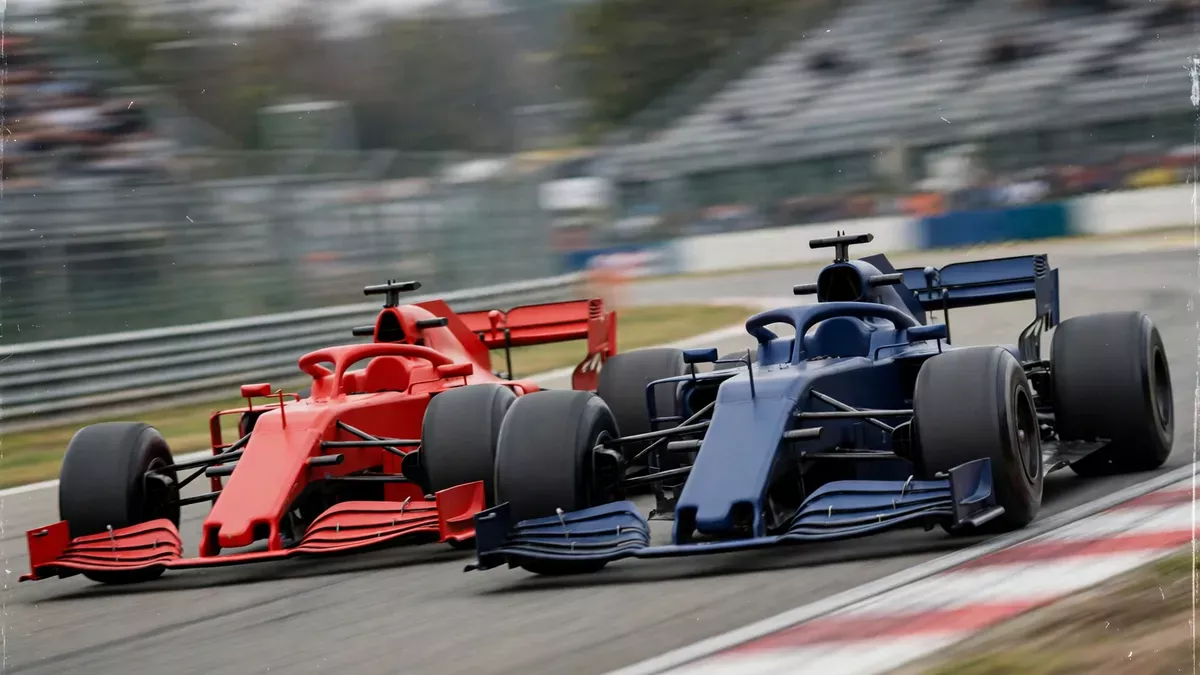
A Formula 1 Sprint is a short race of about 100 kilometers — roughly 62 miles, or a third of a Grand Prix — run on Saturday at six weekends a year. It has its own qualifying session on Friday, pays World Championship points to the top eight finishers (8 points for the winner, down to 1 for eighth), and has no mandatory pit stop. The result does not set the grid for Sunday’s Grand Prix, which is decided by a separate qualifying session on Saturday afternoon.
The Sprint is Formula 1’s answer to a simple problem: on a normal weekend, Friday and Saturday morning belong to practice, and the only session that matters before Sunday is qualifying. The Sprint gives every day of the weekend something competitive — a second race, with real points, inside the same three days. This guide explains how a Sprint weekend runs, how the points work, and how the format has changed since it arrived in 2021.
Key Takeaways
- A Sprint is a flat-out race of about 100 kilometers, run on Saturday at six weekends a year in 2026. There is no mandatory pit stop and the tire choice is free.
- Sprint Qualifying runs on Friday in three short sessions — SQ1 12 minutes, SQ2 10 minutes, SQ3 8 minutes — with tire compounds fixed by rule for each segment.
- Points go to the top eight finishers on an 8-7-6-5-4-3-2-1 scale, and count toward both the Drivers’ and Constructors’ Championships. A driver who wins the Sprint and the Grand Prix scores 33 points in one weekend.
- The Sprint result has no effect on Sunday’s grid. The Grand Prix grid comes from the full qualifying session on Saturday afternoon.
- Parc fermé is split in two on Sprint weekends: cars are locked from Sprint Qualifying until the Sprint ends, then teams may change the setup before Grand Prix qualifying.
The Sprint weekend, hour by hour
A Sprint weekend compresses the normal schedule. Friday holds a single one-hour practice session — the only practice of the weekend — followed by Sprint Qualifying. Saturday opens with the Sprint itself, then the full Grand Prix qualifying session sets Sunday’s grid. Sunday is the Grand Prix, exactly as normal.
| Standard weekend | Sprint weekend | |
|---|---|---|
| Friday | Two practice sessions | One practice session, then Sprint Qualifying |
| Saturday | Final practice, then Qualifying | Sprint race, then Qualifying |
| Sunday | Grand Prix | Grand Prix |
| Points on offer | Grand Prix only (top 10) | Sprint (top 8) plus Grand Prix (top 10) |
The single practice session is what makes Sprint weekends so demanding. Teams arrive with one hour to learn the track, test the setup and prepare the car for a competitive session the same afternoon. A team that gets it wrong on Friday has very little time to recover — which is part of why Sprint weekends produce surprises.
Sprint Qualifying: three short shootouts
Sprint Qualifying follows the same knockout shape as regular qualifying, compressed. SQ1 runs 12 minutes, SQ2 10 minutes and SQ3 8 minutes, with short breaks between them, and the slowest six cars are eliminated at the end of each of the first two segments under the 22-car grid — leaving ten cars to fight for the Sprint pole in SQ3. Lap times are wiped between sessions, just as in regular qualifying.
The key difference from Grand Prix qualifying is tires. The regulations fix the compound for each segment: new medium tires are mandatory in SQ1 and SQ2, and new soft tires in SQ3. There is no strategy in tire choice, and with the sessions so short there is usually time for only one flying lap per segment — one chance to get it right.
Penalties are kept separate between the two competitions: a penalty earned in Sprint Qualifying applies to the Sprint, while a penalty from the Sprint race itself carries over to the Grand Prix.
Points: small, but real
The Sprint pays 36 points in total, and every one of them counts toward both championships — the same points, two tables, exactly as in a Grand Prix.
| Finishing position | Sprint points |
|---|---|
| 1st | 8 |
| 2nd | 7 |
| 3rd | 6 |
| 4th | 5 |
| 5th | 4 |
| 6th | 3 |
| 7th | 2 |
| 8th | 1 |
Eight points is a third of a Grand Prix win, so a Sprint cannot decide a championship on its own — but it can tilt one. A driver who wins the Sprint and the Grand Prix takes 33 points from the weekend, against 25 for a driver who wins only the Grand Prix, and the gap between first and second in a Sprint (one point) is small enough that the real prize is usually the win itself. There is no mandatory pit stop in a Sprint, and unless a car is damaged or it rains, do not expect anyone to visit the pit lane: at 100 kilometers, the race is short enough to run flat out on a single set of tires.
The parc fermé wrinkle
Parc fermé — the rule that forbids teams from changing the car’s setup once competitive running begins — works differently on Sprint weekends. There are two separate windows: the first starts when a car leaves the pit lane for Sprint Qualifying and lasts until the start of the Sprint; the second begins when it leaves the pit lane in Grand Prix qualifying and lasts until the race.
In between, after the Sprint, the restrictions are lifted. Teams can work on the setup using everything they learned on Saturday morning, then lock the cars down again for qualifying. That reopening, added in 2024, is the reason a team can look slow in the Sprint and quick in the Grand Prix on the same weekend — and it is also why Sprint weekends reward teams that learn fast.
How the format evolved
The Sprint has changed shape almost every year since it arrived, which is why older explanations of it are often wrong.
| Years | Format |
|---|---|
| 2021 | Three Sprints as an experiment, starting at Silverstone. Friday qualifying set the Sprint grid, the Sprint set the Grand Prix grid, and the Sprint winner was credited with pole. Points 3-2-1 for the top three. |
| 2022 | Same structure, but points extended to the top eight on the 8-to-1 scale still used today. |
| 2023 | Six Sprints. The Sprint became a standalone event with its own Saturday Sprint Shootout, and the Grand Prix grid came from Friday qualifying instead. |
| 2024 to present | Sprint Qualifying moved to Friday, the Sprint to Saturday morning, and Grand Prix qualifying to Saturday afternoon. Parc fermé reopened between the Sprint and qualifying. |
The direction of travel has been consistent: separate the Sprint from the Grand Prix as much as possible, so that each race stands on its own and neither one spoils the other.
The 2026 Sprint weekends
Six of the 24 Grand Prix weekends in 2026 use the Sprint format: Shanghai (March 13–15), Miami (May 1–3), Montréal (May 22–24), Silverstone (July 3–5), Zandvoort (August 21–23) and Singapore (October 9–11). Montréal, Zandvoort and Singapore host a Sprint for the first time, while Silverstone — where the very first Sprint ran in 2021 — returns to the Sprint calendar for the first time since.
Why Sprints exist — and the argument against them
The case for the Sprint is straightforward: it gives fans a competitive session on all three days of a race weekend, gives teams and drivers more racing for the same trip, and adds a second points-paying contest to the championship without adding a weekend. Tracks chosen for Sprints tend to be ones known for good overtaking, so the short race is usually lively.
The case against is that a Sprint dilutes the Grand Prix: two races in one weekend make each one feel slightly less special, and a crash in the Sprint can wreck a team’s whole weekend before the main event has even started. There is also a competitive complaint — with only one hour of practice, the richest and best-prepared teams have an even bigger advantage than usual. Formula 1 has kept the format at six weekends a year, a third of the calendar, rather than expanding it further, which suggests the sport itself is still weighing that balance.
F1 Sprint FAQ
How long is a Sprint race?
About 100 kilometers, or roughly 62 miles — about a third of a Grand Prix distance. It usually takes around 30 minutes.
Do Sprint points count toward the championship?
Yes. Sprint points count toward both the Drivers’ and Constructors’ Championships, on the same basis as Grand Prix points.
Does the Sprint set the grid for the Grand Prix?
Not any more. In 2021 the Sprint result set Sunday’s grid, but since 2023 the Sprint is a standalone event. The Grand Prix grid comes from the full qualifying session on Saturday afternoon.
Why is there only one practice session on a Sprint weekend?
Because Friday’s second practice slot is taken by Sprint Qualifying. Teams get a single hour to prepare for the whole weekend, which is one of the format’s defining challenges.
Can teams change the car setup during a Sprint weekend?
Between the Sprint and Grand Prix qualifying, yes — parc fermé is lifted after the Sprint. Once Grand Prix qualifying begins, the cars are locked down again until the race.
What tires do drivers use in Sprint Qualifying?
The regulations fix them: new medium tires in SQ1 and SQ2, new soft tires in SQ3. In the Sprint race itself, the tire choice is free and there is no mandatory pit stop.
Related reading
More from our Motorsports hub (/motorsports/): how Formula 1 works — races, points and the World Championship (/how-formula-1-works/), how F1 qualifying works (/how-f1-qualifying-works/), what DRS was and what replaced it in 2026 (/what-is-drs-in-formula-1/), and the scores (/motorsports/scores/), schedule (/motorsports/schedule/) and standings (/motorsports/standings/) pages that follow the season round by round.
Corrections: if you spot an error in this guide, tell us through our Corrections Policy (/corrections-policy/) page and we will check it against official sources.