
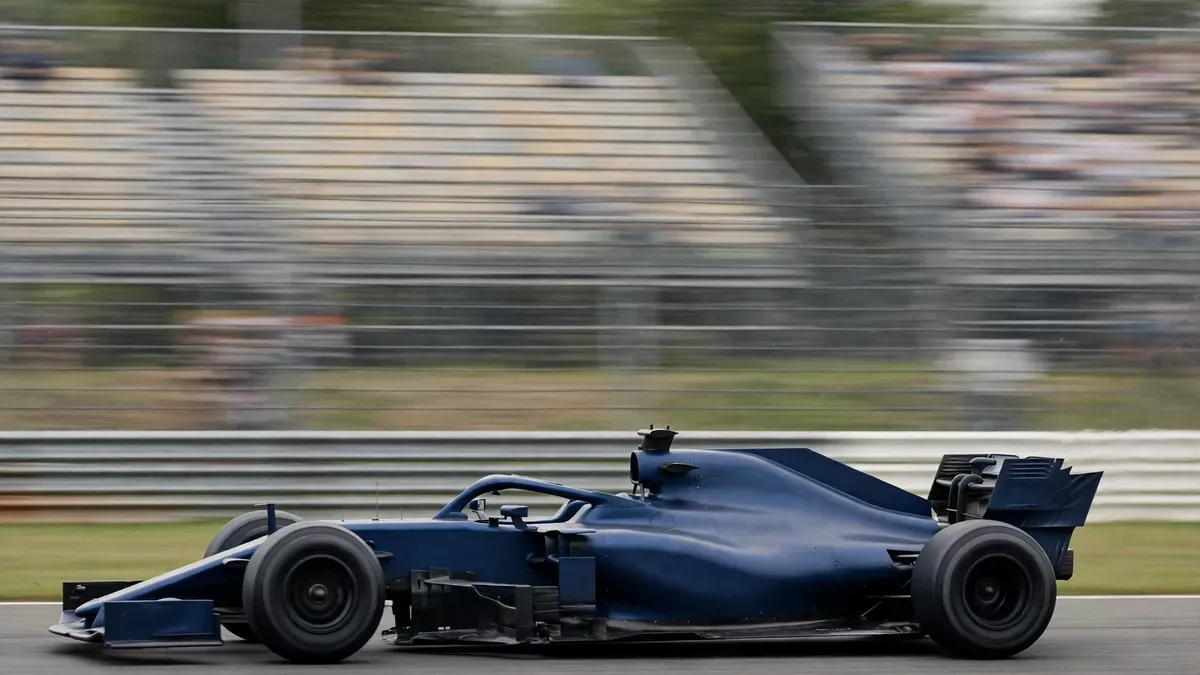
DRS — the Drag Reduction System — was a driver-operated flap in the rear wing of a Formula 1 car that opened on designated straights to cut drag and add straight-line speed, making overtaking easier. It ran from the 2011 season through 2025, and it only worked when a driver was within one second of the car ahead. For 2026, Formula 1 abolished DRS entirely, splitting its job between active aerodynamics — moving wings that every car uses on every lap — and an electrical boost called Overtake Mode.
If you watched Formula 1 at any point in the 2010s or early 2020s, you watched DRS at work, whether you knew its name or not. The onboard camera view of a chasing car pulling out of the slipstream, the flap snapping open, and the car breezing past before the braking zone was the sport’s signature overtaking image for 15 seasons. This guide explains what the system was, the rules that governed it, why fans argued about it for its whole life, and what the 2026 cars use instead.
Key Takeaways
- DRS was a flap in the rear wing that opened to reduce drag, giving a chasing car roughly 10–12 km/h of extra speed by the end of a straight, according to the FIA’s estimate.
- It could only be used inside designated DRS zones on the straights, and only by a driver within one second of the car ahead at a detection point.
- DRS ran from its debut at the 2011 Australian Grand Prix through the end of the 2025 season, when it was abolished under the 2026 regulations.
- Its two jobs were split for 2026: active aerodynamics (Straight Mode and Corner Mode, available to every driver on every lap) handle the drag reduction, while Overtake Mode gives a trailing driver extra electrical energy.
- DRS is still used in Formula 2 and Formula 3, which do not have active aerodynamics or hybrid energy boosts.
What DRS was: a flap that deleted drag
A Formula 1 car’s rear wing is a wing in the truest sense: it pushes the back of the car down onto the track, creating the grip that lets the car corner at extraordinary speed. That downforce comes at a price — drag. On a straight, where cornering grip is useless, the wing is mostly a brake.
DRS attacked that trade-off with a single moving part. The rear wing’s top flap was hinged, and the driver could open it from a button on the steering wheel, leaving a gap between the wing elements. With the flap open, the wing produced far less downforce and far less drag, and the car accelerated to a higher top speed. The flap closed automatically when the driver braked, restoring full downforce for the corner.
The size of the opening grew over the years as the sport tuned the effect: the gap was 50 mm when DRS arrived in 2011, 65 mm from 2014, and 85 mm from 2019. The bigger the gap, the bigger the speed gain — and the more the system could rescue a pass that the cars’ aerodynamics would otherwise have made impossible.
The rules: one second, in the zones
DRS was never a free-for-all. In a race, it was available only inside designated DRS zones — marked sections of straight, usually one to three per circuit — and only to a driver who was within one second of the car ahead at the detection point, a timing line placed just before the zone. Race control switched the system on after the first lap (from 2024; before that, after the second), and switched it off in wet conditions or behind the Safety Car or Virtual Safety Car. In practice and qualifying, drivers could use it more freely at first, but from 2013 its use there was also restricted to the zones.
The one-second rule was the system’s defining feature. It meant DRS was an aid for the chasing car only: the leader, with clear air ahead, could not open the flap. It also created the “DRS train,” one of the era’s most argued-over sights — a line of cars each within a second of the one ahead, each with DRS open, none of them able to pass because the car in front had the same advantage.
Why F1 introduced it: the dirty-air problem
DRS arrived in 2011 because Formula 1 had a problem of its own making. Modern cars generate so much of their cornering grip from aerodynamic downforce that a following car loses a large share of its grip in the turbulent wake — the “dirty air” — of the car ahead. It slides, its tires overheat, and the closer it gets, the worse it handles. Races in the late 2000s had developed a reputation for being processional: the fastest car could sit behind a slower one for an entire race and never get past.
DRS was the sport’s admission that its aerodynamics had broken overtaking, and it arrived alongside two other 2011 changes aimed at the same problem: Pirelli tires designed to wear out and force pit stops, and the return of KERS hybrid boost. The passing count jumped immediately, and DRS stayed for 15 seasons because, for all the arguments about it, it worked: it produced overtakes.
The arguments against it
For all that, DRS was argued about for its entire life, and the arguments were not frivolous. The most common complaint was that it made passing too easy — the “drive-by” overtake, where the chasing car sailed past on the straight without a real contest, and the defending driver, with no DRS of his own, was helpless to stop it. A pass that once required a driver to out-brake his rival into a corner became a matter of pressing a button on a straight.
The DRS train was the second complaint: when several cars ran nose to tail, all of them had DRS and none of them could pass, so the system that was supposed to create action instead froze the order. And there was a mechanical risk — a flap stuck open left a car with dangerously little rear downforce in the corners, while one stuck closed left a driver with no overtaking aid at all.
What replaced it in 2026
The 2026 regulations retired DRS and split its job in two. The drag-reduction job now belongs to active aerodynamics: both the front and rear wings move together, switching between a low-drag Straight Mode on designated straights and a high-downforce Corner Mode everywhere else. Unlike DRS, Straight Mode is available to every driver on every lap, with no one-second rule — and, according to the FIA, it is primarily an energy-efficiency device rather than an overtaking aid, helping the new electric-heavy power units reach the end of the straight with energy to spare. At Monaco in 2026 there was no Straight Mode zone at all, the first event since 2011 with no movable-wing use.
The overtaking job went to the power unit. Overtake Mode is an electrical boost for the trailing driver: a driver within one second of the car ahead at the detection point receives an extra 0.5 MJ of electrical energy and can deploy the full 350 kW of electric power up to 337 km/h, while the leading car’s deployment tapers away after 290 km/h. It was originally announced as Manual Override Mode and renamed, along with Straight Mode and Corner Mode, in December 2025. A third tool, Boost Mode, lets any driver use extra energy to attack or defend anywhere on the lap.
| DRS (2011–2025) | Straight Mode (2026) | Overtake Mode (2026) | |
|---|---|---|---|
| What moves | Rear wing flap only | Front and rear wings together | Nothing aerodynamic — battery energy |
| Who can use it | Chasing car only, within 1 second | Every driver, every lap | Trailing driver, within 1 second |
| Where | Designated DRS zones | Designated straights | Anywhere, once enabled |
| What it does | Cuts drag, adds ~10–12 km/h | Cuts drag for efficiency | Extra 0.5 MJ of electrical energy |
DRS FAQ
What does DRS stand for?
Drag Reduction System. It was a flap in the rear wing that opened to reduce aerodynamic drag and add straight-line speed.
How much faster did DRS make a car?
The FIA estimated a gain of roughly 10–12 km/h by the end of the straight, depending on the circuit and the size of the wing opening.
Why was DRS abolished?
The 2026 regulations replaced it with active aerodynamics on both wings and Overtake Mode, which delivers the passing advantage electrically instead of aerodynamically. The sport wanted the drag-cutting function available to every car, and the overtaking help to come from the hybrid system.
Could a driver use DRS whenever they wanted?
No. In a race it worked only inside the marked zones, only when within one second of the car ahead at the detection point, and only once race control had enabled it — after the first lap, and never in the wet or behind the Safety Car.
Does Formula 1 still use DRS anywhere?
Not in Formula 1. It was last used at the 2025 Abu Dhabi Grand Prix. It remains in use in Formula 2 and Formula 3, whose cars do not have active aerodynamics or hybrid energy boosts.
What is the difference between Straight Mode and Overtake Mode?
Straight Mode is the 2026 drag-cutting system: moving wings, available to everyone on designated straights. Overtake Mode is the 2026 passing aid: extra battery energy for a driver within one second of the car ahead. DRS combined both jobs in one flap; the 2026 rules split them apart.
Related reading
More from our Motorsports hub (/motorsports/): how Formula 1 works — races, points and the World Championship (/how-formula-1-works/), how F1 qualifying works (/how-f1-qualifying-works/), how F1 sprint races work (/how-f1-sprint-races-work/), and the scores (/motorsports/scores/), schedule (/motorsports/schedule/) and standings (/motorsports/standings/) pages that follow the season round by round.
Corrections: if you spot an error in this guide, tell us through our Corrections Policy (/corrections-policy/) page and we will check it against official sources.