
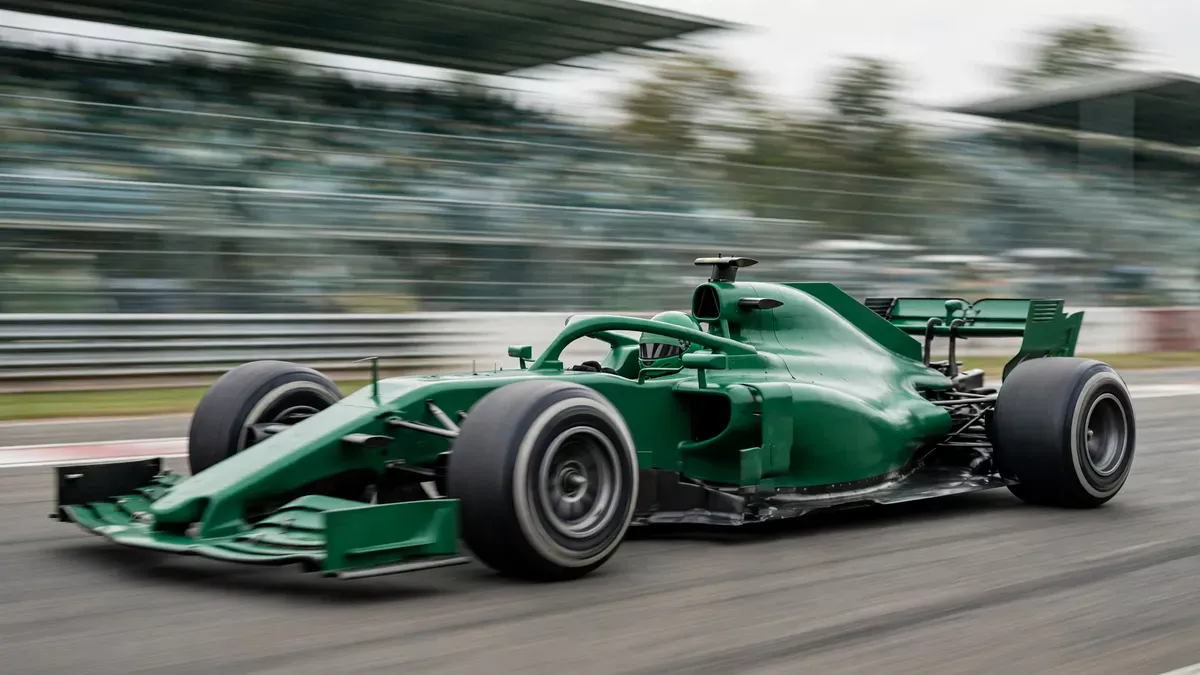
Formula 1 is a championship of two parallel contests played out over a season of races called Grands Prix. Twenty-two drivers, two for each of the eleven teams (the grid expanded in 2026 when Cadillac became the eleventh team), race at every round; the finishing order at each race pays points to the top ten, and those points accumulate into two titles. The Drivers’ Championship goes to the individual with the most points, and the Constructors’ Championship to the team whose two drivers score most between them. Each weekend follows the same rhythm — practice, a qualifying session that sets the starting grid, then the race itself — with six weekends a year adding a shorter Saturday Sprint race for extra points.
It is the world’s most-watched annual motor sport championship for a reason: the cars are the fastest circuit-racing machines on earth, the engineering budgets are enormous, and the whole sport resets more often than fans expect. The 2026 season brought the biggest rule change in decades — new cars, new power units and a new way of overtaking — so there has rarely been a better time to learn how it all fits together. This guide covers the championships, the weekend, the race itself, the points, and what changed in 2026.
Key Takeaways
- Two championships run at once: the Drivers’ title for individuals and the Constructors’ title for teams, scored from the same race results.
- A Grand Prix weekend runs practice sessions, then qualifying on Saturday to set the grid, then the race on Sunday over roughly 190 miles.
- Points go to the top ten finishers of each Grand Prix on a 25-18-15-12-10-8-6-4-2-1 scale. Sprint races at six weekends a year pay the top eight on an 8-to-1 scale. There has been no bonus point for fastest lap since 2025.
- Strategy decides as much as speed: every car must use at least two different tire compounds in a dry race, which guarantees pit stops and tactical choices.
- The 2026 season reset the sport: smaller, lighter cars, active aerodynamics in place of DRS, a near 50-50 split between combustion and electric power, and an eleventh team.
Two championships, one set of results
Every race result feeds both tables at once. If a driver wins, he scores 25 points for himself in the Drivers’ Championship and 25 for his team in the Constructors’ Championship; his teammate’s points are added to the team’s total. This is why team orders — one driver being asked to help the other — have always been part of Formula 1’s politics: the team is racing for its own title at the same time as its drivers chase theirs.
The Constructors’ Championship is the one the money follows. A team’s share of the sport’s prize fund is tied largely to its constructors’ position, and with it come practical advantages such as pit-lane position and, under the sport’s cost-cap rules, development allowances that favor the teams lower down. The Drivers’ Championship is the famous one — the title history remembers — but inside the paddock, the constructors’ table is what the factories and sponsors plan around.
Formula 1 teams are also manufacturers in a way no American series matches: each team designs and builds its own car to a shared rulebook, buying in only certain standard parts and, in some cases, the power unit. That is why the championship is called a constructors’ contest — you are not just watching drivers race; you are watching engineering organizations compete across a season of development.
The grid: eleven teams, twenty-two drivers
Each team runs two cars, and the drivers are contracted to the team, not entered race by race. For 2026 the grid grew to 22 cars for the first time in a decade, after Cadillac joined as the eleventh team — an expansion that also changed the mathematics of qualifying, as our guide to how F1 qualifying works explains.
Under the bodywork, the cars share a formula set by the FIA, motor sport’s governing body, which writes the technical and sporting regulations and enforces them. Since 2021 the sport has also operated with a cost cap on team spending, designed to compress the gap between the richest operations and the smallest while the technical reset of 2026 reshuffled the order underneath them.
A race weekend, day by day
On a standard weekend, Friday holds two one-hour practice sessions in which teams test setups and the drivers learn the track’s current grip. Saturday brings a final practice session and then qualifying — a three-part knockout, Q1, Q2 and Q3, that ranks every driver by their fastest lap and sets the starting grid, two cars per row. Sunday is the race.
Six weekends a year run the Sprint format instead. Practice is cut to a single session on Friday, followed by a short Sprint Qualifying; on Saturday the Sprint race — a flat-out dash of about 62 miles with no mandatory pit stops — runs before regular qualifying, and Sunday’s Grand Prix completes the weekend. The Sprint has its own points for the top eight finishers, which is how a driver can score in two races in one weekend.
| Standard weekend | Sprint weekend | |
|---|---|---|
| Friday | Two practice sessions | One practice session, then Sprint Qualifying |
| Saturday | Final practice, then Qualifying | Sprint race, then Qualifying |
| Sunday | Grand Prix | Grand Prix |
| Points on offer | Grand Prix only | Sprint (top 8) plus Grand Prix (top 10) |
The race itself
A Grand Prix runs to a set number of laps totaling roughly 305 kilometers — about 190 miles — and typically lasts around 90 minutes to two hours. The race begins from a standing start: the cars line up on the grid, complete a formation lap, and launch when the start lights go out. The first corner, with 22 cars arriving together on cold tires and full fuel tanks, is the most dangerous and most watched moment of the weekend.
From there, tire strategy rules the afternoon. Tire supplier Pirelli brings three dry compounds to each event — soft, medium and hard — and in a dry race every driver must use at least two different compounds, which forces at least one pit stop. Stops are timed to the tenth of a second by crews of around twenty mechanics and change all four wheels in roughly two seconds. When to stop — early to gain track position on fresh tires (the undercut) or late to have fresher rubber at the end (the overcut) — is the central tactical question of modern Formula 1, and it is why the strategists on the pit wall, working from live simulations, are as important as the drivers on a Sunday.
Safety interventions shape races too. A Safety Car period bunches the field together behind a control car while an incident is cleared, wiping out the leader’s gap; a Virtual Safety Car instead holds gaps by imposing a speed limit without bunching. Rain rewrites everything: intermediate and full-wet tires come out, visibility collapses, and the advantage swings toward driver skill over car performance.
Points and how the titles are decided
The points system has been stable since 2010 at the top, and unchanged for 2026: the top ten finishers of a Grand Prix score, with a premium on winning that makes victories the currency of a title challenge.
| Finishing position | Grand Prix points | Sprint points |
|---|---|---|
| 1st | 25 | 8 |
| 2nd | 18 | 7 |
| 3rd | 15 | 6 |
| 4th | 12 | 5 |
| 5th | 10 | 4 |
| 6th | 8 | 3 |
| 7th | 6 | 2 |
| 8th | 4 | 1 |
| 9th | 2 | 0 |
| 10th | 1 | 0 |
One thing older guides get wrong: there is no longer a bonus point for setting the fastest lap of the race. That point existed from 2019 to 2024, for top-ten finishers only, and was abolished from the 2025 season. If a race is stopped early and cannot be restarted, reduced points are awarded according to how much of the distance was completed.
If two drivers finish the season level on points, the title is decided on countback: the driver with more race wins takes it, and if wins are equal, more second places, then thirds, and so on down the finishing order. The same system separates tied teams. A championship can also be settled before the final round — a driver or team clinches the title the moment the remaining points available can no longer overhaul their total.
What changed in 2026
The 2026 regulations are the sport’s biggest reset in a generation, changing the cars and the power units at the same time, and the details in this section are specific to the 2026 rules. The cars are smaller and lighter — the wheelbase is 200mm shorter and the minimum weight is down by around 30kg — and they look different, with narrower front wings and flatter floors in place of the ground-effect tunnels of the 2022–2025 cars, cutting downforce by roughly 30 percent.
The headline change is active aerodynamics. The Drag Reduction System (DRS), the movable rear wing that for 15 seasons gave a following driver a speed boost in set zones, is gone. In its place, the front and rear wings themselves move: on designated straights the cars switch to a low-drag Straight Mode, and for corners they return to a high-downforce Corner Mode — available to every driver on every lap, not just those chasing. Overtaking help now comes from the power unit instead: a driver within one second of the car ahead can use Overtake Mode, deploying extra electrical energy (+0.5 MJ) to sustain a higher speed for longer.
That is because the power units changed too. The 1.6-liter V6 turbo hybrid remains, but the complex MGU-H heat motor is removed, the engine’s output is reduced, and the electric MGU-K motor nearly triples in power to around 350 kW — creating a near 50-50 split between combustion and electric power, running on advanced sustainable fuel. Managing that electrical energy across a lap — harvesting under braking, deploying on the straights — has become the defining skill of the new era, for drivers and strategists alike.
Formula 1 FAQ
How many races are there in a season?
The modern calendar runs to roughly two dozen Grands Prix — 24 rounds in 2026 — spread across five continents from early spring to late autumn.
How long does a Grand Prix take?
Usually between 90 minutes and two hours of racing. There is a maximum time limit for races interrupted by stoppages, after which the result is declared on the distance completed.
What is the difference between the Drivers’ and Constructors’ Championships?
Same points, two tables. Each driver’s points are his own in the Drivers’ Championship; both drivers’ points are added together for their team in the Constructors’ Championship, which drives the prize money.
Do drivers score points for fastest lap?
Not any more. The fastest-lap bonus point ran from 2019 to 2024 and was abolished from 2025, so in 2026 finishing position alone decides the points.
Why do the cars have to pit if the tires could last?
Because the rules require two different dry compounds to be used in a dry race. The mandatory stop is deliberate: it creates the strategy battles — undercuts, overcuts and Safety Car gambles — that decide modern Grands Prix.
What does a Sprint weekend change?
It adds a second, shorter race on Saturday worth points to the top eight, sets its grid with its own Sprint Qualifying on Friday, and cuts practice to one session. The main Grand Prix runs as normal on Sunday — see our guide to how F1 qualifying works for the full breakdown.
Related reading
More from our Motorsports hub: how F1 qualifying works, and the scores, schedule and standings pages that follow the season round by round.
Corrections: if you spot an error in this guide, tell us through our Corrections Policy page and we will check it against official sources.