
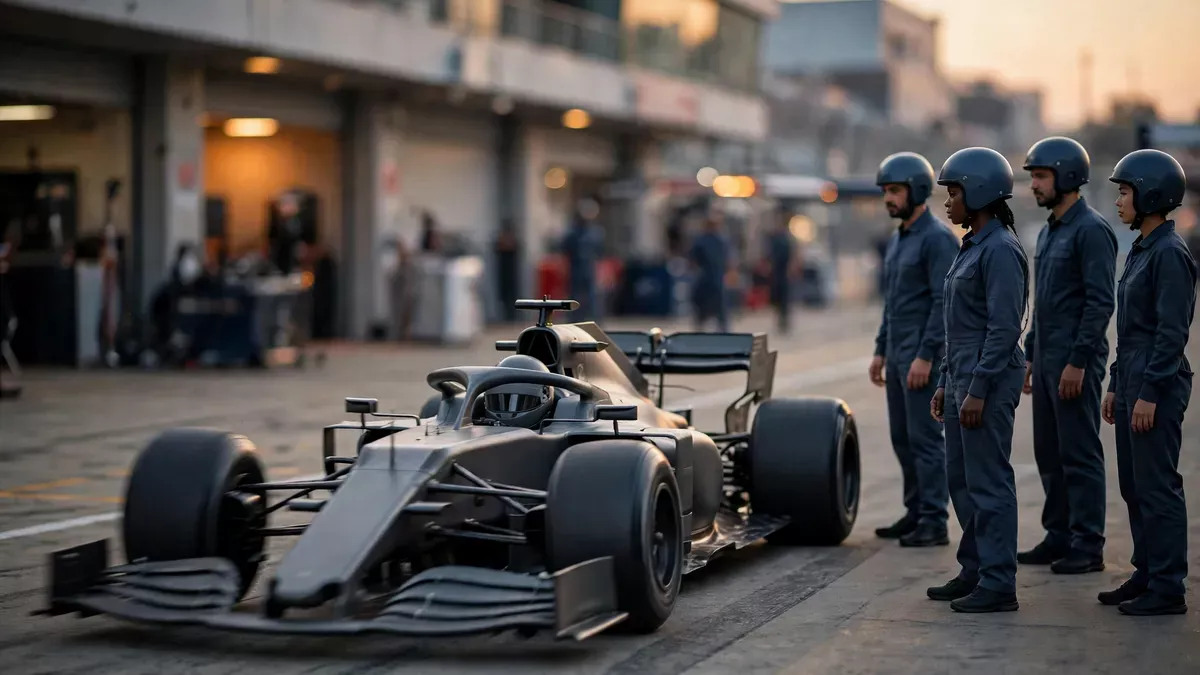
Formula 1 qualifying is a one-hour knockout that decides the starting order for the race. It runs in three sessions on Saturday afternoon: Q1, with every car on track, eliminates the slowest six; Q2 eliminates six more; and Q3 is a shootout between the ten fastest for pole position — the first slot on the grid. Lap times are wiped between sessions, so every segment is a fresh contest, and the knockout format means a single mistake, a blocked lap or a mistimed run can strand a fast car at the back. On Sprint weekends, a second, shorter version of the same format — Sprint Qualifying — runs on Friday to set the grid for Saturday’s Sprint race.
The format keeps the shape it has had since 2006, but the numbers inside it moved for 2026: Cadillac’s arrival as the eleventh team took the grid from 20 cars to 22, so six cars now drop out of each of the first two sessions instead of five. This guide walks through each session, what makes a lap fast, the Sprint version, and why the qualifying order is not always the order the cars start in. For the full picture of the sport, see our pillar guide to how Formula 1 works.
Key Takeaways
- Qualifying has three knockout parts: Q1 (18 minutes), Q2 (15 minutes) and Q3 (12 minutes), with times reset between each.
- Under the 2026 rules, with 22 cars on the grid, the slowest six are eliminated in Q1 (starting 17th to 22nd) and six more in Q2 (11th to 16th). With the old 20-car grid it was five and five.
- Q3 sets the top ten: the fastest lap takes pole position. Pole matters most at tight street circuits where overtaking is hardest.
- Sprint Qualifying follows the same knockout shape in shorter sessions — SQ1 12 minutes, SQ2 10, SQ3 8 — with tire compounds fixed by rule for each segment.
- Qualifying order is not always grid order: penalties for new power-unit parts or on-track offenses are applied after the session.
The three sessions, step by step
Qualifying begins with all 22 cars free to run for the full 18 minutes of Q1. There is no limit on laps: drivers typically go out early for a banker lap — a safe, representative time on the board — then pit for fresh tires and attack again at the end, when the track is at its fastest. When the clock runs out, drivers already on a lap may finish it; then the slowest six are eliminated and take grid positions 17th to 22nd in the order of their times.
After a short break, the surviving 16 start again from zero in Q2, because every lap time from Q1 is deleted. Fifteen minutes later, six more are eliminated into positions 11th to 16th. The final ten go through to Q3 with their times wiped once more, and over 12 minutes they fight for the front of the grid: the fastest Q3 lap takes pole position, and the rest line up second to tenth in time order.
| Session | Length | Cars taking part | Eliminated | What it decides |
|---|---|---|---|---|
| Q1 | 18 minutes | 22 | Slowest 6 | Grid positions 17–22 |
| Q2 | 15 minutes | 16 | Slowest 6 | Grid positions 11–16 |
| Q3 | 12 minutes | 10 | None | Pole position and grid positions 1–10 |
What makes a qualifying lap
Qualifying is the purest test of speed in Formula 1 because the cars run in their fastest configuration: low fuel, the softest tire compound the weekend offers at maximum grip for a single lap, and engine modes turned up. A set of soft tires gives its best grip for essentially one flying lap, so the run is choreographed — an out lap to bring the tires and brakes into their working window, one timed lap at the limit, then a slow in lap. Mistime the out lap and the tires are past their best before the lap even starts.
Two other factors decide Saturdays. The first is track evolution: as more cars run, rubber is laid down and the surface gets faster, so the final minutes of each session are the quickest — which is why the whole field floods out at the end, and why traffic becomes a real hazard. A driver needs clean air, not a slower car in the way through the fast corners. The second is risk. A yellow flag for someone else’s spin, a lap deleted for crossing the white lines that mark the track limits, or a brush with the wall can end a session’s plan in a second. The knockout format amplifies all of it: in Q1, a genuine contender caught out by traffic can be eliminated before the contest for pole has even begun.
Why 2026 is different: 22 cars, six out
From 2017 to 2025 the grid held 20 cars, and qualifying cut five drivers in Q1 and five in Q2. Cadillac’s entry for 2026 made it 22 cars and 11 teams, and the arithmetic no longer worked — keeping a five-car cut would have swollen the later sessions. The regulations were therefore amended so six cars are eliminated at the end of Q1 and six at the end of Q2, preserving the ten-car Q3 shootout and the same session lengths of 18, 15 and 12 minutes.
The practical effect is a busier, more dangerous Q1: 22 cars hunting for track space in 18 minutes, with the midfield compressed into a few tenths of a second. The margin between surviving Q1 and starting 17th is often smaller than the time a driver loses behind one slow car on an out lap.
Sprint weekends: qualifying twice
Six weekends a year run the Sprint format, and those weekends contain two qualifying sessions. Friday’s Sprint Qualifying sets the grid for Saturday’s Sprint race and follows the same knockout logic in compressed form: SQ1 runs 12 minutes, SQ2 10 minutes and SQ3 8 minutes, and with the 22-car grid the slowest six are eliminated in each of the first two segments. The key difference is tires — the regulations fix the compound for each segment, with new medium tires mandatory in SQ1 and SQ2 and new softs in SQ3, so there is no strategy in tire choice and usually only time for one flying lap per segment.
Saturday then runs the Sprint — a short race of about 62 miles paying points to the top eight — before the cars go through the full, regular qualifying session later the same day to set Sunday’s Grand Prix grid. A driver can therefore qualify twice in 24 hours, once in each format, and the two results often differ: the Sprint version, run after just one practice session, rewards whoever got the car right first.
When qualifying order is not the grid
The grid that starts the race is the qualifying order plus penalties. Drivers take grid drops for exceeding their season’s allocation of power-unit components, and for offenses such as impeding another driver in qualifying or causing a collision in a previous race. A driver can therefore set the third-fastest time and start tenth, promoting everyone behind. Times matter at the back too: any driver whose best Q1 lap is slower than 107 percent of the fastest Q1 time needs the stewards’ permission to start at all, a rule that exists to keep dangerously slow cars off the grid — in practice it is almost always granted when a car was quick in practice.
After qualifying, the cars also enter parc fermé conditions: from the start of qualifying, teams may make only very limited changes to the car before the race, which is why Saturday setup choices are a gamble on Sunday’s weather and race pace. Our Motorsports hub and the F1 schedule pages keep track of every session across the season.
F1 qualifying FAQ
What does pole position mean?
First place on the starting grid — the slot at the front, earned by setting the fastest lap in Q3. It is the best starting position, with a clear track ahead at the start.
Why are the lap times reset between sessions?
To keep every segment a clean contest. A time from Q1 cannot protect a driver in Q2, so a mistake or a traffic problem in any session can eliminate a fast car.
How many cars are knocked out in Q1 and Q2?
Six in each under the current rules, because the 2026 grid has 22 cars. From 2017 to 2025, with 20 cars, it was five in each session, and Q3 has always kept ten cars.
Is qualifying the same on a Sprint weekend?
The Sprint race has its own shorter qualifying on Friday — SQ1, SQ2 and SQ3 with fixed tire compounds — while the Grand Prix still uses the full Q1, Q2, Q3 session on Saturday.
Can a driver qualify last and still win the race?
It happens rarely, usually through rain, Safety Cars and attrition, but overtaking 21 cars on merit alone is close to impossible at most circuits. Qualifying position is the single best predictor of the race result, which is why Saturdays matter so much.
What happens if a driver sets no time in Q3?
They are placed at the back of the Q3 group — tenth, or by their earlier session times if several drivers set no time — behind everyone who recorded a lap.
Related reading
More from our Motorsports hub: how Formula 1 works — races, points and the World Championship, and the scores, schedule and standings pages that follow the season round by round.
Corrections: if you spot an error in this guide, tell us through our Corrections Policy page and we will check it against official sources.