
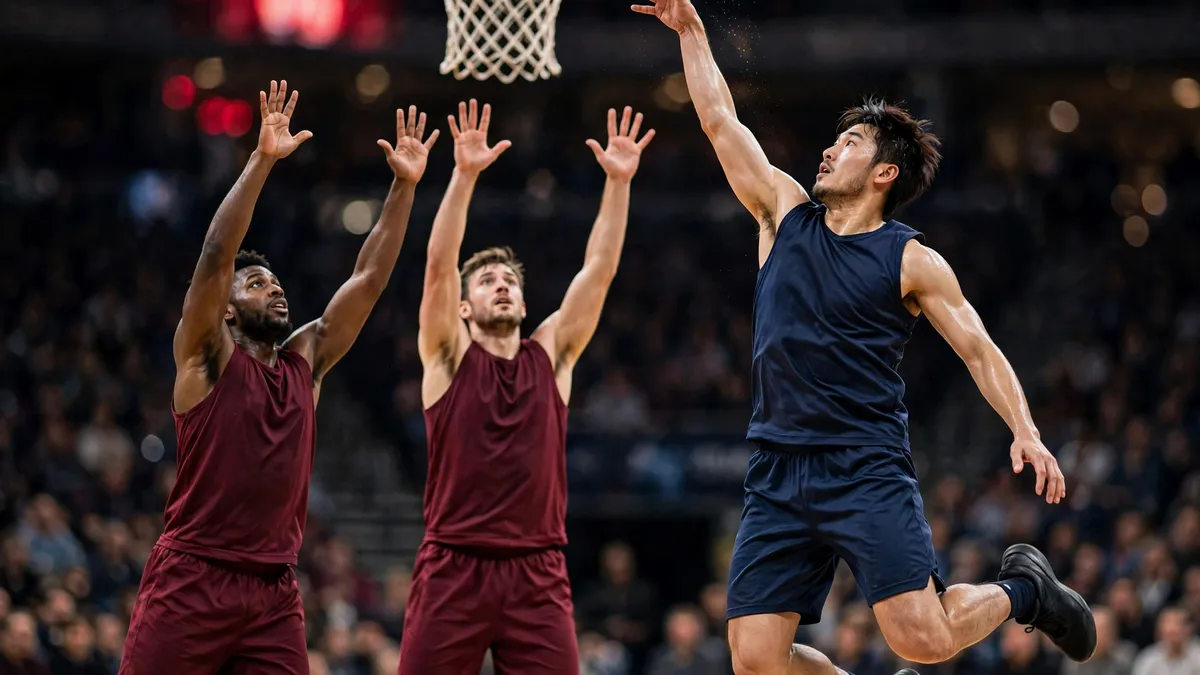
When an NBA game is tied after 48 minutes, the teams play a five-minute overtime period — and keep playing five-minute periods until one ends with a leader. There are no ties in the NBA, no shootouts and no sudden death: overtime is simply more basketball, played under the same rules as regulation with a few adaptations. Each overtime begins with a jump ball; personal fouls carry over (a player with five fouls is one whistle from disqualification all night), team fouls continue under the fourth-quarter penalty structure so the bonus arrives quickly, and each team receives two timeouts per overtime period under the league’s pace reforms. Statistics compiled in overtime count fully in season totals. The longest NBA game ever played ran six overtimes, in 1951. This guide explains the mechanics, the strategy of the extra period, and how the NBA’s answer to a tie differs from football’s.
Key Takeaways
- Overtime = repeated 5-minute periods until a period ends untied. NBA games never end in ties.
- Each overtime starts with a jump ball; the shot clock and all normal rules apply unchanged.
- Fouls carry over: personal fouls stay on the player’s total (six disqualifies), and team-foul/bonus rules continue on the fourth-quarter pattern.
- Each team gets 2 timeouts per overtime period (reduced from three in the 2017 pace reforms).
- All overtime statistics count in players’ and teams’ season numbers.
- The record is six overtimes: Indianapolis vs. Rochester on January 6, 1951, a 75-73 final.
The mechanics of the extra period
The five minutes after regulation are a miniature of the game itself. A jump ball at center court opens every overtime, and winning it is worth more than it looks: first possession in a five-minute period is a real edge. Scores, fouls, the bonus, reviews and challenges all proceed as normal, with the coach’s challenge bank unchanged. Timeouts reset to two per team for each overtime period, regardless of what was saved from regulation — and the late-game “advance” option (using a timeout to move the inbound to the frontcourt in the final minutes) remains available. The alternation quirk: teams switch baskets for each overtime just as for a new period, and fouls accumulate without mercy — overtime is where foul trouble, managed all evening, goes to be collected: a star sitting on five fouls must defend a full extra period at one whistle’s distance from disqualification, while his coach decides whether the risk is the strategy.
Why five minutes works
The period’s length is calibrated to basketball’s scoring rate. A quarter lasts 12 minutes; five minutes gives each team roughly ten to twelve possessions — enough for skill, depth and late-game execution to assert themselves, too few for the period to become a war of attrition on an ordinary night. Overtime is also rare enough to stay special: only a small single-digit share of regular-season games reach it in a typical season, and most end in a single extra period. International basketball (FIBA) independently settled on the same answer — five-minute periods, repeated until decided — which suggests the NBA’s format is less an invention than the sport’s natural solution: when in doubt, play more basketball. The one modern pressure on the format is scheduling: in an era of load management (covered later in this series), deep-overtime games impose recovery costs that ripple into the next game’s availability report.
How overtime games actually end
Because five minutes is a full quarter’s worth of possessions compressed, overtime strategy differs from regulation’s endgame in identifiable ways. First possession value inflates (in a five-minute game, a 4-0 start is a genuine hole), which is why winning the tip and scoring first correlates so strongly with OT wins. Free throws dominate late OT possessions: team fouls accumulated in the fourth quarter’s pattern mean the bonus is usually one foul away, so drivers attack the rim and defenders must guard without hands — the foul guide’s late-game logic, extended by five minutes. Fatigue and rotation decide many second and third overtimes: the starters who forced OT have logged 45-plus minutes, coaches shorten to seven-man rotations, and a fresh bench defender or an energy big can swing a period that stars are surviving rather than commanding. And the foul-out math occasionally produces the sport’s strangest lineups: deep-OT games in which multiple players have been disqualified — under extreme circumstances the NBA even has a provision for a disqualified player to return if his team would otherwise have fewer than five players (his return costs a technical foul and a foul is charged for each subsequent foul — a rule invoked so rarely that each occurrence becomes trivia).
The deep end: multiple overtimes and the record books
A second overtime begins to bend the evening; a third changes it entirely — game times push past three hours, rotations are survival exercises, and the box score inflates toward the absurd (our triple-double guide notes that OT is where counting stats go to be padded legitimately). The absolute record stands from the pre-shot-clock era: on January 6, 1951, the Indianapolis Olympians beat the Rochester Royals 75-73 in six overtimes — a final score that also reminds us the extra periods of a stall-ball era produced fewer points than a modern quarter. Five-overtime games have occurred a handful of times since, most recently in the modern era as rarities; four-overtime games make news a few times a decade. In the playoffs, nothing about the rules changes — the same five-minute periods repeat — except the stakes compress rotations further and the foul-out and fatigue mathematics become series-shaping events.
NBA overtime vs. football’s answers
The NBA’s philosophy is continuity: the tie is resolved by more of the same game. Compare the alternatives on this site: the NFL’s overtime is a timed period with kickoffs and (in the regular season) the possibility of an actual tie, while college football’s overtime abandons the full field for alternating possessions from the 25 and, ultimately, a two-point shootout. Basketball can afford purity because its scoring is frequent and its periods are short: no one has ever needed a shootout when five more honest minutes almost always separate two teams. The absence of sudden death is the point: an NBA game cannot be won on a coin flip or a single possession without response — it must be won, repeatedly if necessary, across a full extra period of basketball.
NBA overtime FAQ
How long is NBA overtime?
Five minutes per period, repeated as many times as needed until a period ends with one team ahead. There is no limit and there are no ties.
Does overtime start with a jump ball?
Yes — every overtime period opens with a jump ball at center court, just like the start of the game.
Do fouls carry into overtime?
Yes. Personal fouls remain on the player’s total (six disqualifies, so a player with five fouls is at risk all period), and team fouls continue under the fourth-quarter penalty structure, so the bonus arrives quickly.
How many timeouts does each team get in overtime?
Two per overtime period, refreshed for each new period, regardless of how many were used in regulation.
Do overtime stats count?
Yes — points, rebounds and everything else compiled in overtime count fully in season and career totals.
What is the most overtimes in an NBA game?
Six: Indianapolis Olympians 75, Rochester Royals 73, on January 6, 1951 — the longest game in league history.
Related reading
Overtime is where the foul system collects its debts and the playoffs find their longest nights — follow them on our NBA hub and live scores page.
Corrections: if you spot an error in this guide, tell us through our Corrections Policy page and we will check it against official sources.