
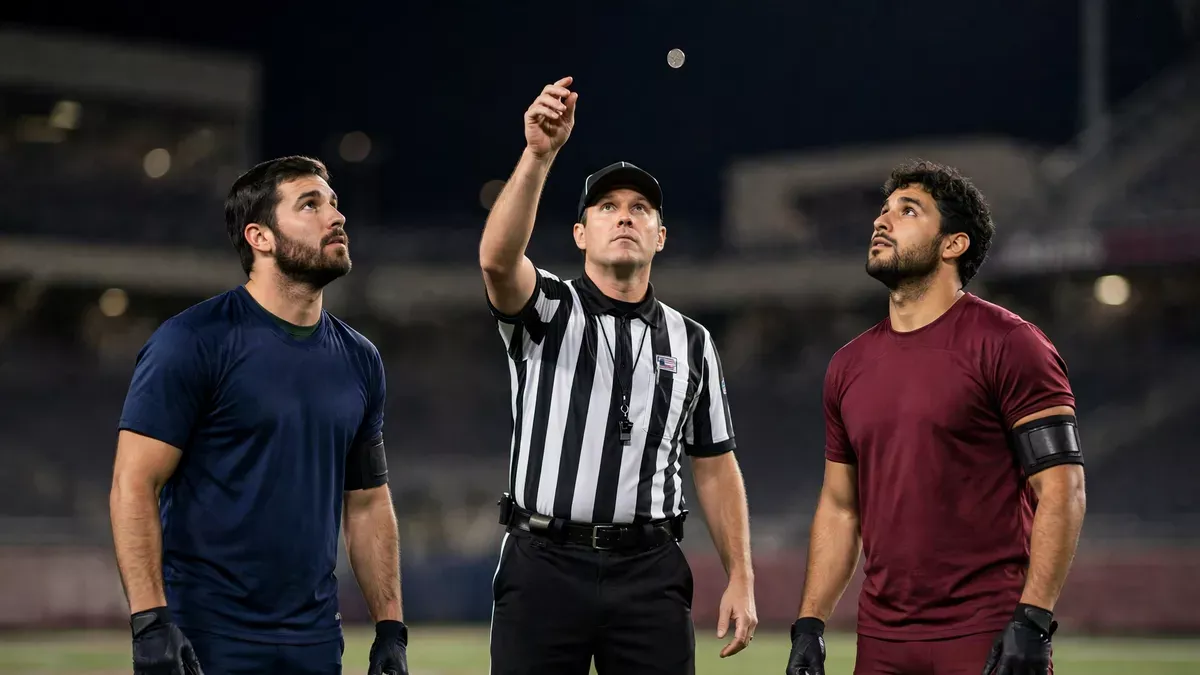
NFL overtime now guarantees both teams at least one possession in both the regular season and the playoffs. In the regular season, overtime is a single 10-minute period: after a coin toss and kickoff, each team gets the ball at least once, and if the score is still tied when the clock expires, the game ends as a tie. In the playoffs, each team is likewise guaranteed a possession — after that, the game becomes sudden death and continues through as many 15-minute periods as needed, because postseason games cannot end tied.
This guide explains the current rules step by step, then the three decades of argument that produced them: the old pure sudden death, the 2010 “modified” fix, and the famous playoff game that finally forced the league to guarantee both offenses the ball.
Key Takeaways
- Regular-season overtime: one 10-minute period, both teams guaranteed a possession, ties possible.
- Playoff overtime: 15-minute periods, both teams guaranteed a possession, then sudden death — no ties, ever.
- A touchdown on the opening possession no longer ends a playoff game (rule changed in 2022); the same guarantee reached the regular season in 2025.
- If a team scores a safety on the opening possession, or scores after both teams have had the ball, the game ends immediately.
- Each team gets two timeouts per overtime period (three in a second period, under the standard rule), and all replay reviews are initiated by the booth.
- The Chiefs–Bills playoff classic of January 2022 — won by Kansas City without Buffalo’s offense touching the ball — was the direct cause of the current format.
The regular-season rules
When a game ends tied after four quarters, the captains meet for a second coin toss. The winner typically elects to receive (or, more rarely, to defend a goal), and overtime opens with a kickoff just like the start of a half.
The period is 10 minutes. The first team possesses the ball; that possession ends in a touchdown, a field goal, a turnover or a punt, and then the other team gets its guaranteed possession, with one exception — if the first team scores a touchdown and the second team’s answering possession produces only a field goal, the game is over when that possession ends. More precisely: both teams are assured the opportunity to possess, so the game cannot end on the opening possession unless it ends by safety (which still wins the game immediately, since the scored-upon team has, by definition, already had its opportunity with the ball). After both teams have possessed, the game becomes sudden death for whatever time remains: the next score of any kind wins. If the 10 minutes expire with the score level, the result is a tie, recorded in the standings with its own tiebreaker consequences (see our NFL tiebreakers guide).
Coaches manage the clock exactly as in regulation, with two timeouts per team in the period, the two-minute warning, and booth-initiated replay review — no coach’s challenges in overtime.
The playoff rules
Playoff overtime runs on 15-minute periods and continues until there is a winner. The possession guarantee applies identically at the start: each team will possess the ball at least once, and the game cannot be decided by a single opening touchdown drive. After both teams have had their opening possessions, the next score wins, through as many periods as required, with a full intermission structure between periods after the second. Teams prepare for the possibility of effectively playing a fifth quarter — and in the famous cases, deep into a sixth — with exhausted rosters; it has decided a Super Bowl (the Patriots’ 28–3 comeback against Atlanta was completed in overtime under the older modified rules, the only Super Bowl ever to need it).
How the rules evolved — and why
Overtime itself was born in one game: the 1958 NFL Championship between the Colts and Giants, tied at the end of regulation and decided by the first sudden-death period in league history — a game so famous it is still routinely called the greatest ever played, and the reason a championship could never again be allowed to end level. The playoffs used sudden death from then on; the regular season adopted overtime in 1974.
Pure sudden death (1974–2009). For decades, the first score of any kind, including a field goal on the opening drive, won the game. The coin toss carried enormous weight, and the system’s unfairness was mostly theoretical until elite quarterbacks made opening-drive endings routine.
The modified fix (2010 playoffs, 2012 regular season). The league ruled that a field goal on the opening possession no longer ended the game: the other team would get a chance to match or beat it, while an opening touchdown still ended play immediately. It was a compromise — it ended the cheapest endings while preserving sudden-death drama — and it survived exactly one era-defining game.
The Kansas City game (January 2022). In the divisional round, Buffalo and Kansas City traded leads in a legendary final two minutes, the Chiefs tied the game with 13 seconds left, won the coin toss, and drove for a touchdown on the opening possession of overtime. The Bills’ offense — which had played one of the great playoff games ever — never took the field. Within months, owners approved the both-teams-possession rule for the playoffs.
The regular season follows (2025). The league extended the guaranteed-possession format to the regular season, trimming the remaining weirdness between the two codes. What remains different: the regular season’s 10-minute cap (and its ties) versus the playoffs’ play-to-a-winner structure.
The strategy the rules create
The current format has settled the old debate about the coin toss — receiving first is still preferable (you can win earlier and, crucially, you hold the first sudden-death possession if the first two drives cancel out) — and shifted the real chess elsewhere: whether to go for two after an answering touchdown to end the game immediately rather than kicking the extra point and handing the ball back (analytics staffs model this exact decision all week), how aggressively to use fourth downs in the opening drives, and clock management when a tie is an acceptable outcome — a regular-season-only variable that has produced some genuinely strange endgame arithmetic, including teams playing for the tie that helps their tiebreaker position.
NFL overtime FAQ
Can an NFL regular-season game end in a tie?
Yes. If the score is level after the 10-minute overtime period, the game is a tie. Playoff games cannot end tied.
Does the first touchdown in overtime still win the game?
Not anymore, in either the regular season or the playoffs — the other team is guaranteed a possession. (A safety on the opening possession does end it.)
How long is NFL overtime?
10 minutes in the regular season; 15-minute periods, repeated as needed, in the playoffs.
What happens after both teams have had the ball in overtime?
The game becomes sudden death: the next score of any kind wins.
Why did the rules change in 2022?
Because Kansas City beat Buffalo in the 2021-season divisional playoffs on an opening-possession touchdown while Buffalo’s offense never played in overtime. Owners voted to guarantee both teams a possession in the postseason.
How is college football overtime different?
Completely — college teams trade possessions from the opponent’s 25-yard line with no game clock, a format explained in our college overtime guide.
Related reading
Build the full picture with our guides to how the NFL playoffs work (/how-the-nfl-playoffs-work-seeding-byes-and-home-field-advantage-explained/) and how NFL tiebreakers work, and follow weekly drama on our NFL hub (/nfl/) and scores page (/nfl/scores/).
Corrections: if you spot an error in this guide, tell us through our Corrections Policy (/corrections-policy/) page and we will check it against official sources.