
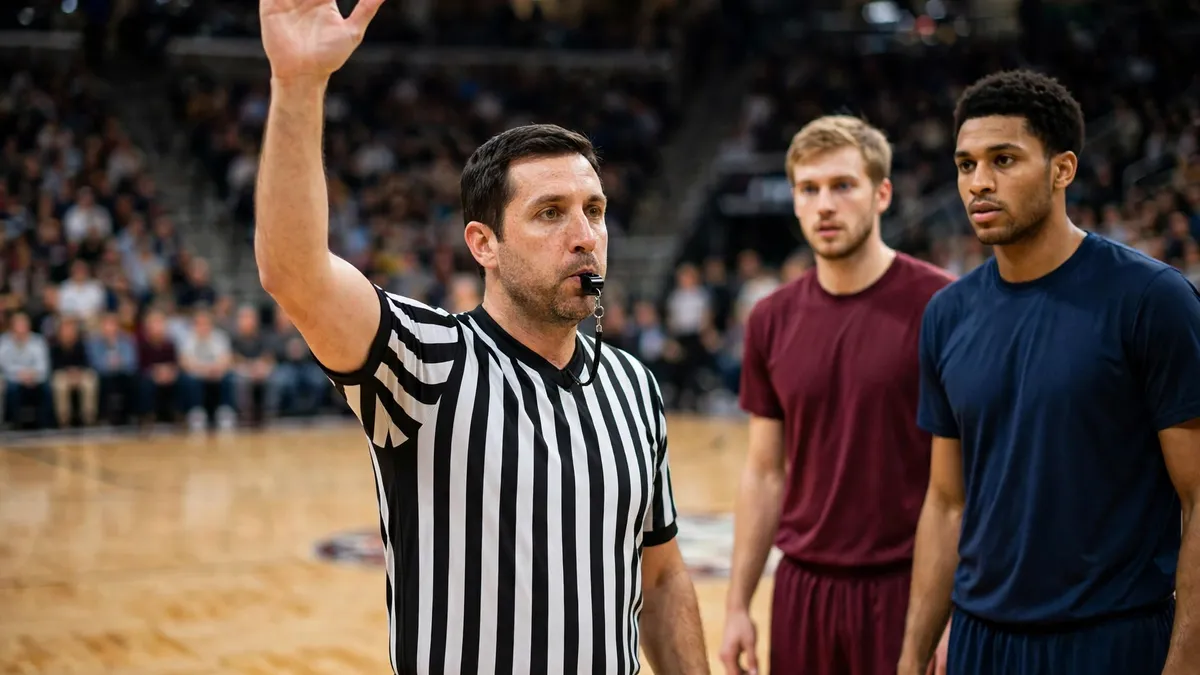
NBA fouls come in four families, and each punishes differently. A personal foul is illegal contact (or an offensive player’s charge): six of them disqualify the player for the game, and enough of them by a team in one quarter triggers “the bonus,” in which even non-shooting fouls send the fouled player to the line for two free throws. A flagrant foul is a personal foul judged unnecessarily hard — Flagrant 1 — or unnecessarily hard and excessive — Flagrant 2, which also ejects the player — and it always costs two free throws plus possession. A technical foul punishes conduct and rule-breaking rather than contact (arguing, taunting, delay of game, defensive three seconds) and costs one free throw, with automatic suspensions for players who accumulate them. This guide explains each family, the bonus math that decides late-game strategy, and the fouls with their own special rules.
Key Takeaways
- Foul out: 6 personal fouls in the NBA (college and FIBA use 5). Personal fouls include offensive fouls.
- The bonus: on a team’s 5th foul of a quarter, non-shooting fouls start producing 2 free throws. Team fouls reset each quarter.
- Shooting fouls: 2 free throws on a missed two-pointer, 3 on a missed three-pointer, 1 if the shot goes in (the “and-one”).
- Flagrant 1 = unnecessary contact; Flagrant 2 = unnecessary and excessive (ejection). Both yield 2 free throws plus the ball.
- Technical fouls cost 1 free throw; the 16th technical of a player’s regular season triggers an automatic one-game suspension (and every second one after), with a stricter scale in the playoffs.
- Special cases: clear-path fouls (2 shots + ball), away-from-play fouls in the last 2 minutes (1 shot + ball), offensive fouls (never free throws for the defense by themselves).
Personal fouls: contact, charges and the six-foul limit
A personal foul is illegal physical contact with an opponent — reaching, holding, pushing, blocking, hand-checking — or, by the offense, charging into a set defender. What the foul produces depends on the moment: a foul on a shooter yields free throws matching the shot’s value (two for a missed two, three for a missed three, one if the shot scores); a non-shooting defensive foul before the bonus yields only an inbound; an offensive foul yields a turnover and never free throws (it still counts as a personal foul and a team foul). Six personal fouls disqualify the player — “fouling out” — and managing stars at four and five fouls is one of the coach’s recurring in-game decisions: benching a star with early fouls protects the finish but concedes the middle, a trade-off visible in every close playoff game.
The bonus: team fouls, quarter by quarter
Fouls are also tallied by team, resetting each quarter. Once a team commits its fifth team foul of the quarter, it is “in the penalty” — the bonus — and every subsequent non-shooting defensive foul that quarter produces two free throws instead of an inbound. One wrinkle protects the end of quarters: if a team has committed three or fewer fouls when the final two minutes of a quarter begin, it gets one foul to give before the bonus attaches — so a team cannot be pushed into the penalty by a single late foul. The bonus is a strategic weapon: offenses hunt fouls once opponents are in the penalty (a reach 35 feet from the basket becomes two points), defenses with a “foul to give” use it to break up a final play, and the intentional-fouling endgame of close games only works because fouls send the right players to the line rather than awarding the ball. Note the contrast with the college game’s halves-based bonus and one-and-one — the NBA’s quarterly reset makes foul trouble a rhythm that restarts four times a night.
Flagrant fouls: when contact crosses the line
Officials review hard fouls at the courtside monitor and grade them: ordinary personal, Flagrant 1 (contact that is unnecessary — a wind-up, excessive force, or contact to the head that basketball play didn’t require) or Flagrant 2 (unnecessary and excessive — the player is ejected immediately). Both flagrants cost two free throws plus possession for the fouled team — the harshest standard play outcome in the rulebook — and flagrants accrue points in the playoffs (1 for a Flagrant 1, 2 for a Flagrant 2): a player reaching four flagrant points in one postseason is automatically suspended a game, a rule that has suspended stars in conference finals. The judgment calls are the fights you know: the same swipe is a playoff foul in May and a Flagrant 1 in November, and players calibrate to the grading they expect. The league also reviews flagrants after games and can upgrade, downgrade, fine or suspend retroactively.
Technical fouls: the conduct ledger
A technical foul punishes behavior and procedure, not contact: arguing with officials, taunting, profanity directed at an opponent or official, hanging on the rim, delay of game (a team’s second delay is the tech), too many players on the court, or a coach leaving the coaching box to protest. A special team version — defensive three seconds (a defender camping in the lane without actively guarding anyone) — is also a technical. The penalty is one free throw (shot by any player of the offended team on the floor), after which play resumes from the point of interruption — no change of possession is awarded by the tech itself. Two technicals on a player or coach in one game means ejection. The long ledger matters more: a player’s 16th technical of the regular season brings an automatic one-game suspension, with another suspension for every second technical thereafter (the count resets for the playoffs, where the suspension threshold is the seventh technical). Fines accompany each rung. The system explains the season-long dance between emotional stars and officials: a player sitting on 15 techs in March plays the spring in a self-imposed code of silence.
The special-rule fouls
- Clear-path foul: fouling a player who has a clear path to the basket with no defender between him and the hoop (and the ball ahead of the defense) costs two free throws plus possession — the rule that removed the easy “chase-down grab” from transition defense.
- Away-from-play fouls (last 2:00): intentionally fouling a poor free-throw shooter away from the play in the final two minutes of the fourth quarter or overtime (or anytime the offended team is in certain late-game states the rule defines) yields one free throw plus possession — the anti-“Hack-a-Shaq” provision, which ended the strategy of fouling a bad shooter off the ball to stop the clock.
- Transition take fouls: since 2022, a deliberate foul that stops a fast break without a play on the ball costs one free throw plus possession, restoring the break the foul was designed to kill.
- Offensive and loose-ball fouls: never produce free throws for the fouled team beyond bonus rules on other fouls — an offensive foul is simply a turnover (plus a personal and team foul charged).
How fouls shape the game you watch
Foul economics bind strategy together: the bonus turns marginal contact into points, so disciplined teams defend with their chests in the fourth quarter; the six-foul limit turns a star’s third foul into a substitution crisis; flagrant grading polices the line between playoff physicality and danger; and the technical ledger taxes emotion across an 82-game season (the schedule’s grind, covered in our schedule guide later in this series). Next time a coach keeps a two-foul star on the bench for a half, or a guard deliberately fouls at midcourt with 1:58 left, you are watching this guide’s rules make decisions before the players do.
NBA fouls FAQ
How many fouls does it take to foul out in the NBA?
Six personal fouls. (College and FIBA disqualify at five.)
What is “the bonus” in the NBA?
A team’s penalty state after its fifth team foul in a quarter: from then on, non-shooting fouls award two free throws. Team fouls reset every quarter, with a late-quarter allowance for teams carrying three or fewer fouls into the last two minutes.
What’s the difference between Flagrant 1 and Flagrant 2?
Flagrant 1 is unnecessary contact; Flagrant 2 is unnecessary and excessive contact and brings automatic ejection. Both give the fouled team two free throws and possession, and both count toward the playoff flagrant-points suspension system.
How many technical fouls before a suspension?
In the regular season, a player’s 16th technical triggers an automatic one-game suspension, and every second technical after that triggers another. In the playoffs the threshold is seven. Two in one game means ejection.
Do offensive fouls count?
Yes — as a personal foul for the player and a team foul for the bonus, but they never award free throws by themselves; the ball simply changes hands.
What is a clear-path foul?
Fouling a dribbler who has no defender between him and the basket in transition: two free throws plus possession for his team.
Related reading
Fouls bend the late-game geometry of the playoffs and the box scores in our triple-double guide — follow every whistle on our NBA hub and scores page.
Corrections: if you spot an error in this guide, tell us through our Corrections Policy page and we will check it against official sources.