
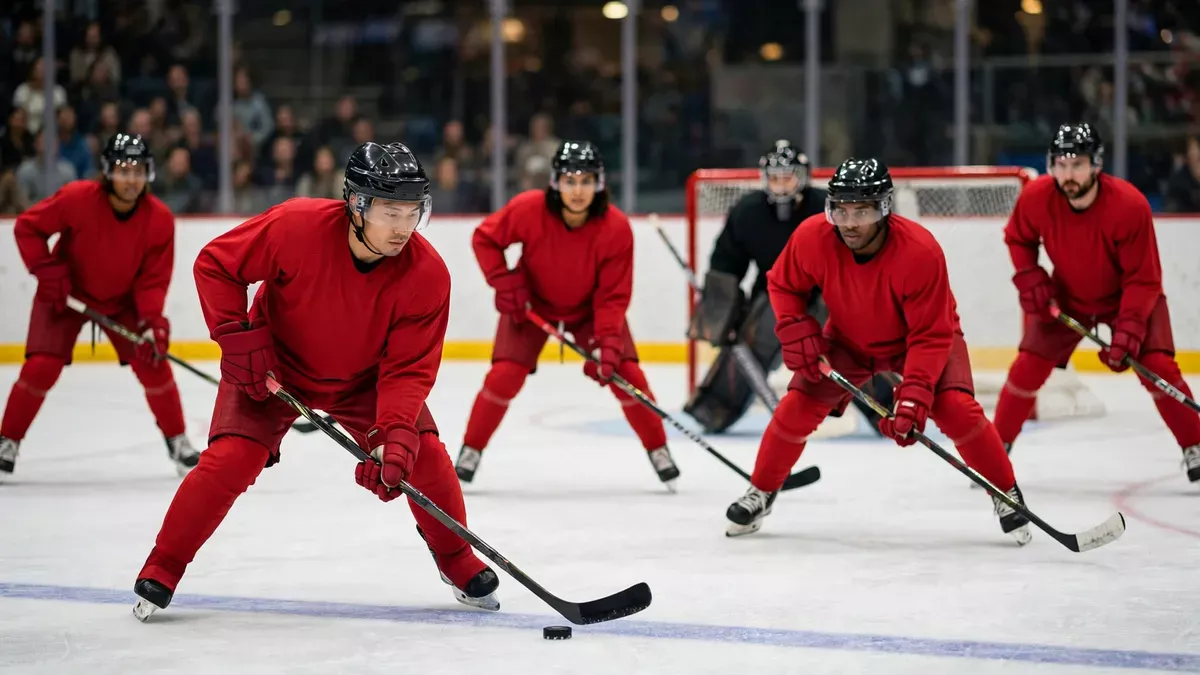
A power play is the manpower advantage one team gets when an opponent is penalized: the penalized player sits in the penalty box, his team skates a man short, and the other team attacks with an extra skater — usually 5-on-4 for two minutes on a minor penalty, or for a full five minutes on a major. The shorthanded team’s answer is the penalty kill, a four-man defensive unit whose job is to block lanes, clear the puck and burn the clock until the penalty expires. Together, power play and penalty kill are hockey’s special teams, and they decide an outsized share of games.
Almost every rule a new fan finds strange — players serving time in a box, teams allowed to ice the puck freely, a goal ending a penalty early — lives inside this one mechanism. This guide explains how penalties create power plays, the different kinds of penalties and how long each lasts, how both special-teams units set up, and the quirks — 5-on-3s, delayed penalties, pulled goalies — that make special teams the most tactical minutes in hockey.
Key Takeaways
- A penalty sends a player to the box and his team plays shorthanded; the opponent’s advantage is the power play.
- A minor penalty lasts two minutes but ends immediately if the power-play team scores. A major penalty lasts a full five minutes of power-play time no matter how many goals are scored.
- Two penalties at once can create a 5-on-3, the most dangerous situation in hockey; teams never skate with fewer than three skaters plus the goalie.
- The penalty kill defends with four skaters in a box or diamond, and shorthanded teams may ice the puck without penalty — their main escape.
- On a delayed penalty, the team about to get the power play pulls its goalie for an extra attacker, because play will stop the moment the offending team touches the puck.
How a penalty creates a power play
When a referee calls a penalty, the offending player leaves the ice and sits in the penalty box for the length of the call, and — unlike soccer or basketball — his team cannot replace him. Play continues a man down. Most penalties come in two basic sizes:
- Minor penalty (2 minutes). The everyday call: tripping, hooking, slashing, holding, interference, high-sticking that draws no blood and dozens more. The shorthanded team gets its player back the instant the power-play team scores, which makes the minor a race: score once and the punishment ends.
- Major penalty (5 minutes). Reserved for more dangerous fouls, most often fighting and severe versions of fouls such as boarding or checking from behind. The full five minutes run no matter how many goals the power play scores, so a major is the most damaging standard call in the sport.
- Misconduct (10 minutes). The player sits for ten minutes, but his team does not play shorthanded — a teammate serves nothing and the team replaces him on the ice. A game misconduct ejects the player for the rest of the game, with the team again able to replace him unless the foul itself drew a minor or major as well.
- Match penalty. An ejection for a deliberate attempt to injure, paired with a five-minute major that a teammate serves in the box.
Two special cases matter. If the goalie is penalized, he never leaves the net — a teammate who was on the ice serves the time instead. And if a foul takes away a clear scoring chance on a breakaway, the referee can award a penalty shot instead of a power play, as our guide to NHL overtime and the shootout explains in the shootout context.
The common setups
| Situation | On the ice | How long it runs |
|---|---|---|
| Standard power play | 5 skaters vs 4 | 2:00 (minor) — ends on a goal; 5:00 (major) — runs in full |
| Two-man advantage | 5 vs 3 | Until a goal, or until the first penalty expires |
| Shorthanded odd case | 4 vs 4 or 3 vs 3 | Coincidental penalties or overtime reduce both teams |
| Penalty kill | 4 skaters + goalie | Survive, clear the puck, change lines, repeat |
A power-play unit usually deploys four forwards and one defenseman in an umbrella: the defenseman or a forward at the top point, two shooters on the flanks, a bumper in the middle of the slot, and a net-front forward screening the goalie. The kill answers with a box that collapses toward the net or a diamond that pressures the point.
Anatomy of a power play
A good power play is a passing machine built to produce one thing: a shot the goalie has to move to see. The unit enters the zone with control, sets up in formation, and then works the puck quickly from side to side, hunting for the seam pass across the middle of the ice that forces the four killers and the goalie to slide. Point shots come with the net-front forward screening the goalie’s eyes and two sticks waiting for deflections and rebounds.
Power plays are judged by percentage — goals divided by opportunities — and the whole league lives in a fairly narrow band, which is why a two-goal night on the power play is a headline. Coaches run two units, a first group of stars and a second of complementary pieces, and each unit gets roughly a minute before fresh players come over the boards. The positions those units use are variations on the standard five skaters described in our guide to hockey positions.
Anatomy of a penalty kill
The kill’s job description is shorter: survive. Four skaters protect the middle of the ice, take away the cross-ice pass, block shooting lanes with sticks and bodies, and the moment they win the puck they fire it the length of the ice — legally, because shorthanded teams are exempt from icing, as our icing guide explains. Every clear forces the power play to skate back, regroup and re-enter, burning 15 or 20 seconds each time.
Killers change in waves: a forward pair pressures up ice, then sprints off mid-kill when a clear gives them the chance. Aggressive kills chase the puck carrier to deny setup time; passive kills sit in a tight box and dare the power play to shoot through traffic. And the kill’s last layer is the one coaches call their best penalty killer: the goaltender, who has to read shots through his own screen of defenders. Killers also score more often than you’d expect — a shorthanded goal, scored while down a man, is one of the sport’s great momentum swings, often coming from a blocked shot that springs a breakaway the other way.
5-on-3s, delayed penalties and other quirks
Stack two penalties and the sport’s most lopsided scene appears: the 5-on-3. The attacking team surrounds three skaters and a goalie, moves the puck around the outside and usually scores or comes close enough that the threat alone warps the game. If a third penalty is called while a team is already down to three skaters, it waits — no team ever skates below three skaters, so the extra penalty’s clock does not start until one of the current ones ends or a goal is scored.
The delayed penalty produces hockey’s strangest tableau. When a referee raises his arm for a penalty but the non-offending team keeps the puck, play continues until the offending team touches it — so the team about to go on the power play sprints its goalie to the bench for a sixth attacker, playing keep-away with an empty net behind them, sometimes scoring before the whistle ever blows. If they do score, a minor penalty is wiped out entirely; the goal counts as the punishment. Late in games, teams trailing by a goal combine both tricks — pulling the goalie during a power play for a 6-on-4 — which is part of the endgame chess our guide to how NHL standings work shows mattering so much in tight playoff races. In the playoffs, one more wrinkle: there are no shootouts, so overtime is 5-on-5 sudden death and power plays there can end a series in a heartbeat.
Power Play FAQ
How long is a power play in the NHL?
Two minutes for a minor penalty — but it ends early the moment the power-play team scores. A major penalty gives a full five minutes of power-play time regardless of goals scored.
What is the difference between a minor and a major penalty?
A minor (2 minutes) covers most everyday fouls and ends on a power-play goal. A major (5 minutes) covers fighting and the most dangerous fouls and runs its full length even if the power play scores several times.
Can a team be down two players at once?
Yes — overlapping penalties create a 5-on-3. But no team ever drops below three skaters plus the goalie; additional penalties are served one after another.
Why can the shorthanded team ice the puck?
Penalty-killing teams are exempt from icing. Firing the puck down the ice is their main way to relieve pressure and change players, and the exemption is part of the penalty’s design.
What is a delayed penalty?
When the offending team doesn’t have the puck, the referee signals the penalty but lets play continue until that team touches the puck. The other team uses the free time to pull its goalie for an extra attacker.
What is a shorthanded goal?
A goal scored by the team killing a penalty. They are uncommon, dramatic, and often turn a game — the team that was being punished scores instead.
Related reading
Follow the league on our NHL hub, scores page, schedule and standings — and learn the rule that penalty killers rely on most in our guide to icing.
Corrections: if you spot an error in this guide, tell us through our Corrections Policy page and we will check it against official sources.