
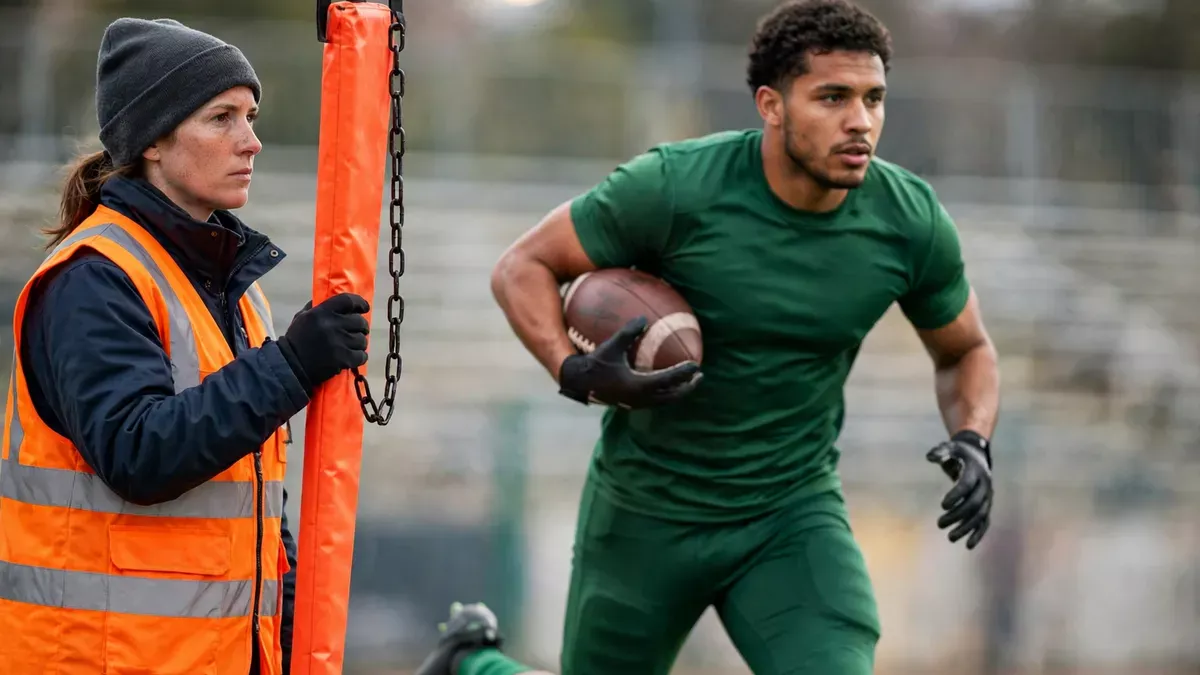
A first down is American football’s reset button: an offense has four downs (plays) to advance the ball at least 10 yards, and if it succeeds, it earns a new set of four downs and keeps driving. The point the offense must reach is the line to gain, measured by the chain crew on the sideline, and the ball’s official position after each play — the spot — is what decides whether the line was reached. Fail to gain the 10 yards in four downs and possession flips to the defense, right where the drive died.
This guide explains the whole mechanism for new fans: downs, the line of scrimmage, how the chains work, measurements, goal-to-go situations, and the rulings that decide inches — forward progress, the spot after a penalty, and why the ball is placed where it is.
Key Takeaways
- An offense gets 4 downs to advance 10 yards; reaching the line to gain earns a fresh set of downs (“first-and-10” again).
- The chain crew marks the line to gain with a 10-yard chain between two rods; the down box shows the current down.
- The ball’s spot is set by forward progress — where the ball was when the runner was stopped going forward.
- Inside the defense’s 10-yard line, it’s “goal-to-go”: the line to gain is the goal line itself.
- Penalties move the ball and can create or erase first downs (including automatic first downs for some defensive fouls).
- A failed fourth-down attempt turns the ball over on downs at the spot.
Downs: four plays to gain ten yards
Every possession begins with first-and-10: first down, 10 yards to go. The offense runs a play; wherever that play ends becomes the new spot, and the count updates — gain six yards and it’s second-and-4; lose two and it’s third-and-12. The notation always reads down & distance: the down you’re on, and the yards remaining to the line to gain.
Reach or cross the line to gain at any point and the series restarts at first-and-10 from the new spot (unless the line to gain was the goal line — then it’s a touchdown). Miss it after fourth down and the drive is over: the defense takes possession at the spot, a turnover on downs. This four-play economy is the sport’s strategic heartbeat. First downs are time and territory; teams track them like a currency, because every conversion extends a drive, rests your defense, and pushes the opponent’s offense further from its own.
The play clock gives the offense 40 seconds (25 after certain stoppages) to snap the ball between downs, so the whole system ticks at a defined rhythm.
The line of scrimmage and the spot
The line of scrimmage is the imaginary line across the field where the ball sits before the snap; the offense lines up behind it, the defense beyond the neutral zone (the ball’s length) on the other side. When a play ends, officials spot the ball where the play’s progress ended:
- Forward progress: a runner’s down is judged at the furthest point the ball reached while the runner was moving forward under his own momentum before being driven back — a rule that rewards runners for ground earned and prevents defenses from dragging ballcarriers backward for cheap yardage.
- Out of bounds and the goal line: a runner stepping out stops progress at that point (and stops the clock in the late-game situations where that matters); the ball breaking the plane of the goal line — any part of it crossing, in possession — is a touchdown regardless of where the player’s body is.
- Completed catches: the spot is where the receiver secures the ball and is down, unless he runs after the catch — then it’s where the run ends. On an incomplete pass, the ball returns to the previous spot and the down is spent with zero yards gained.
Sub-inch spots happen constantly, and they’re judgment calls the chain measurement then verifies.
The chains: how the line to gain is marked
The chain crew — officials working the sideline — operates three pieces of equipment. Two rods mark the ends of a 10-yard chain: one at the ball’s position when the series began, the other at the line to gain. A third marker, the down box, stands at the current line of scrimmage and displays the down number.
When a play ends close to the line to gain and the officials cannot be certain by eye, they call for a measurement: the chain is carried onto the field, stretched from the spot of the series’ start, and the ball’s position is compared to the far rod. In the NFL, the ball is measured against the chain with the rods set precisely — if any part of the ball crosses the plane of the rod, it’s a first down. Measurements are few in the replay era (the spot itself is reviewable), but they remain the sport’s best theater of inches.
On television you see this system rendered digitally: the yellow line is the line to gain, the blue line the line of scrimmage — broadcast graphics now so standard that new fans learn the geometry from them before they ever notice the actual chain crew.
Goal-to-go, and when ten yards isn’t ten yards
If a first down is earned inside the defense’s 10-yard line, the offense cannot gain another first down by yardage — there isn’t room. The series becomes first-and-goal: the line to gain is the goal line, and the offense has its remaining downs to score a touchdown or settle for a field goal. Broadcast notation switches accordingly (“2nd & goal at the 4”).
Penalties rewrite distances constantly. Offensive fouls (holding, false start) move the ball back and replay the down; defensive fouls move it forward, and several carry an automatic first down — defensive holding and roughing the passer among them — which can rescue a stalled drive without the offense gaining a yard. A half-the-distance rule applies near the goal lines: penalties inside a team’s own territory near its end zone are enforced as half the distance to the goal rather than the full yardage.
Why first downs run the sport
Statistically, first downs correlate with scoring better than almost any volume stat, because they’re compound interest: each conversion adds plays, and plays are scoring chances. Third-down conversion rate is the famous clutch stat, fourth-down decisions are the analytics era’s loudest argument (go, and risk the turnover on downs, or punt and trust field position), and “moving the chains” remains the plainest description of offensive control. When you hear that a team “couldn’t stay on the field,” this is the mechanic underneath it — four plays, ten yards, again and again until somebody fails.
First down FAQ
How many yards do you need for a first down?
10 yards from where the series started — or the goal line, if that is closer (goal-to-go).
What does “3rd & 7” mean?
Third down, with 7 yards remaining to reach the line to gain.
What is a turnover on downs?
Failing to reach the line to gain on fourth down: the other team takes possession at the spot where the play ended.
Can a penalty create a first down?
Yes. Several defensive fouls carry an automatic first down, and any penalty that moves the ball across the line to gain also earns one.
What is forward progress?
The spot where a ballcarrier’s forward momentum was stopped — the ball is placed there even if the defense then pushed him backward.
Why do officials still measure with chains?
Because the chain is the precise reference for the line to gain. Replay reviews the spot; the measurement verifies the distance against it.
Related reading
New to the sport? Pair this with our guides to how the NFL playoffs work (/how-the-nfl-playoffs-work-seeding-byes-and-home-field-advantage-explained/) and NFL overtime (/how-nfl-overtime-works-and-why-the-rules-changed/), then follow live drives on our NFL scores page (/nfl/scores/) and the NFL hub (/nfl/).
Corrections: if you spot an error in this guide, tell us through our Corrections Policy (/corrections-policy/) page and we will check it against official sources.