
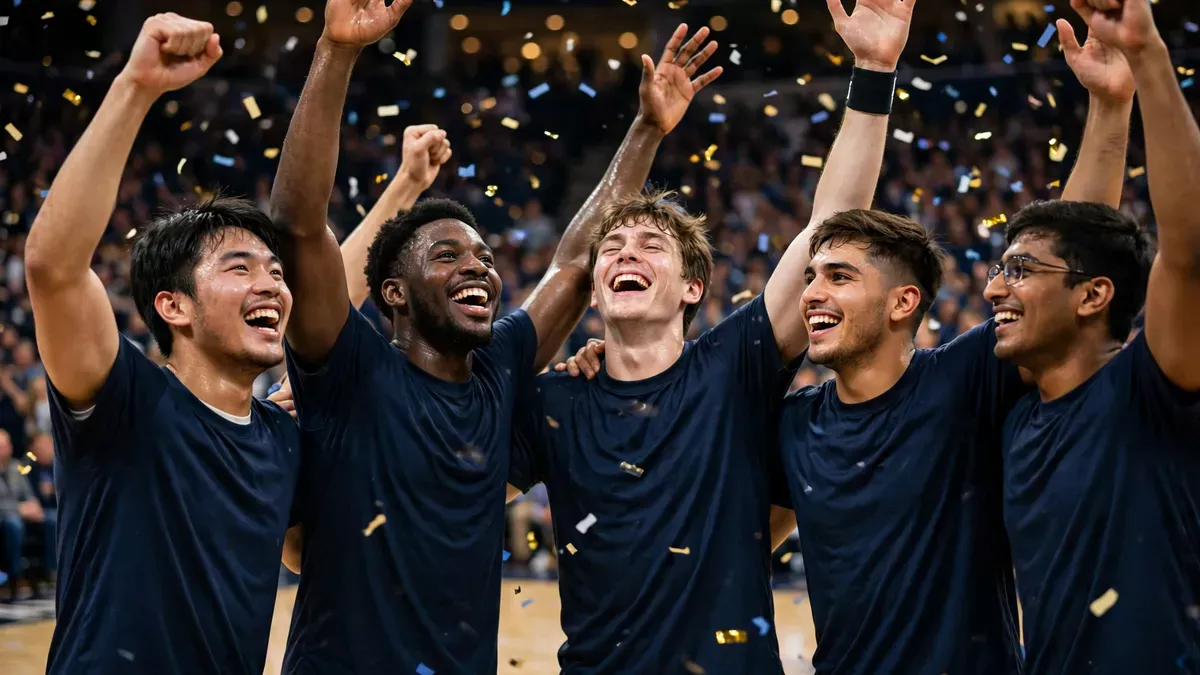
March Madness is engineered for upsets. Start with single elimination — one bad night ends a season, where the NBA gives a better team seven games to assert itself. Add a 40-minute game on a 30-second clock: roughly 65–70 possessions per team instead of the NBA’s 100, so the favorite gets far fewer chances for its superiority to average out. Layer on the three-pointer, the game’s great variance machine — an underdog that shoots 12-for-24 from deep can outscore a better team that shoots 5-for-24, and four days of scouting cannot legislate hot hands. Then remove home court (neutral sites), mix in matchup-specific styles (a veteran mid-major’s zone or press against a freshmen-heavy favorite), and add the emotional asymmetry: the favorite plays with the pressure of a season’s expectations, the underdog with house money. The result is statistical and eternal: 12-seeds beat 5-seeds about a third of the time historically, 15-seeds have beaten 2-seeds around ten times, and 16-seeds have done it twice — UMBC in 2018 and Fairleigh Dickinson in 2023. This guide explains each ingredient of the chaos.
Key Takeaways
- Single elimination + short games = variance: ~67 possessions is too few for the better team to be safe, every single night.
- The three-pointer is the underdog’s equalizer: high-volume, high-variance shooting lets lesser talent outscore better talent for 40 minutes.
- Seeds cluster quality imperfectly: the 5–12 and 6–11 bands are closer in true strength than the seed gap suggests, which is why those lines produce the famous upsets.
- Neutral courts strip the favorite’s home edge (though early rounds are often placed near top seeds), while underdog-friendly crowds adopt the little guy by halftime.
- Style matchups matter more in one game: slow tempos shorten the game further; zones and presses attack specific favorite weaknesses.
- The 16-over-1 barrier fell twice (UMBC 2018, FDU 2023) — proof the tail event exists, not that it became common.
The math: fewer possessions, bigger swings
Upsets are, at bottom, a sample-size story. A team that wins 60 percent of its possessions’ value against an opponent will almost always win a long series and will usually win a long game — but basketball’s college format is neither. With ~67 possessions per side and a 30-second clock, a favorite’s edge might be worth, in expectation, six to nine points; the standard deviation of a single game’s margin is larger than that. Now inject the three-pointer’s variance: a team attempting 30 threes faces a realistic swing of ±15 points from shooting luck alone across that sample. The underdog doesn’t need to be better — it needs the night’s distribution to land in its tail once, in a format with no tomorrow to restore order. The NBA playoffs show the control condition: the same sport in best-of-seven over 48-minute, 24-second-clock games produces favorites advancing at rates that would bore a bracket pool. March chooses the other trade, deliberately, and the “madness” is the invoice.
The bracket’s soft spots
Certain seed lines upset so regularly they have folklore. 12 over 5 is the signature: the 12 lines are typically strong mid-major champions or battle-tested at-large teams, the 5 lines often power-league teams whose résumés outran their form — the true talent gap is frequently one or two possessions, and 12-seeds have historically won roughly one in three. 11 over 6 runs similarly hot, and 11-seeds own a habit of not stopping (multiple 11s have reached the Final Four). 10 over 7 barely counts as an upset at all. The converse end is nearly sealed: 1-seeds have lost only twice in the first round in tournament history — UMBC’s 74–54 rout of Virginia in 2018 (as roughly a 20-point underdog, still the standard for the genre) and Fairleigh Dickinson’s defeat of Purdue in 2023, won by the shortest team in the field against the tallest player in the country, as if scripted to demonstrate that matchup chaos beats raw quality on the right night. Between those poles, the committee’s seeding imperfections — mid-majors underseeded by résumé arithmetic — add a few extra points of upset fuel annually.
Style and the shortened game
Underdog coaches who win these games usually shrink them. A slow, grinding tempo (58 possessions instead of 70) cuts the favorite’s sample further; a packed zone dares a cold shooting night to become an elimination; a relentless press attacks a favorite whose backup point guard is a freshman. Veteran roster construction is the quiet weapon: the classic giant-killer is a senior-laden mid-major champion that has played 100 games together, facing a power team whose two best players are 19 and will be professionals in June. The portal era has redistributed experience downward less than expected — power teams now buy veterans too — but cohesion gaps remain real in March, when two days of practice separate strangers from systems. Add foul variance (a favorite’s center picks up two whistles in four minutes under the five-foul college rulebook) and neutral-crowd adoption — 15,000 neutrals roaring for the 14-seed by the under-eight timeout, a real physiological wind — and an upset stops being a mystery and becomes an accumulation of small tilts, any three of which can coincide on a Thursday afternoon.
What favorites do about it
The sport’s best coaches treat the first weekend as variance management: they slow nothing down but systematize everything — set defenses that concede nothing in transition, lineups that avoid foul exposure for irreplaceable players, and a ruthless refusal to play the underdog’s tempo. They also prepare for the specific mid-major on the line rather than the generic bracket, because the fatal scouting report in March is the one written for the team you expected to play. Even perfect process buys probability, not certainty: the tournament’s economics depend on it. The upsets fill the highlight reels, bust the brackets by Friday night, and — as the next piece in this series explores — occasionally compound into the multi-week runs that give the event its fairy tales.
March Madness upsets FAQ
What is the most common March Madness upset?
The 12-seed over the 5-seed: historically, 12-seeds win roughly a third of those games. 11-over-6 is close behind, and 11-seeds have produced multiple Final Four runs.
Has a 16-seed ever beaten a 1-seed?
Yes, twice: UMBC beat Virginia in 2018 (the first, by 20 points) and Fairleigh Dickinson beat Purdue in 2023. Those are the only two in the history of the 64-plus-team era.
Why doesn’t the NBA have upsets like this?
Sample size. Best-of-seven series over longer games with shorter clocks give the better team hundreds more possessions to prove it. Single-game, 40-minute college basketball maximizes variance by design.
What is the biggest upset in tournament history?
UMBC over Virginia in 2018 is the standard answer: a 16-seed, roughly a 20-point underdog, winning by 20 — the largest seed upset, executed as a blowout.
Which round has the most upsets?
The first round, by construction: 32 games, the widest seed gaps that still involve plausible winners (5–12 through 8–9), and the freshest underdogs.
Do upsets mean the seeding was wrong?
Sometimes — underseeded mid-majors are a real artifact — but mostly they mean variance happened. A team can be correctly seeded and correctly beaten on a night when the threes fell the other way.
Related reading
The structure that manufactures these nights is our March Madness pillar, and the fairy-tale runs they grow into are the subject of the next guide in our College Basketball hub.
Corrections: if you spot an error in this guide, tell us through our Corrections Policy page and we will check it against official sources.