
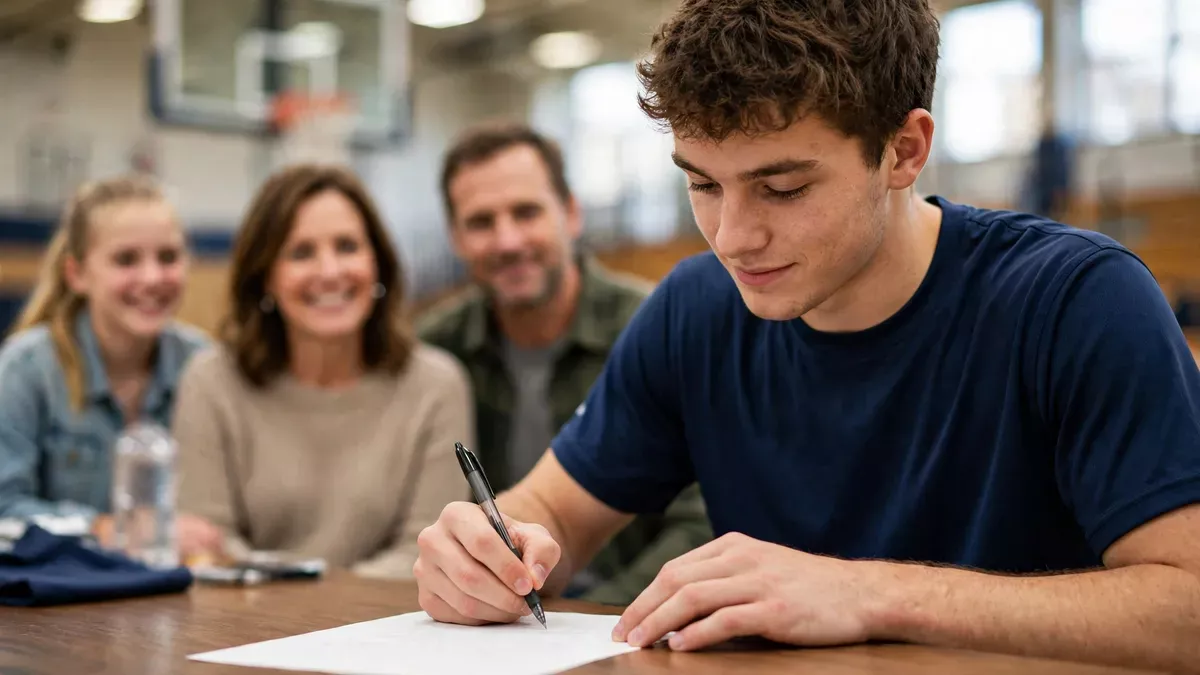
College basketball recruiting is a year-round talent market with its own calendar, its own scouting economy and two signing periods. Coaches may first contact recruits directly on June 15 after their sophomore year of high school; the sport’s real evaluation arenas are the spring and summer shoe-company circuits — Nike’s EYBL, the Adidas and Under Armour circuits — where the top prospects in each class play in front of every major staff during designated live periods. Recruiting services (247Sports, On3, Rivals and ESPN) rank each class; roughly the top 25 or so players earn five-star status. Recruits take official visits (paid by the school, now effectively unlimited) beginning in their junior year, commit verbally whenever they choose — non-binding — and make it real by signing a financial aid agreement (the document that replaced the National Letter of Intent in 2024) during the one-week early signing period in November or the regular period in the spring. Layered over all of it now sits the transfer portal: most rosters are rebuilt annually from both pipelines. This guide walks the full cycle.
Key Takeaways
- First permissible direct contact: June 15 after a prospect’s sophomore year; offers and rankings heat up through the junior-year AAU season.
- The shoe circuits (EYBL and its rivals) are the evaluation core — live periods in spring and summer let college coaches watch prospects against elite competition.
- Rankings matter for visibility: five-stars are roughly the top 25 in a class; the McDonald’s All American Game is the showcase honor.
- Official visits begin in the junior year and are no longer meaningfully capped; verbal commitments bind no one.
- Signing: an early period in mid-November (where most top recruits sign) and a regular period running mid-April to mid-May; players sign financial aid agreements, the NLI’s successor.
- The portal now shares the market: coaches weigh a proven 21-year-old transfer against an 18-year-old freshman for every roster spot.
The calendar and the circuits
Basketball recruiting runs on two interleaved calendars: the scholastic season (high school ball, November–March, with June “scholastic live periods” where coaches evaluate players with their high school teams at approved events) and the grassroots season (AAU/travel ball, spring and summer), which the shoe companies industrialized. Nike’s Elite Youth Basketball League — the EYBL, culminating in the Peach Jam — plus the Adidas 3SSB and Under Armour Association circuits form a de facto national league of the best 15-to-17-year-olds, playing compressed weekends in front of bleachers of college coaches during NCAA live (evaluation) periods, mostly in April and July. Outside live periods, coaches rely on film, high school games and the recruiting services. The June 15-after-sophomore-year contact date triggers the modern ritual of midnight calls and the first wave of offers; by a prospect’s junior summer, serious programs have watched him dozens of times. International recruiting runs in parallel — European academies, FIBA youth events and Australian pathways feed a growing share of rosters — and prep-school reclassification (a player moving up or down a graduating class) lets elite prospects tune their arrival year, a maneuver essentially unique to basketball.
Rankings and the star system
The services rank classes nationally (top 150 for the major outlets), and the star ladder mirrors football’s: five stars for roughly the top 25–30 players, four stars through the top ~100–150, three stars for the next tier. But basketball rankings compress probability differently: in a five-man sport, the top of the class is disproportionately destined for one-and-done stardom, so the top 10 carries outsized weight — a single five-star commitment remakes a program’s season and its coach’s security. Showcase rosters certify the elite: the McDonald’s All American Game (24 selections), the Jordan Brand Classic and Nike Hoop Summit function as the class’s public summit. Rankings still guarantee nothing about college production — the sport’s history is littered with anonymous three-stars who became All-Americans — but they structure the market: they decide which AAU games coaches attend, which prospects get the June 15 calls, and which fan bases melt down on commitment day. For the money now attached to those commitments, our NIL guide covers the deals layered on top.
Visits, offers and commitments
The official visit — school-paid travel, lodging and hosting, up to 48 hours on campus — opens in the prospect’s junior year under current rules, and the old five-visit cap has been lifted in the modern deregulated framework (men’s basketball recruits may now take unlimited official visits, with schools managing their own budgets). Unofficial visits (family-paid) can happen almost any time. Unofficial and official visits alike are scripted productions: open-gym runs with the current team (the true evaluation — for both sides), facility tours, academic pitches and, in the NIL era, collective meetings that amount to compensation conversations conducted within the rules’ evolving limits. A verbal commitment announces a choice and stops nothing: rival staffs keep recruiting committed players (the sport’s open secret), and decommitments spike every autumn as coaching changes and portal math reshuffle depth charts. Only the signed aid agreement settles anything — and as in football, the agreement the player signs is now a financial aid/scholarship agreement under the post-2024 framework that retired the NLI; generally it binds the school to the scholarship while rules govern the player’s exit routes.
The two signing periods
Basketball’s signature quirk is its November early signing period: a one-week window early in the senior-year season when the majority of top-100 recruits sign, choosing certainty before their final high school season. The regular signing period runs from mid-April to mid-May, serving late bloomers, decommitments, spring coaching-change refugees — and programs holding scholarships open deliberately for the transfer portal, whose spring window overlaps it. That overlap has inverted roster strategy: where staffs once filled every spot by November, many now sign two or three freshmen and keep flexibility for April, when proven college players move. Junior-college recruiting, once a major pipeline, has thinned as the portal absorbed its role. The end product of all these windows is a sport in which a roster can turn over half its names in a single spring — and in which recruiting rankings in November predict the following March less reliably than at any time in the sport’s history.
Basketball recruiting FAQ
When can basketball coaches contact recruits?
Direct recruiting contact (calls and messages) is permitted starting June 15 after the prospect’s sophomore year of high school. Questionnaires and camp materials can arrive earlier.
What is the EYBL?
Nike’s Elite Youth Basketball League — the premier grassroots (AAU) circuit for elite 15-to-17-year-olds, finishing with the Peach Jam. Adidas and Under Armour run rival circuits.
When do basketball recruits sign?
During the early signing period — one week in mid-November of senior year — or the regular period from mid-April to mid-May. Players sign financial aid agreements, which replaced the National Letter of Intent in 2024.
How many five-star recruits are there in basketball?
Roughly the top 25–30 players per class, depending on the service. In a five-player sport, a single five-star changes a program more than any single football recruit can.
What is reclassifying?
A prospect changing his designated graduating class — up (arriving at college a year early) or down (adding a developmental year) — common among elite prep-school players to tune age, exposure and draft timing.
Do recruiting rankings decide who gets offers?
No — staffs make their own evaluations, especially on the circuits. Rankings follow and amplify the market; they influence attention and fan expectations more than coaches’ boards.
Related reading
The college-football counterpart of this process is our football recruiting guide, and the destination these recruits dream about is March Madness — follow signing classes on our College Basketball hub.
Corrections: if you spot an error in this guide, tell us through our Corrections Policy page and we will check it against official sources.