
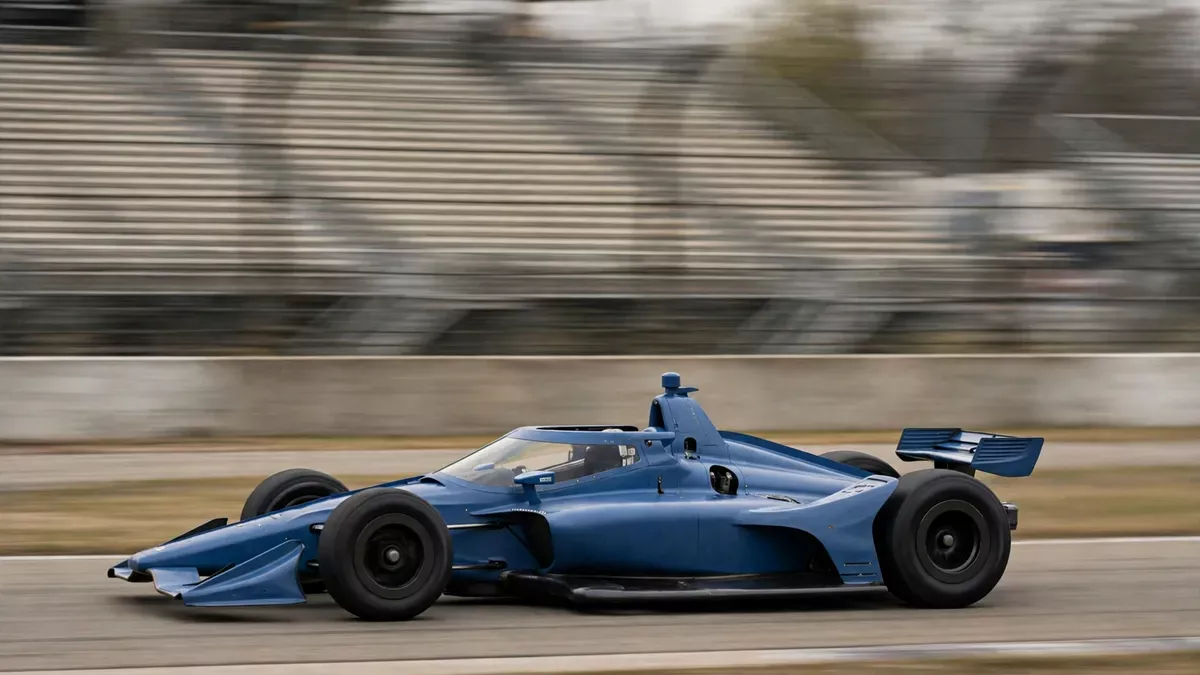
IndyCar is America’s top open-wheel racing series, and it is the only major championship in the world that races on three completely different kinds of track in a single season: high-speed ovals, temporary street circuits through city centers, and permanent road courses. The same cars and drivers contest all of them, and the championship goes to the driver who scores the most points across the whole season — there is no playoff, no reset, and no double-points finale. The 2026 season ran 18 races from March to September, split evenly with six ovals, six street courses and six road courses, and that three-way mix is what makes IndyCar different from every other series on the calendar.
It is also a series built for close racing. The cars are near-identical in their chassis, the engines come from just two manufacturers, and the points table pays every starter, so a driver who finishes mid-pack every week can still matter in the standings. This guide explains the championship, the three kinds of track, the cars, a race weekend, the points system, and the strategy — pit stops, push-to-pass and fuel saving — that decides races.
Key Takeaways
- IndyCar is a single championship contested on ovals, street circuits and road courses — six of each on the 2026 calendar, 18 races in all.
- There is no playoff and no points reset. Every race counts equally toward one season-long total, and the champion is the driver with the most points after the final race.
- A race win pays 50 points on a scale that runs down to 5 points for every starter, with bonus points for pole position, leading a lap and leading the most laps — a maximum of 54 points per race.
- Qualifying changes with the track: three knockout segments on road and street courses, a two-lap solo run on ovals, and a unique four-lap format at the Indianapolis 500.
- Push-to-pass, a temporary horsepower boost, is available on road and street courses only — never on ovals — and from 2026 it can be used from the moment the green flag falls.
The championship: one table, no playoff
The NTT IndyCar Series is the top level of American open-wheel racing, sanctioned by IndyCar and owned by Penske Entertainment. Unlike NASCAR, which resets the standings for a playoff, IndyCar runs a straight season-long championship: points earned in March count exactly the same as points earned in September, and the driver with the most points when the final race ends takes the Astor Challenge Cup as champion. The 2026 season was the 115th official championship season of American open-wheel racing, and Álex Palou won his fifth title in six seasons — his fourth in a row — with one race to spare.
That simplicity shapes how drivers race. There is no “win and you’re in” shortcut, and there is no safety net for a bad stretch. Consistency matters as much as winning: a driver who finishes in the top five every week can beat a driver who wins three races and crashes out of three more. It also means the title fight can be decided before the finale — a driver clinches the moment the points still available can no longer overhaul his total — or go down to the last laps of the last race, as it did in 2026 when the championship was settled at Laguna Seca.
There is also a manufacturers’ championship, contested by the two engine suppliers, Chevrolet and Honda. The top two finishing cars for each manufacturer in every race score points toward it on the same scale as the drivers’ table, with a race win worth five bonus points for the manufacturer and a pole position worth one. Honda won the 2026 Manufacturers’ Cup. A Rookie of the Year is named each season, and there are separate discipline titles for the best oval driver and the best road-course driver.
Three kinds of track
No other top series asks its drivers to be good at three different disciplines, and the calendar is built around the contrast.
| Track type | What it is | 2026 count | What it rewards |
|---|---|---|---|
| Oval | A closed loop, usually 1 to 2.5 miles, run at full speed | 6 | Drafting, nerve, car control at 220 mph and more |
| Street circuit | A temporary course through city streets, lined with walls | 6 | Precision, braking, surviving contact |
| Road course | A permanent circuit with left and right turns, elevation and runoff | 6 | Versatility, rhythm, setup range |
Ovals are IndyCar’s signature. The cars run inches apart at speeds approaching 240 mph at Indianapolis, drafting in packs where a tow from the car ahead can be worth several miles per hour. The smallest ovals, like the 1.25-mile World Wide Technology Raceway at Gateway, run 260 laps and 325 miles under the lights, while Indianapolis is a 2.5-mile rectangle where the race lasts 500 miles. Oval racing is a team sport in a different sense: the draft means drivers work together in lines, and a driver who loses the draft can fall back in seconds.
Street circuits are the opposite: tight, bumpy, unforgiving, with concrete walls instead of runoff. St. Petersburg opens the season on the streets of a Florida waterfront city, and Long Beach and Detroit are long-standing stops. There is nowhere to make a mistake — a brushed wall ends a qualifying lap or a race — so street races reward the drivers who can brake late and place the car within inches, lap after lap.
Road courses sit between the two. Purpose-built circuits such as Road America, Mid-Ohio and Laguna Seca have elevation changes, fast sweepers and slow hairpins, and they reward the all-round driver: the one who can carry speed through a long corner and still brake deep into a tight one. Because the calendar is split evenly, a champion has to be fast everywhere. A driver who dominates on ovals but struggles on street circuits will not win the title.
The cars and the engines
Every car on the grid uses the same Dallara chassis, which is why the series is often called a “spec chassis” formula — but it is not a spec series. Teams build their own dampers, choose their own setups and develop their own aerodynamics within a shared rulebook, and the engines come from two manufacturers: Chevrolet and Honda. Each is a 2.2-liter twin-turbocharged V6, paired with a hybrid energy-recovery system added in 2024. Together the package produces around 700 horsepower, and the hybrid unit stores energy under braking and deploys it as an extra boost worth roughly 60 horsepower.
The cars look different from Formula 1 machines in one obvious way: they carry an aeroscreen, a ballistic windscreen in front of the driver, instead of the halo. The aeroscreen was introduced for driver protection and has become part of the car’s identity. On ovals the cars run low-downforce speedway wings; on road and street courses they run bigger wings for cornering grip. Tire supplier Firestone brings two dry compounds to road and street races — a harder primary tire with a black sidewall and a softer alternate with a red sidewall — and teams must use both compounds in a dry race. On ovals there is only one tire, and no choice to make.
The full-time grid is 25 cars — 10 teams running two or three cars each — and the field grows at the Indianapolis 500, where the tradition is a 33-car starting field. The series runs a charter system for full-time entries, and the Leaders Circle program pays guaranteed prize money to the top 22 entries in the entrants’ championship.
A race weekend, day by day
A standard IndyCar weekend is shorter and simpler than a Formula 1 weekend. Practice usually runs on Friday and Saturday, with qualifying on Saturday and the race on Sunday, though some events run on a compressed two-day schedule. In 2026, road and street practice followed a new pattern: a 40-minute session for the full field, followed by two 12-minute segments split by odd and even pit boxes, so every driver gets clean track time.
Qualifying is where the format splits by track type. On road and street courses it runs in three segments, much like Formula 1: the field is divided into two groups, each gets 10 minutes, and the fastest six from each group advance to a 12-car second segment; the fastest six from that session reach the Firestone Fast Six, which sets the front of the grid. In 2026 the groups were set by the qualifying results of the previous race, and on street circuits the Fast Six became a one-lap shootout — each driver gets a single timed lap, with the running order chosen by the fastest drivers from the previous segment. The pole winner earns a championship point.
On ovals other than Indianapolis, qualifying is a solo affair: each driver gets two warm-up laps and then two timed laps alone on track, and the combined time sets the grid. The qualifying order is set by entrant points, with the championship leader going last. At a double-header weekend — two races at the same track — the first timed lap sets the grid for race one and the second lap sets it for race two.
The Indianapolis 500 has its own qualifying format, covered in full in our guide to the Indianapolis 500 (/what-is-the-indianapolis-500/): four-lap runs over two days, with the average speed deciding the grid, and a Top 12 and Firestone Fast Six on the final day.
Push-to-pass and the hybrid
Push-to-pass is IndyCar’s overtaking aid, and it works differently from Formula 1’s old DRS. It is a button on the steering wheel that gives the driver a temporary horsepower boost from the engine — the driver can use it to attack or to defend, anywhere on the track, at any time within the rules. Two things about it matter for watching a race.
First, it only exists on road and street courses. Ovals get no push-to-pass at all: the 2026 rulebook lists allotments for road and street events only, so on an oval the only boost is the hybrid system, which drivers earn back lap by lap by lifting in the draft and regenerating energy under braking. Second, the allotment is limited. Each road or street event gives drivers a fixed total — 150 seconds at St. Petersburg, Detroit and Laguna Seca, 200 seconds at Barber, Mid-Ohio and Road America — and from 2026 the boost became available continuously from the moment the green flag falls, rather than only after a set number of laps. That means drivers can use it from the start, and the tactics are about when, not whether: spend it early to build a gap, or save it for the final laps when the car ahead is defending.
The hybrid adds a second layer. Because the energy has to be harvested before it can be spent, a driver who has been following closely and lifting in the draft may have more energy to deploy than the leader — which is one reason the closing laps of a road-course race often produce the best racing of the day.
Pit stops and strategy
IndyCar pit stops are among the fastest in motor sport. A routine stop changes four tires and adds fuel in a matter of seconds, and the crews are small — six crew members over the wall, compared with around twenty in Formula 1 — so the choreography is tighter and the margin for error smaller. A slow stop or a dropped wheel nut can cost a driver a dozen positions, and a perfectly timed one can win a race.
Strategy turns on three variables: fuel, tires and cautions. On road and street courses, the requirement to use both tire compounds forces at least one stop and creates the undercut and overcut — stopping early for fresh tires to gain track position, or staying out to have fresher rubber at the end. On ovals, fuel mileage is the king: a driver who saves fuel can stretch a stint by a lap or two, and a well-timed yellow flag can hand a race to a car that was about to pit anyway. The fuel window — the number of laps a car can run on a full tank — is the number every strategist on the pit stand is watching, and it is why the end of an oval race is often decided by who gambles on fuel and who does not.
Cautions shape races more in IndyCar than in Formula 1 because the field is so close. A yellow flag bunches the field and erases a leader’s gap; it also lets everyone pit at once, which can turn a race upside down in a single lap. The series uses a full-course yellow with the pace car, and restarts are single-file after the leader controls the pace to the green flag.
Points and how the title is decided
The points table is simple at the top and generous at the bottom: every driver who takes the start scores at least 5 points, and the winner takes 50.
| Finishing position | Points |
|---|---|
| 1st | 50 |
| 2nd | 40 |
| 3rd | 35 |
| 4th | 32 |
| 5th | 30 |
| 6th | 28 |
| 7th | 26 |
| 8th | 24 |
| 9th | 22 |
| 10th | 20 |
| 11th–25th+ | 19 down to 5 |
On top of that, three bonus points are available at every race: 1 point for winning the pole, 1 point for leading at least one lap, and 2 more points for leading the most laps. A perfect weekend — pole, win, most laps led — is worth 54 points. The Indianapolis 500 pays the same points as every other race: unlike some past seasons, 2026 ran no double-points races anywhere on the calendar, including the 500, so every one of the 18 races counted exactly the same toward the championship.
If two drivers finish the season level on points, the tie is broken by countback: the driver with more race wins ranks higher, and if that is still tied, more second places, then thirds, and so on down the results. The same countback applies to the manufacturers’ championship.
Why IndyCar feels different
Part of the appeal is the closeness. Because the chassis is shared and the engines are close in performance, the gaps are tiny: on a road course the whole field can be covered by little more than a second in qualifying, and on an oval the top ten can be separated by less than a second over two laps. That is why the racing looks the way it does — packs of cars, constant position changes, and finishes decided by fractions of a second. The 2026 Indianapolis 500 was won by 0.0233 seconds, the closest finish in the race’s history.
The other part is the variety. A driver who wins at St. Petersburg in March has to be just as good at Indianapolis in May and at Laguna Seca in September, on tracks that demand opposite skills. Formula 1 has one kind of circuit with different shapes; IndyCar has three kinds of racing in one championship. That is also why American fans talk about IndyCar drivers as the most complete racers in the sport — and why a driver who wins the title has beaten the field on every kind of track there is.
IndyCar FAQ
How many races are in an IndyCar season?
The 2026 season ran 18 races from March 1 to September 6: six ovals, six street circuits and six road courses. The calendar changes slightly from year to year, but the three-way split is the series’ identity.
How many points does an IndyCar race win pay?
50 points, on a scale of 50-40-35-32-30-28-26-24-22-20 for the top ten, with 5 points guaranteed to every starter. Bonus points for pole, leading a lap and leading the most laps can take a perfect weekend to 54.
Does IndyCar have a playoff?
No. There is no playoff and no points reset: every race counts equally toward one season-long total, and the champion is the driver with the most points after the final race.
What is push-to-pass?
A steering-wheel button that gives the driver a temporary horsepower boost. It is available on road and street courses only, in a fixed total per event (150 or 200 seconds), and from 2026 it can be used from the green flag onward. Ovals get no push-to-pass.
How is IndyCar different from Formula 1?
The cars use a shared chassis with two engine suppliers, the calendar mixes ovals, street circuits and road courses, and the championship is a straight points table with no constructors’ title for the teams — the manufacturers’ championship is contested by the engine suppliers. For the other side of the comparison, see our guide to how Formula 1 works (/how-formula-1-works/).
What is the biggest race in IndyCar?
The Indianapolis 500, run every May at Indianapolis Motor Speedway — 33 cars, 200 laps, 500 miles, and the largest single-day crowd in motor sport. It is explained in full in our guide to the Indianapolis 500 (/what-is-the-indianapolis-500/).
Related reading
More from our Motorsports hub (/motorsports/): the Indianapolis 500 explained (/what-is-the-indianapolis-500/), how Formula 1 works (/how-formula-1-works/), and the scores (/motorsports/scores/), schedule (/motorsports/schedule/) and standings (/motorsports/standings/) pages that follow the season round by round.
Corrections: if you spot an error in this guide, tell us through our Corrections Policy (/corrections-policy/) page and we will check it against official sources.