
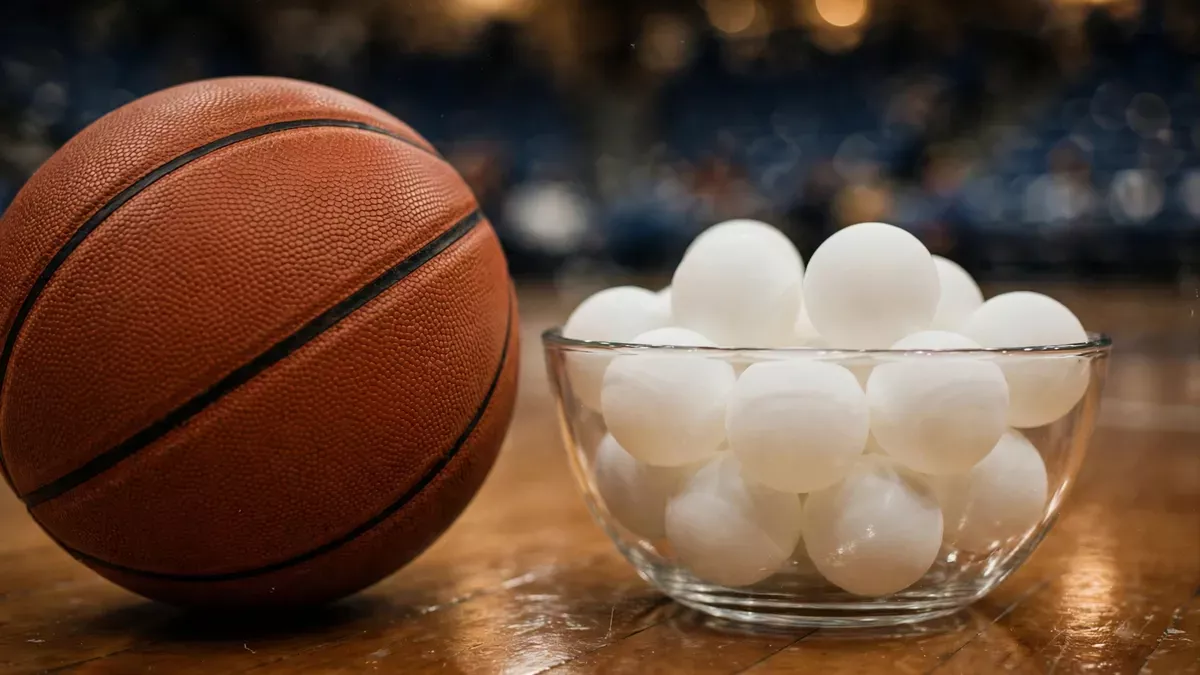
The WNBA Draft Lottery is the weighted draw that decides the first two picks of the WNBA Draft. Every team that missed the playoffs takes part, but the odds are not set by last season alone: they are based on each team’s combined record over the last two seasons, spread across 1,000 numbered combinations in a 14-ball lottery machine. Only two picks are actually drawn — the winners of the first two combinations take picks No. 1 and No. 2 — and every remaining team is then slotted by its two-year record, worst first, which guarantees the team with the worst two-year record can pick no lower than third.
This guide is the deep dive: why the league uses two years of results instead of one, how the combinations are allocated, what happens inside the drawing room, how ties and expansion teams are handled, and why traded picks make the lottery a spectator sport for teams that were not even bad. The wider draft — eligibility, rounds and rookie contracts — is covered in our guide to how the WNBA Draft works; here, it is all about the draw.
Key Takeaways
- Only teams that miss the playoffs enter the lottery — five teams for the 2026 draft, seven for the 2027 draft as the league has grown to 15 teams.
- Odds are based on each team’s cumulative record across the last two seasons — a system adopted in 2015 to make one year of tanking pointless.
- Each team is assigned a share of 1,000 four-number combinations, drawn from 14 balls numbered 1 to 14. The one combination left unassigned (11-12-13-14) triggers a redraw if it comes up.
- Only the No. 1 and No. 2 picks are drawn. The remaining lottery teams pick in order of their two-year records, worst first — so the worst team is guaranteed at least the No. 3 pick.
- Lottery picks can be traded, so a playoff team can hold a lottery slot. An independent accounting firm (Ernst & Young) oversees the drawing.
Why two years? The anti-tanking design
Most draft lotteries reward the single worst season. The WNBA deliberately does not. When the league adopted the current format in 2015, it shifted the basis of the odds to each team’s combined record over the two most recent seasons — so a team that wants the best odds has to be bad for two years, not one. A single deliberate dive barely moves your position, because your previous season’s wins count against you just as heavily as this season’s losses.
The design has a second effect fans feel every spring: it blurs the line between the lottery teams. A team that was poor two years ago and mediocre last year can carry better odds than a team that collapsed only last season, and the “worst team in the league” by last season’s standings does not automatically hold the most combinations. When the league announces the odds each fall, it publishes the two-year records alongside them — that combined column, not the final standings, is the one that matters. Those standings, season by season, are on our WNBA standings page, and the playoff race that decides who is in the lottery at all is laid out in our guide to how the WNBA season works.
The odds: 1,000 combinations, shared by record
The machine at the heart of the lottery holds 14 balls, numbered 1 through 14. Four balls drawn without regard to order make 1,001 possible combinations; 1,000 of them are assigned to the lottery teams in blocks, and one — 11-12-13-14 — is deliberately left unassigned. A team’s number of combinations is its odds: hold 420 of them and you have a 42 percent chance of winning each draw.
The blocks are allocated in proportion to the two-year records. In the original four-team format adopted in 2015, the split was 442, 276, 178 and 104 chances from worst record to best. As the lottery has grown — five teams for the 2026 draft, seven for 2027 — the same principle stretches across more teams. For the 2026 lottery, Dallas, with a combined 19-65 record across 2024 and 2025, held the most chances with 420. For the 2027 lottery (scheduled for November 15, 2026), Houston and Toronto top the table at 329 each — Toronto, an expansion team with only one season behind it, is judged on its 2026 record alone, and its .250 winning percentage matched Houston’s two-year mark; a head-to-head tiebreaker between the two means Houston can fall no lower than third and Toronto no lower than fourth.
| 2027 lottery (Nov 15, 2026) | Basis | Chances of 1,000 |
|---|---|---|
| Houston | 22-66 across 2025–26 | 329 |
| Toronto | 11-33 in 2026 (expansion team, one season) | 329 |
| Chicago’s pick (held by Washington) | 26-62 across 2025–26 | 161 |
| Seattle | 31-57 across 2025–26 | 93 |
| Portland | 17-27 in 2026 (expansion team, one season) | 52 |
| Los Angeles | 37-51 across 2025–26 | 24 |
| Phoenix’s pick (held by Los Angeles) | 43-45 across 2025–26 | 12 |
The draw itself: two picks, then the records take over
The ceremony most fans see — envelopes, logos, a televised reveal — is theater built on a short, heavily supervised procedure. In the drawing room, with a representative of the league’s independent accounting firm overseeing, the 14 balls are mixed and four are drawn. The team holding that combination gets the No. 1 pick. (If the unassigned combination comes up, it is discarded and drawn again.) The balls go back in, the machine mixes again, and a second combination is drawn for the No. 2 pick; if the second draw produces a combination belonging to the team that already won, it too is redrawn.
Then the lottery ends — that is the part casual coverage often misses. There is no draw for the third pick or beyond. The remaining lottery teams are slotted in order of their cumulative two-year records, worst first: the worst of the rest picks third, the next fourth, and so on through the field. That is why the worst two-year team is guaranteed at least the third pick: the two drawn picks are the only places it can be jumped, and never by more than two teams. The playoff teams then fill the rest of the first round in reverse order of the previous season’s standings, and rounds two and three follow the same standings order for everyone.
Traded picks, expansion teams and other wrinkles
Three wrinkles complicate the clean picture. Traded picks: a lottery slot belongs to the pick, not the team, and picks are traded years ahead. Chicago missed the playoffs in 2026, but Washington holds the Sky’s 2027 first-rounder and so stands in the draw with Chicago’s odds; Los Angeles holds chances from two different records — its own, plus 12 from Phoenix’s pick. A genuinely good team can therefore win the lottery with a bad team’s combinations, which is how contenders occasionally land generational rookies.
Expansion teams: a team with no two-year history is assessed on the single season it has played. In the 2027 lottery that rule put Toronto level on odds with the team holding the worst two-year record — an expansion roster’s one hard season counts the same as two.
Ties: when two teams’ percentages match, the league breaks the tie before allocating combinations — for Houston and Toronto, the 2026 head-to-head result (Houston went 1-2 against Toronto) set their floors, Houston’s at the third pick and Toronto’s at the fourth.
WNBA Draft Lottery FAQ
Which teams are in the WNBA Draft Lottery?
Every team that missed the playoffs in the most recent season — five for the 2026 draft, and seven for the 2027 draft with 15 teams in the league.
Why are the odds based on two seasons?
To discourage tanking. The format adopted in 2015 uses each team’s cumulative record over the last two seasons, so one bad year cannot buy the best odds on its own.
How many picks does the lottery decide?
Two. The draws set picks No. 1 and No. 2; the remaining lottery teams are then ordered by their two-year records, worst first.
What is the worst pick the worst team can get?
Third. With only two picks drawn, the team with the worst two-year record can be jumped by at most two teams.
How does the drawing work?
Fourteen balls numbered 1 to 14 are mixed; four are drawn to form a combination. Teams hold blocks of the 1,000 assigned combinations, and the team holding the drawn combination wins the pick. The 11-12-13-14 combination is unassigned and forces a redraw.
Can a playoff team win the lottery?
Yes — if it owns a non-playoff team’s first-round pick through a trade. The slot follows the pick: Washington holds Chicago’s 2027 first-rounder, and Los Angeles holds Phoenix’s.
Related reading
Follow the league on our WNBA hub, with scores and standings — and read the companion guides to how the WNBA Draft works and the WNBA salary cap, which decides what the players the lottery delivers will be paid.
Corrections: if you spot an error in this guide, tell us through our Corrections Policy page and we will check it against official sources.