
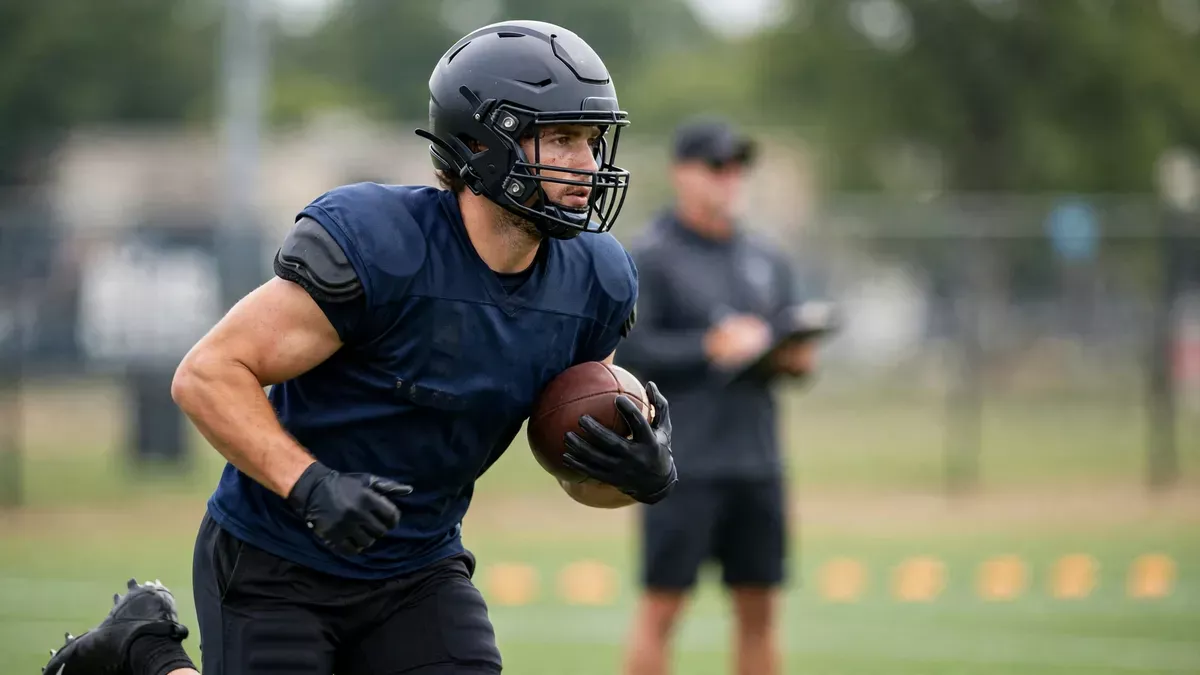
The practice squad is each NFL team’s 16-player reserve roster (17 with an international pathway player): players who practice with the team all week, learn the system, and simulate the upcoming opponent — but cannot play in a game unless their team formally calls them up. Call-ups happen two ways: a standard elevation, a temporary promotion that lets a player dress for one game before automatically reverting to the squad (each player can be elevated three times per season), or a full signing to the 53-man active roster. Practice squad players are also the league’s open market in miniature: any other team may sign one away at any time, provided it puts him on its own active roster.
Key Takeaways
- Practice squads hold 16 players (17 with an international pathway exemption), separate from the 53-man active roster.
- Up to six spots may go to veterans with unlimited experience; the rest are for players with limited accrued seasons.
- Practice squad pay is weekly — a fixed minimum scale for younger players and a higher negotiable band for veterans — and it counts against the salary cap.
- A standard elevation promotes a player for one game; he reverts automatically the next day. After three elevations in a season, he must be signed to the active roster to play again.
- Any team can sign another team’s practice squad player — but only onto its 53-man roster, with a minimum stay of three weeks’ pay guaranteed.
- Teams may protect up to four practice squad players each week, blocking them from being signed away during that week.
Who is eligible — and who actually fills these spots
Practice squads were once strictly for raw rookies. The modern squad (expanded under the 2020 collective bargaining agreement and the temporary rules that followed) is a mix by design:
- Up to 10 players with no more than two accrued seasons of NFL experience — the developmental core.
- Up to 6 veterans with unlimited experience, a change that turned the squad into a genuine reserve of game-ready professionals: backup quarterbacks, veteran corners, special-teams specialists a phone call from Sunday.
- One international exemption: a player from the league’s International Player Pathway program may be carried as a 17th member without using one of the 16 spots, a roster mechanism now central to the league’s global recruiting.
The typical squad blends all three: draft picks who didn’t survive the final cut, undrafted rookies the team is developing, and veterans who know the playbook. Most were cut at the end of training camp and passed through waivers before they could be signed to the squad — a detail that explains the annual late-August drama: a team that cuts a promising rookie must sweat out the waiver wire (where all 31 other teams can claim his contract) before it can stash him on its own squad.
What practice squad players do all week
The name is literal. Practice squad players run the scout team, wearing the upcoming opponent’s schemes so the starters can rehearse against them — the unglamorous work for which teams hand out internal “scout team player of the week” honors. They lift, meet, and drill with the team, travel only when elevated, and watch games from the sideline or the stands unless called up. What they are developing is specific: technique, the playbook, and trust. Coaches routinely say a player’s elevation was earned in October practices the public never saw; the squad is best understood as an apprenticeship with a uniform, and a long line of NFL starters — including future All-Pros who were cut multiple times, like pass rusher James Harrison, who spent time on practice squads early in his career — served exactly that apprenticeship.
Pay: weekly checks, real money
Practice squad players are paid by the week during the season, on CBA-set scales: players with limited experience earn a fixed weekly minimum (in recent seasons roughly $13,000 per week), while veterans are paid within a higher band with room to negotiate — a tool teams use to keep a coveted veteran from signing elsewhere. Over a full season those checks add up to a meaningful professional salary, though a fraction of the active-roster minimum. Practice squad salaries count against the salary cap (the full machinery is in our salary cap guide (/nfl-salary-cap-explained-dead-money-restructures-and-the-franchise-tag/)), which is one reason veteran-heavy squads are a deliberate budget choice, not an accident.
Elevations: the Saturday transaction that moves Sundays
The single most-read transaction of any game week is the standard elevation. A team with injuries or matchup needs may elevate up to two practice squad players for a given game (announced, typically, on Saturday afternoon). The elevated player dresses and plays like any active-roster member — then automatically reverts to the practice squad the day after the game, without passing through waivers. The limits keep the mechanism honest:
- Three elevations per player, per season. After a third elevation, the player cannot be elevated again; to play in another game he must be signed to the 53-man roster outright.
- Elevations are per-player, not per-team: a club can burn different players’ elevations across the season and manage them like timeouts.
- Game-day math: elevated players count toward the game’s active/inactive list, which interacts with the injury designations in our injury report guide (/how-the-nfl-injury-report-works-questionable-doubtful-and-out-explained/) — a “questionable” starter and a Saturday elevation at his position are the same sentence written twice.
Playoff football sharpens all of this: elevations continue into the postseason, and squads built with veteran depth famously surface in January, when a 34-year-old “practice squad” corner starts a playoff game he was signed in September to be ready for.
Poaching, protection, and getting called up for good
Here is the rule that makes agents love the practice squad: any of the other 31 teams may sign a practice squad player at any time — the only requirement is that he goes onto the signing team’s 53-man active roster (with at least three weeks of pay guaranteed even if he is released sooner). The player’s own team has no right to match or block the move, and the player cannot be signed to another team’s practice squad directly. For the player it’s the dream phone call: active roster, active pay, real snaps.
The defense against poaching is the protected list: each week, by Tuesday, a team may designate up to four practice squad players as protected, and those players cannot be signed away that week. Protections reset weekly, so the list is a reliable public tell of which reserves a team values most — beat writers track it the way they track the injury report. The full promotion, though, remains the simple one: the team signs its own player to the 53, usually when a roster spot opens through injury or a release — the ending every practice squadder is practicing toward.
Practice squad FAQ
How many players are on an NFL practice squad?
Sixteen, plus a possible 17th player from the International Player Pathway program who does not count against the limit.
Can practice squad players play in games?
Only if elevated (up to two players per game, up to three times per player per season) or signed to the 53-man active roster.
How much are practice squad players paid?
Weekly, on a CBA scale: a fixed minimum for inexperienced players (roughly $13,000 a week in recent seasons) and a higher negotiable band for veterans.
Can another team steal a practice squad player?
Yes — any team may sign him, but only onto its 53-man roster, with at least three weeks’ pay guaranteed. Up to four players per week can be protected from being signed away.
Do practice squad salaries count against the salary cap?
Yes. All player compensation, including practice squad pay, counts under the cap.
What happens after a player’s three elevations are used?
He cannot be elevated again that season. To appear in another game he must be signed to the active roster.
Related reading
The practice squad touches everything else in roster building — the salary cap (/nfl-salary-cap-explained-dead-money-restructures-and-the-franchise-tag/), free agency (/how-nfl-free-agency-works-unrestricted-restricted-and-the-legal-tampering-window/) and the injury report (/how-the-nfl-injury-report-works-questionable-doubtful-and-out-explained/) — and Saturday elevations are worth watching on our NFL scores page (/nfl/scores/) and the NFL hub (/nfl/).
Corrections: if you spot an error in this guide, tell us through our Corrections Policy (/corrections-policy/) page and we will check it against official sources.