
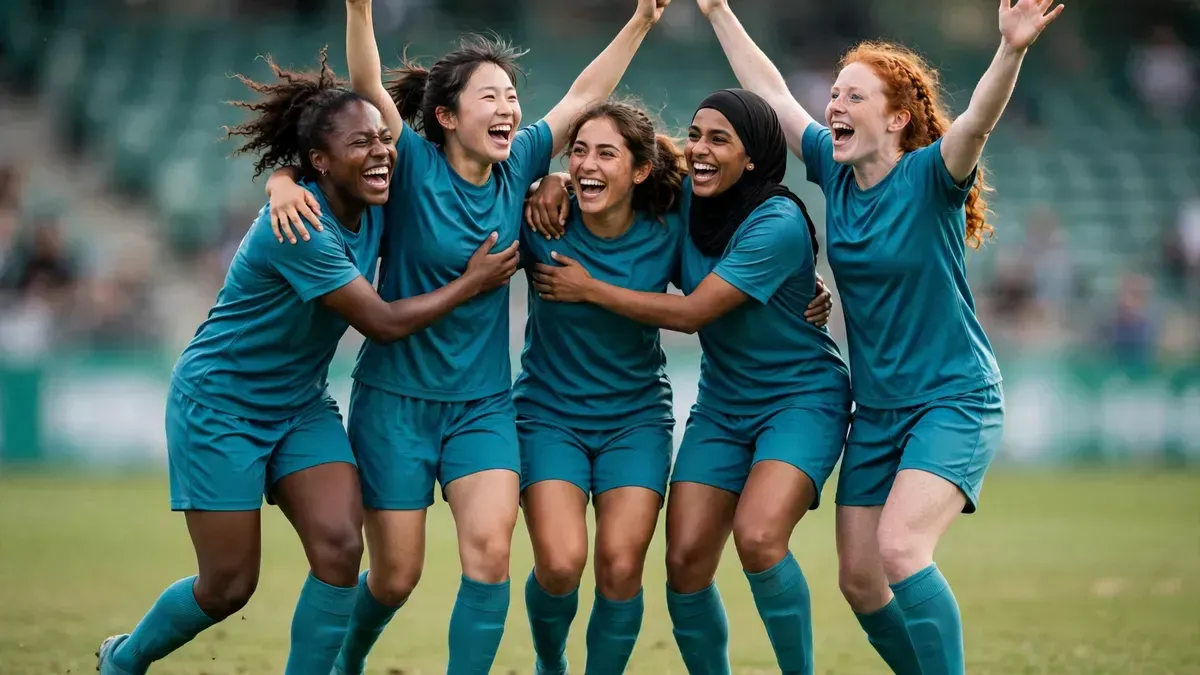
The US Women’s National Team is not a club and it has no season. It is a squad assembled camp by camp by the head coach from a wide pool of professional players — most of them based in the National Women’s Soccer League (NWSL), with a growing number at European clubs — for training camps, friendly matches and tournaments. Its calendar is organized around a repeating cycle: a FIFA Women’s World Cup every four years, with the next one in Brazil in 2027, an Olympic tournament in the years between, with Los Angeles hosting in 2028, and Concacaf’s regional competitions deciding who qualifies for both.
The results that structure has produced are unmatched in the women’s game: four World Cup titles (1991, 1999, 2015 and 2019) and five Olympic gold medals (1996, 2004, 2008, 2012 and 2024). This guide explains how a team that only exists when it is called together actually works — who picks the players, how rosters shrink for the biggest tournaments, and how the four-year cycle fits together.
Key Takeaways
- The USWNT is a selection, not a club. The head coach names a new roster for every camp and tournament from a pool of professionals, and no player owns a place.
- Players earn their living at clubs — mostly in the NWSL, increasingly in Europe — and join the national team during designated FIFA windows, when clubs must release them.
- Tournament rosters are fixed and smaller than camp squads: 23 players at a World Cup, and just 18, plus alternates, at the Olympics.
- The cycle runs World Cup (2027 in Brazil) to Olympics (2028 in Los Angeles), with the Concacaf W Championship serving as the region’s qualifying tournament and the SheBelieves Cup providing an annual home test each winter.
- The current head coach is Emma Hayes, who took charge in 2024 and won Olympic gold in her first summer with the team.
A team that exists only when it is called together
Between tournaments, the USWNT’s year is a rhythm of camps. Several times a year, FIFA’s international calendar sets aside windows in which club soccer pauses and national teams gather. For each window, the head coach names a roster — usually somewhere in the low-to-mid twenties — and those players leave their clubs, train together for a week or so, and play one or two matches, typically friendlies, before returning to club duty. A traditional January training camp opens each year, and the SheBelieves Cup, a four-team invitational tournament hosted in the United States every year since 2016, brings elite opponents to American stadiums in the winter or early spring.
Underneath the roster announcements sits the player pool: a much larger group of professionals the coaching staff and scouts track at their clubs all season. Form in the NWSL or in Europe is the audition. Players move in and out of that pool constantly — a breakout club season earns a first call-up, a loss of form or an injury costs a place — which is why USWNT rosters are best read as a running judgment about the next tournament, not as a fixed squad. Youth national teams feed the pipeline from below, with the under-20 and under-17 sides playing their own World Cups on a two-year cycle, alongside the college game that was historically the program’s main pathway.
Rosters: from camp squads to a tournament 23
Everything narrows as a major tournament approaches. Camp rosters expand and contract as the coach experiments, but a World Cup squad is fixed by FIFA at 23 players, chosen months of evaluation distilled into one list, with only injury replacements permitted close to the tournament. The Olympic tournament is tighter still: rosters of 18 players, plus a small group of alternates who train with the team and can be called into the squad if a player is hurt. An 18-player limit across a six-game tournament is one of the most brutal selection problems in the sport — versatile players who can cover three positions are worth more than specialists.
Those numbers explain the pattern US fans see every cycle. In the years between tournaments, dozens of players receive call-ups and the roster debate is wide open. In a tournament year, the same core plays almost every minute, and the arguments shrink to the final three or four places on the list. The 2023 World Cup supplied the cycle’s cautionary tale: the US went out in the round of 16, its earliest exit at a World Cup or Olympics, and the federation turned to a new coach — Emma Hayes, appointed from Chelsea, who took charge in the spring of 2024 and won Olympic gold in Paris that summer.
The four-year cycle
| Tournament | How often | What it is | Where it sits in the cycle |
|---|---|---|---|
| FIFA Women’s World Cup | Every 4 years | The sport’s biggest prize; 32 teams | Next: Brazil 2027 |
| Olympic Games | Every 4 years | Smaller field, 18-player rosters, intense schedule | Next: Los Angeles 2028 |
| Concacaf W Championship | Every 4 years | The regional championship, and Concacaf’s qualifying route to the World Cup | The 2026 edition sends teams to Brazil 2027 |
| Concacaf W Gold Cup | Launched in 2024 | A second regional championship, with guest nations invited; the US won the first edition | First held in 2024 |
| SheBelieves Cup | Annual | Four-team invitational hosted by the US | Every winter/spring since 2016 |
The shape of the cycle means the USWNT plays a major tournament in most summers: a World Cup, then an Olympics two years later, with regional championships and qualifying in between. Qualifying runs through Concacaf, the confederation for North America, Central America and the Caribbean. The Concacaf W Championship — which the US has won nine times — doubles as the qualifying tournament: in the last cycle, winning the 2022 edition sent the US to both the 2023 World Cup and the 2024 Olympics. The men’s game runs on a parallel structure, explained in our guide to the Gold Cup.
Between the tournaments, the work is regeneration. The years after a World Cup are when new players are blooded and an older core is phased out; the year before one is when experimentation stops and combinations harden. It is a cycle the program’s honors reflect: World Cup winners in 1991, 1999, 2015 and 2019, Olympic champions in 1996, 2004, 2008, 2012 and 2024, and medalists at almost every major tournament it has entered — a standard each new roster is measured against from its first camp.
One more structural piece sits underneath the soccer. In 2022, U.S. Soccer and the national teams’ players’ associations signed collective bargaining agreements that placed the women’s and men’s teams on identical pay structures, including pooling and splitting FIFA World Cup prize money equally between the two squads — the first arrangement of its kind in world soccer, and the settlement of a dispute the women’s players had carried through the courts and the bargaining table for years.
USWNT FAQ
Is the USWNT a club team?
No. It is the United States’ national team, run by U.S. Soccer. Its players are professionals employed by clubs — mostly NWSL teams, plus a growing number in Europe — who are called into national-team camps throughout the year.
How are players chosen for the roster?
The head coach selects each camp and tournament roster from a wide player pool, based on club form, fitness, tactical fit and experience. There is no permanent squad: players are evaluated continuously, and places are won and lost camp by camp.
How many players are on a World Cup roster?
Twenty-three, the squad size set by FIFA for the Women’s World Cup. Olympic rosters are smaller — 18 players, plus alternates who can step in for an injured player.
Who coaches the USWNT?
Emma Hayes, the former Chelsea manager, who took charge in 2024 and won the Olympic gold medal in Paris in her first tournament with the team.
When is the next Women’s World Cup?
In 2027, hosted by Brazil. The next Olympic tournament follows in 2028, in Los Angeles, and the US qualifies for both through Concacaf competition — the Concacaf W Championship is the region’s qualifying route.
What is the SheBelieves Cup?
An annual four-team invitational tournament hosted in the United States since 2016, usually played in the winter or early spring. It gives the USWNT high-level matches on home soil in the years between major tournaments.
Related reading
More from our Soccer hub: how the men’s regional championship works in our guide to the Gold Cup, and the scores, schedule and standings pages that track the USWNT and the rest of the soccer calendar.
Corrections: if you spot an error in this guide, tell us through our Corrections Policy page and we will check it against official sources.