
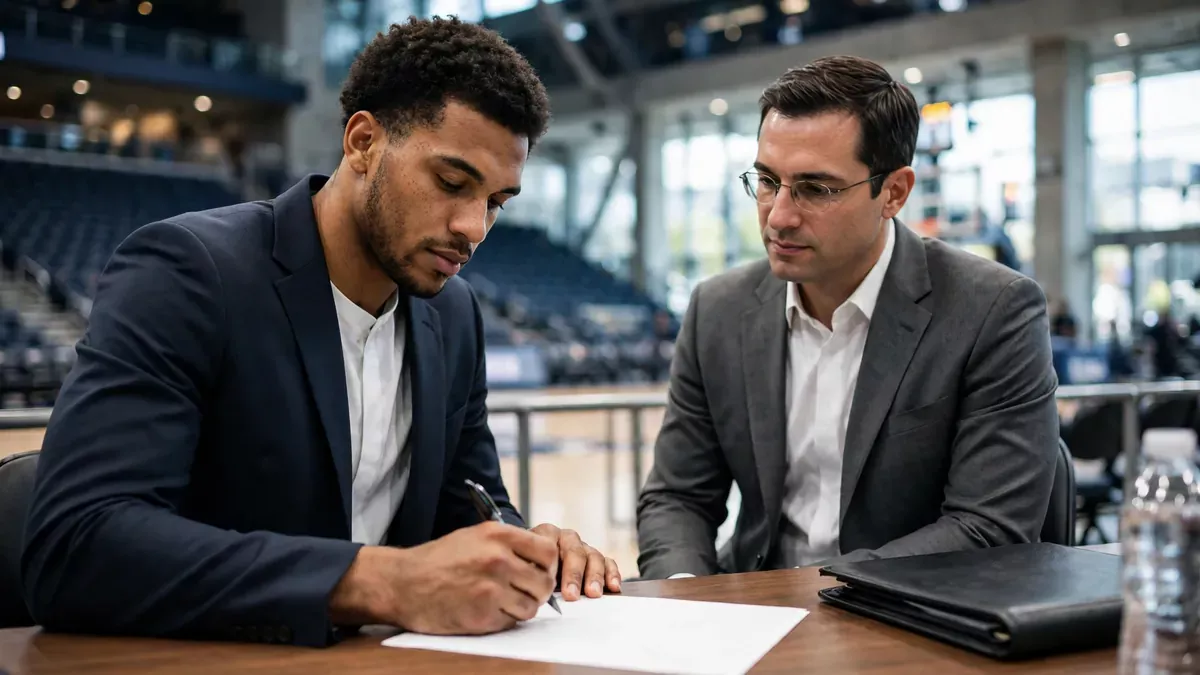
NBA free agency is the summer market in which expiring contracts come due, and it runs on the machinery of the salary cap. A player whose deal ends becomes either an unrestricted free agent, free to sign anywhere, or a restricted free agent, whose team can keep him by extending a qualifying offer and matching any outside offer sheet within 48 hours. Teams spend with one of two currencies: real cap space, created by letting their own free agents’ “cap holds” go, or the exception ladder — Bird rights for their own players, mid-level and minimum deals for everyone else. Most headline agreements are struck during the July moratorium, a negotiating window in which deals are announced everywhere and official nowhere, before signings unlock. This guide explains the calendar, the two classes of free agent, offer sheets, cap holds, and the sign-and-trade — the transaction that lets a player leave while his old team gets something back.
Key Takeaways
- Unrestricted free agents choose freely. Restricted free agents (after a qualifying offer) can be kept: their team has 48 hours to match a signed offer sheet.
- Bird rights let teams exceed the cap for their own free agents — but those players carry cap holds that eat space until they sign or are renounced.
- Negotiations open at the end of June; the moratorium (several days) delays official signings, so July’s first week is announcements, not contracts.
- A sign-and-trade sends a free agent to a new team via his old one — but the receiving team is hard-capped at the first apron all season, so the device is used selectively.
- Options decide the market: player options declined, team options picked up and partial guarantees shape who is actually free each summer.
- Tampering (contact before the negotiating window) is policed with fines, voided deals and lost draft picks.
The calendar: moratorium first, signatures later
The league year rolls over at the end of June. Teams and players first resolve options and qualifying offers in the days after the draft, then negotiations formally open — in recent cycles, on the evening of June 30 — and the moratorium begins: a window of several days in which agreements may be reached, salaries and the new cap are audited, and nothing may be signed. The moratorium exists for bookkeeping (the cap is computed from audited revenue) and for theater (it concentrates the market’s news into one frenzied week). Verbal agreements during the moratorium are binding only in honor — the era’s famous reversal, DeAndre Jordan’s 2015 return to the Clippers after agreeing with Dallas, is why nobody calls a deal done until the ink lands when the moratorium lifts (in recent years, July 6). Signing order then matters operationally: teams sequence their official moves — signings, trades, exception uses — to maximize what the arithmetic in our salary-cap guide allows.
Unrestricted vs. restricted: the two doors
An unrestricted free agent (UFA) is simply free: his contract ended (or his option year was declined) and any team may sign him within its cap means. Most veterans reach the market this way, including via player options (the player’s choice to end the deal) and team options (the club’s choice not to extend it).
A restricted free agent (RFA) is a first-round pick finishing his rookie deal (or a short-service veteran) whose team extended a one-year qualifying offer — a preset tender (for first-rounders, scaled to draft position). The QO buys the team matching rights: the player shops for an offer sheet from another team; if he signs one, his original team has 48 hours to match its terms and keep him, or let him go. Matching has teeth: a matched player cannot be traded for a year without his consent (and never to the team whose offer sheet was matched in that span), so matching is a commitment, not a parking maneuver. Players who find no market can sign the qualifying offer itself, play one year, and become unrestricted the next summer — the bet-on-yourself path. Offer sheets must run at least two seasons and follow max rules; they freeze both teams’ flexibility while the 48-hour clock runs, which is itself a strategic weapon.
Cap space vs. exceptions: the two ways to pay
A team’s summer identity is set by which currency it holds. Cap-space teams have let contracts expire (and managed the cap holds — the placeholder charges for their own unsigned free agents, often larger than the player’s likely salary — by renouncing players they won’t keep, surrendering their Bird rights in exchange for real room). Cap space is the only way to sign a star outright, which is why “two max slots” planning spans years of disciplined books. Exception teams operate over the cap: they keep their own stars with Bird rights and shop the mid-level, bi-annual and minimum markets detailed in our cap guide. Every summer’s market is thus really two markets — a handful of space teams bidding for the top class, and everyone else dividing the exception economy — plus the trade market, where capped-out contenders do most of their real shopping.
The sign-and-trade
When a free agent wants a team that lacks space — or his old team wants compensation for losing him — the sign-and-trade bridges the gap: the player signs a new contract with his old team (minimum three years, first year guaranteed) and is immediately traded to his destination. Benefits flow both ways: the player gets his team and his Bird-sized raises; the old team gets players or picks instead of an empty roster spot. The tax is structural: the receiving team is hard-capped at the first apron for the entire season, a restriction severe enough in the apron era that sign-and-trades are now used mainly by teams content to live beneath that line. Related devices — extend-and-trades and the renegotiation — exist at the margins, but the plain sign-and-trade remains the summer’s most misunderstood headline: it usually signals not a coup but a compromise all three parties could live with.
The market’s shadow rules
Tampering — recruiting another team’s player before the negotiating window — is universally practiced-adjacent and occasionally punished: the league has fined teams, voided agreements and stripped second-round picks in recent cases (a collapsed 2020 sign-and-trade became the modern cautionary tale when the investigation cost Milwaukee a pick). The order of operations is the front office’s real craft: a team with one max slot and three targets must know, hour by hour, which cap holds to renounce, which exceptions to preserve and which agreements must be sequenced first — mistakes are permanent, and the league office validates every step on the trade-and-signing calls. And the second wave matters: after the stars sign, the mid-level market and the minimum market redistribute dozens of rotation players in July’s quieter second half — the signings that often decide which contender’s bench survives April. For comparison with the other league’s spring version, our NFL free agency guide covers the hard cap’s very different summer.
NBA free agency FAQ
When does NBA free agency start?
Negotiations open at the end of June (June 30 evening in recent cycles), but contracts cannot be signed until the moratorium lifts several days later, in early July.
What is the difference between unrestricted and restricted free agency?
An unrestricted free agent may sign with any team. A restricted free agent’s current team holds matching rights after extending a qualifying offer: if he signs an offer sheet elsewhere, the team has 48 hours to match and keep him.
What is a qualifying offer?
A one-year tender (scaled by draft position for first-round picks) that a team extends to make a player restricted. The player may sign it and play the year out, becoming unrestricted the following summer.
What is a cap hold?
A placeholder charge representing a team’s unsigned free agent, counted against the cap until the player signs or the team renounces his rights. Cap holds are why reported “cap space” is always provisional.
What is a sign-and-trade?
A free agent signs with his current team and is traded immediately to his chosen team. It requires at least a three-year deal, and it hard-caps the receiving team at the first apron for the season.
Can a player back out of a free-agency agreement?
During the moratorium, agreements are verbal and not binding — it has happened famously (DeAndre Jordan, 2015). Once signed after the moratorium, a contract is a contract.
Free agency is the salary-cap system in motion, priced by the supermax rules and parallel to the trade market — follow every signing on our NBA hub.
Corrections: if you spot an error in this guide, tell us through our Corrections Policy page and we will check it against official sources.