
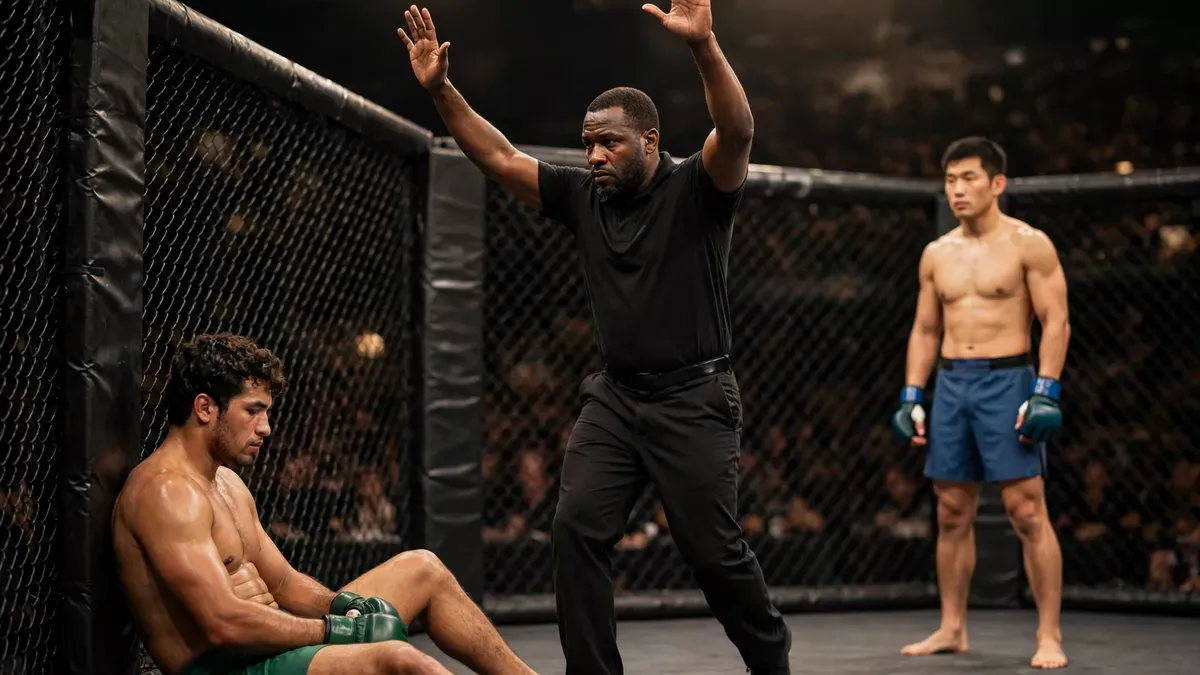
Every MMA fight ends in one of three ways: somebody is finished, somebody gives up, or the judges decide. A knockout (KO) means a fighter has been struck and cannot continue — the fight is over the moment they are out. A technical knockout (TKO) means the fight was stopped by the referee, a doctor or the fighter’s own corner because continuing was no longer safe or sensible, even if the fighter was still conscious. A submission means a fighter was forced to quit — tapping out to a choke or a joint lock — or was choked unconscious and saved by the referee.
The three terms get used loosely in conversation, but on a fighter’s record they are precise categories, and the difference between a KO and a TKO is really a difference about who ended the fight: the strike itself, or a person stepping in. This guide works through each finish, then covers what happens when nobody gets finished at all.
Key Takeaways
- A KO is a fight ended by strikes rendering a fighter unable to continue. If a fighter is knocked unconscious, it is a knockout, full stop.
- A TKO is a stoppage by someone else: the referee intervening, a doctor ruling a fighter unfit to continue, or the corner retiring their fighter.
- A submission covers tapping out, quitting verbally, and the technical submission — a fighter who passes out in a choke or is caught in a lock the referee must stop.
- If the fight goes the distance, three judges score it round by round; if it ends early for accidental reasons, the result can be a technical decision or a no contest.
- Standard UFC bouts are three five-minute rounds; title fights and main events are five rounds. Every finish type can happen in any of them.
The knockout: the strike ends it
A knockout is the cleanest finish in the sport. A legal strike — a punch, kick, knee or elbow — leaves a fighter unable to continue, and the referee’s only job is to wave the fight off and protect them. Loss of consciousness is the classic image, but a KO also covers a fighter who is still awake yet plainly incapable of continuing or defending themselves when the referee makes the call at the moment of the blow.
What separates a KO from a TKO on the record is where the ending came from. When the strike itself settles the matter, the result is recorded as a knockout. Body shots can do it as well as head shots: a fighter folded by a kick to the liver who cannot rise has been knocked out, even though they were conscious throughout. Knockouts are the finishes that build highlight reels, but they are also the ones officials are quickest to protect fighters from — a referee who sees a fighter out on impact should be there before any follow-up strike lands.
The TKO: somebody stops it
Most “knockouts” in MMA are actually TKOs, because most stoppages are a human judgment rather than a single lights-out moment. A technical knockout is recorded whenever the fight is stopped for a fighter’s own protection or because they cannot continue, in one of three ways:
| Who stops it | How it happens | Recorded as |
|---|---|---|
| The referee | A fighter is taking unanswered strikes and no longer defending intelligently | TKO |
| The ringside doctor | A cut, an eye injury or another injury makes it unsafe to continue | TKO |
| The fighter’s corner | The corner retires their fighter between rounds, or throws in the towel during one | TKO |
| The fighter | A fighter quits on the stool between rounds, signals they cannot go on, or is injured by a legal technique | TKO |
The referee stoppage is the most debated call in the sport. Referees are taught to stop a fight when a fighter stops defending themselves intelligently — covering up without improving position while taking clean shots is the classic trigger — and every stoppage is second-guessed against two opposite errors: stopping too early and robbing a fighter who was about to recover, or stopping too late and letting a beaten fighter take damage that served nothing. Doctor stoppages follow a visible logic: the doctor examines the injury, often mid-round for a bad cut, and if they rule the fighter unfit, the referee has no discretion to overrule them. Corner stoppages are the rarest of the three, and the most honorable — a corner that can see what pride hides from the fighter ends the night themselves.
The submission: made to quit
A submission ends a fight without strikes being the cause. The standard version is the tap out: caught in a choke or a joint lock, a fighter taps the opponent or the mat repeatedly — or calls out verbally — and the referee stops the fight the moment the tap is seen. It is recorded as a submission, and it is the grappler’s equivalent of the knockout: one fighter imposed a technique the other could not escape.
Two variations matter. The first is the technical submission, for when there is no tap: a fighter who refuses to submit to a choke may lose consciousness, or a joint lock may cause an injury before the tap comes, and in either case the referee stops the fight and the result is still a submission win. The second is submission to strikes — a fighter tapping out while being hit, which is recorded as a TKO rather than a submission, because the strikes, not a hold, caused the surrender. That small filing difference shows how carefully the categories are kept: the record reflects what actually ended the fight.
If nobody finishes: decisions and draws
A fight with no finish goes to the judges. Three judges score each round under the same 10-point must system boxing uses — which our guide to how boxing scoring works explains in full — and the totals produce a unanimous, split or majority decision, or, rarely, a draw. Decisions are the most common ending in modern MMA at the elite level, where fighters are closely matched and hard to finish.
Two edge cases complete the picture. A disqualification ends a fight when a fighter breaks the rules in a way that leaves the opponent unable to continue, or commits a deliberate flagrant foul: the offender loses. A no contest is the result when a fight ends early through an accident — an accidental clash of heads opening a fight-ending cut in the opening rounds is the standard example — and the bout is struck from both records as if it never produced a winner. If enough rounds have been completed when an accidental foul ends things, the judges’ cards can instead produce a technical decision. Title fights add one more wrinkle: a champion who draws keeps the belt, since the challenger must actually take the title. The route to those title fights is covered in our guide to UFC title fights and rankings.
MMA fight endings FAQ
What is the difference between a KO and a TKO?
A KO means the strike itself ended the fight — the fighter cannot continue, conscious or not. A TKO means the referee, a doctor or the corner stopped it to protect the fighter, who may still be conscious and protesting.
Can a fighter be knocked out by a body shot?
Yes. A strike to the body that leaves a fighter unable to continue is a knockout, even with no loss of consciousness involved.
What counts as tapping out?
Repeatedly tapping the opponent or the canvas with a hand — or, if both arms are trapped, tapping with a foot or calling out verbally. Any of them tells the referee to stop the fight immediately.
What is a technical submission?
A submission finish without a tap: the referee stops the fight because a fighter has passed out in a choke or a joint lock has caused, or is about to cause, serious injury.
What happens if a fighter taps to strikes?
It is recorded as a TKO, not a submission, because strikes forced the surrender. Submissions on a record come from chokes and joint locks.
How long does a fighter have to recover from a low blow?
Under the unified rules used by the UFC, a fighter fouled by a low blow can be given up to five minutes to recover. If they cannot continue and the foul is judged accidental, the result is usually a no contest early in a fight or a technical decision later; a deliberate foul can mean disqualification.
Related reading
More from our UFC and Boxing hub: how UFC title fights and rankings work, how boxing scoring works, how boxing title belts work, and the scores page for the latest results.
Corrections: if you spot an error in this guide, tell us through our Corrections Policy page and we will check it against official sources.