
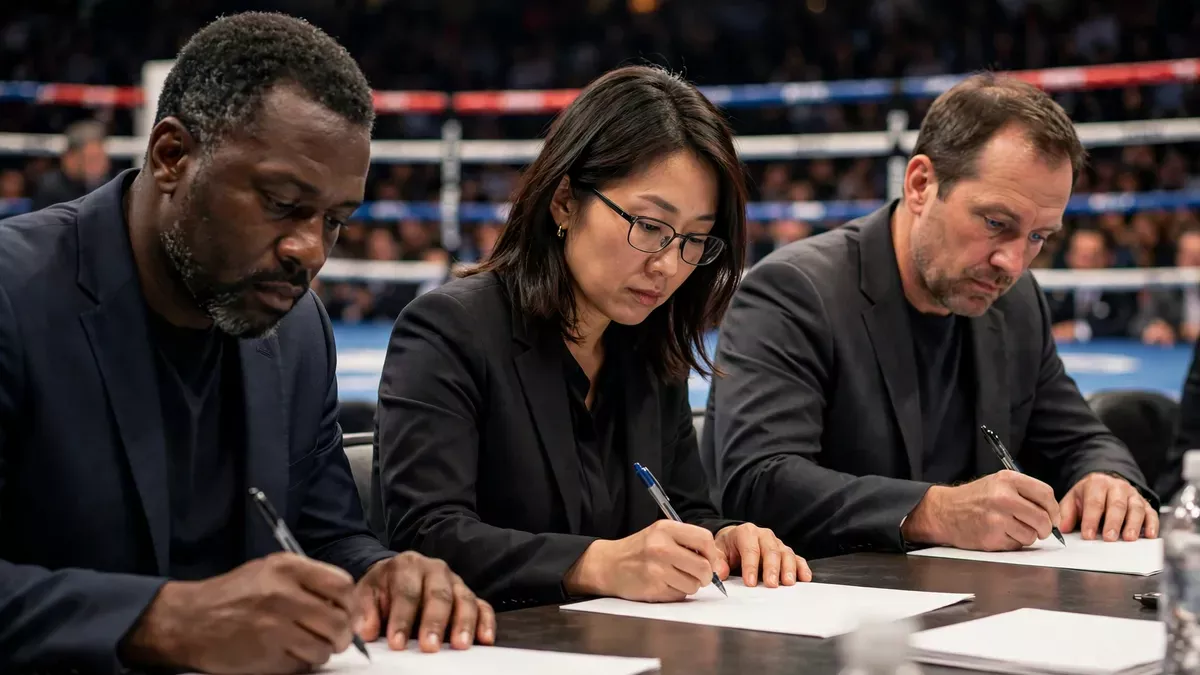
Boxing has no scoreboard. Instead, three judges sit at ringside and score every round on paper cards under the 10-point must system: one fighter must be given 10 points for the round, and the other gets 9 or fewer. Win a round and you take it 10-9; knock your opponent down in it and you usually take it 10-8. Add the rounds up at the final bell and the totals decide the winner — which is why a fight can look close to the crowd and wide on the cards, or the other way round.
The system is simple in outline and argued about endlessly in practice, because each round is a separate judgment about who did the better work. This guide explains how rounds are scored, what judges are told to look for, how knockdowns and fouls change the numbers, and how to read the result when it is announced.
Key Takeaways
- Three judges score the fight independently, round by round, from different sides of the ring. The referee runs the fight but does not score it.
- Under the 10-point must system, the winner of a round scores 10 and the loser 9 — or fewer if they were knocked down or had points deducted.
- A knockdown typically costs the downed fighter an extra point: a round they lost anyway becomes 10-8, and two knockdowns make it 10-7.
- Judges score clean, effective punching first, then effective aggression, ring generalship and defense. Punch counts alone do not decide rounds.
- Title fights are scheduled for 12 rounds. Most other professional fights run four to ten rounds, and the cards are only read out if the fight goes the full distance.
The 10-point must system
Every round is scored on its own, sealed off from the rounds around it. The judge awards 10 points to the fighter they believe won the round — that is the “must” in the system’s name — and 9 to the loser. A truly even round, where neither fighter separates themselves, can be scored 10-10, though judges are generally discouraged from sitting on the fence and even rounds are rare in practice.
Because each round is worth roughly the same, the system rewards consistency over moments. Winning seven rounds narrowly beats winning five rounds hugely, which produces the classic boxing puzzle: a fighter can appear to land the heavier, more memorable punches and still lose, because the opponent banked more rounds by small margins. There is no mechanism for carrying dominance from one round into the next — a fresh 10 points is on the table when every bell rings.
What changes a 10-9 into something else
Knockdowns and fouls are what bend the basic 10-9 shape of a round:
| What happened in the round | Typical score for the round |
|---|---|
| One fighter clearly won it, no knockdowns | 10-9 |
| The winner also knocked the opponent down once | 10-8 |
| The winner knocked the opponent down twice | 10-7 |
| A completely even round | 10-10 |
| The round’s winner was knocked down themselves | 9-9 |
| Either fighter has a point deducted for a foul | That fighter loses a further point |
A knockdown is scored when a fighter is put down by a legal punch — touching the canvas with anything other than the soles of the feet, or being held up only by the ropes. One knockdown turns a lost round into a two-point defeat; it also means a fighter who was knocked down can still salvage a 9-9 if the judges thought they won the rest of the round. The deductions row works differently: fouls are punished by the referee, who instructs the judges to take a point from the offender’s score for that round. Low blows, holding and hitting, and repeated head clashes after warnings are the usual causes, and a point deduction lands on top of whatever the round itself produced.
What the judges are looking for
Judges are instructed to score, above all, clean and effective punching: legal blows that land on target with visible effect. Around that core sit the other traditional criteria — effective aggression (moving forward in a way that produces offense, not just walking in), ring generalship (controlling where the fight happens and at what pace), and defense (blocking, slipping and making the opponent miss).
Notice what is missing from the list: raw punch totals. CompuBox-style counts can show one fighter throwing and landing more, but if the opponent’s fewer punches were cleaner and harder, judges are entitled — expected, even — to give the round to quality over quantity. That is the source of most scoring controversy. Three judges watch from three different sides of the ring, see different angles of the same exchanges, and weigh clean work against volume differently. Honest disagreement built into the geometry of the system explains more disputed cards than corruption does, though it rarely consoles the losing side.
Reading the decision
If the fight goes the distance, the three cards are added up and the result read aloud in one of four forms. A unanimous decision means all three judges scored for the same fighter. A majority decision means two judges scored for the winner and the third had it a draw. A split decision means two judges scored for the winner and one for the loser — the cards that produce the loudest gasps in the arena. And if the totals level out, the fight itself is drawn: a majority draw (two cards even, one for a fighter) or a split draw (each fighter winning on one card, the third even).
The individual scores tell the fight’s second story. Three cards of 115-113 — seven rounds to five, in a twelve-round fight — describe a genuinely close contest. A card of 118-110 in the same fight says one judge saw a different bout entirely. Announcers convert totals into rounds instinctively: since a routine round is a one-point swing, every three points of margin is roughly a round of difference, before knockdowns and deductions muddy the arithmetic. MMA borrowed this entire framework for its own decisions, as our guide to how MMA fights end explains — which is why a “split decision” means the same thing in both sports.
Twelve rounds, and everything shorter
Championship fights under the four major sanctioning bodies — the subject of our guide to boxing title belts — are scheduled for 12 rounds. That distance was once 15 rounds, and the championship rounds, 11 and 12, still carry a special reputation as the territory where stamina decides fights. Below title level, professional fights are set at ten, eight, six or four rounds depending on the fighters’ experience and the occasion, and the same scoring applies: every round 10 points to its winner, cards totaled at the end.
One consequence new viewers miss: because cards are only totaled at the final bell, there is no official running score. Broadcasters keep unofficial cards, and corners guess at where they stand, but nothing announced during the fight is binding. A fighter who believes they are ahead may coast through the last round; a fighter who believes they are behind goes looking for the knockout — and both are acting on guesses, which is exactly why so many fights end with both corners celebrating at the bell. For the results those cards produce, see the scores page on our UFC and Boxing hub.
Boxing scoring FAQ
Who scores a boxing match?
Three judges seated at ringside, each watching from a different side of the ring and scoring independently. The referee controls the fight and can order point deductions, but does not score.
What does “10-point must” mean?
The winner of each round must receive 10 points. The loser receives 9 or fewer, so every round creates at least a one-point gap unless it is scored even at 10-10.
How much is a knockdown worth?
Effectively an extra point. A round lost with one knockdown against you is scored 10-8 instead of 10-9; two knockdowns make it 10-7. A fighter who is knocked down but otherwise wins the round can salvage a 9-9.
Can a round be scored even?
Yes, 10-10 rounds are allowed, but judges are encouraged to find a winner and they are uncommon. Even rounds matter most on individual cards, where a 10-10 can be the difference between a majority decision and a draw.
What is the difference between a split and a majority decision?
On a split decision, two judges picked the winner and one picked the loser. On a majority decision, two judges picked the winner and the third scored the fight a draw — nobody picked the loser, but the cards did not agree.
Why do judges sometimes disagree so wildly?
They watch from different sides of the ring, so each sees different angles of the same punches, and they weigh clean power against volume and aggression differently. The system expects independent judgment, and independent judgment sometimes diverges.
Related reading
More from our UFC and Boxing hub: how boxing title belts work, how MMA fights end, how UFC title fights and rankings work, and the scores page for the latest results.
Corrections: if you spot an error in this guide, tell us through our Corrections Policy page and we will check it against official sources.