
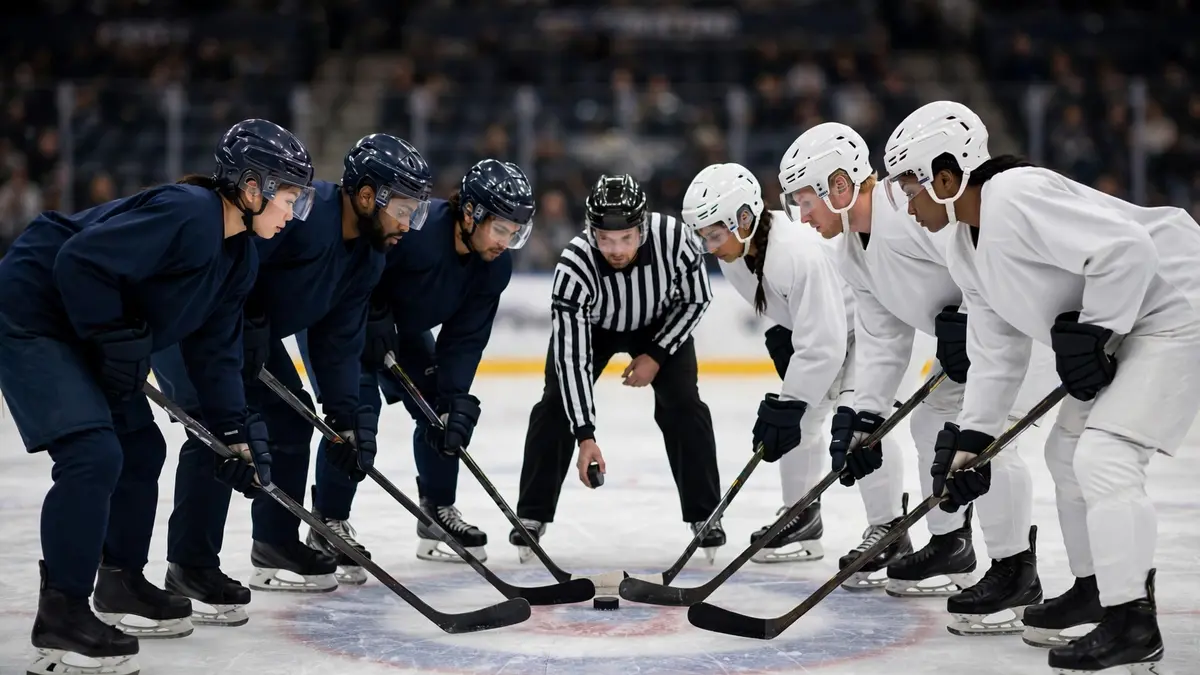
A hockey team puts six players on the ice at even strength: one goaltender, two defensemen and three forwards — a center flanked by a left wing and a right wing. The defensemen guard the area in front of their own net and start the attack moving forward, the center links defense to offense and takes most faceoffs, the wingers work the boards and the scoring areas along their side, and the goalie is the last line, the only player who almost never leaves the ice. Every other thing you will hear in a broadcast — first line, shutdown pair, power-play quarterback — is a variation on those six jobs.
Hockey positions look fluid because players skate everywhere, but the roles are real. This guide walks through each position, what “lines” and “pairings” mean, and how the structure bends on special teams.
Key Takeaways
- At even strength a team dresses six skaters per shift: a goalie, two defensemen (left and right), and three forwards — center, left wing and right wing.
- The center is the connective position: faceoffs, support in all three zones, and usually the first forward back on defense.
- Defensemen play in pairs and forwards in lines of three; a standard roster carries four forward lines and three defense pairs, rotated in shifts of well under a minute at full pace.
- Wingers are loosely tied to a side, not chained to it — they swap sides on rushes and cover for each other constantly.
- Special teams rearrange everything: power plays often use four forwards and one defenseman, and the “positions” become shooting and passing spots around the zone.
The lineup at a glance
| Position | On the ice | Core job |
|---|---|---|
| Goaltender (G) | 1 | Stop the puck; play nearly the whole game |
| Left defense (LD) | 1 | Protect the left side of the defensive zone; start breakouts |
| Right defense (RD) | 1 | Protect the right side; pair with the LD in all situations |
| Center (C) | 1 | Faceoffs, link defense to attack, support everywhere |
| Left wing (LW) | 1 | Work the left boards, forecheck, finish chances on that side |
| Right wing (RW) | 1 | Same job on the right side |
Twelve forwards and six defensemen make up the skaters a team normally uses in a game, with a starting goalie and a backup. Shifts are short — players sprint for a burst, then change on the fly while play continues, so the whole unit turns over every minute or so without a whistle.
The goaltender: the fixed point
The goalie is the one true specialist. Dressed in the big pads, mask and catching glove, the goaltender defends a net six feet wide and four feet tall and is expected to play the full game — unlike everyone else, the goalie does not rotate in shifts. A backup goaltender dresses for every game and usually plays only when the starter is pulled for performance or injury, or on one end of back-to-back nights.
Modern goalies do more than stop shots. They handle the puck behind the net to slow down dump-ins, direct their defensemen with shouts and stick taps, and must stay square to shooters while tracking passes through traffic. The trapezoid behind each net marks the only area where a goalie may play the puck behind the goal line — stray outside it to touch the puck and it is a delay-of-game penalty. When a team pulls its goalie for an extra attacker late in a game, the net sits empty and the sixth skater is almost always another forward.
Defensemen: the last line and the first pass
The two defensemen form a pairing, and pairs stay together shift after shift so each man knows where his partner will be. Their first job is the defensive zone: protect the slot — the dangerous ice directly in front of the net — box out opposing forwards, block shots, and win the puck along the boards.
Their second job starts the offense. A breakout usually begins with a defenseman retrieving a dumped puck and making the first pass to a forward, and in the offensive zone the pair holds the blue line, keeping pucks in and taking point shots through traffic. Coaches describe their best all-around defenseman as a number one, and the pairings below him as the second and third pairs, with ice time shrinking down the list. A defenseman who jumps into the rush and runs a power play from the point is called an offensive defenseman; one kept for heavy defensive minutes against top scorers is a shutdown defenseman. Shoots matter here: a left-shot and a right-shot partner give a pair clean passing angles on both sides, which is why right-shot defensemen are prized.
The center: hockey’s connective tissue
Ask coaches which forward position is hardest and most will say center. The center takes the faceoffs — the set-piece draws that restart play all over the ice — and then becomes the swing man of the shift. In the defensive zone the center supports the defensemen down low, often acting as a third defender in front of the net. In transition he is the middle option carrying or passing the puck up ice, and in the offensive zone he roams between the circles looking for shots while staying responsible enough to be the first forward back when possession flips.
That two-way burden is why the league’s most complete players are so often centers, and why broadcasters praise a “200-foot game”: the center is the forward expected to matter at both ends of a rink that is 200 feet long.
The wingers: boards, rushes and goals
The left and right wings take their names from the side of the ice they line up on, and their home base is the half-wall — the boards in the defensive zone where they wait for breakout passes — and the corners and slot at the other end. Wingers lead the forecheck, pressuring defensemen into turnovers, and they are typically the finishers: more pure goal scorers play wing than center, because the wing carries fewer defensive duties and can cheat a stride toward offense.
The sides are guidelines, not rails. Wingers cross over on the rush, swap sides covering for a pinching defenseman, and many shoot “off-wing” — a left-shot playing right wing — so their blade faces the middle of the ice for one-timers and quicker releases. When you hear a forward described as a “top-six winger”, it means he plays on one of the two scoring lines; bottom-six wingers bring energy, penalty killing and physical play in shorter, harder shifts.
Lines, pairings and how coaches deploy them
Forwards skate in lines of three and defensemen in pairs, and a coach manages the game through them. The first line usually holds the best scorers and faces the opponent’s top defenders; the second line provides secondary scoring; the third is often a checking line built to neutralize and wear down; the fourth plays the fewest minutes and sets a physical tone. Defense pairs follow the same ladder.
Because changes happen on the fly, deployment is a chess match. The home team gets the last change after stoppages, so home coaches chase favorable matchups — their shutdown pair against the visiting star, their top line against a weak third pair. Watch who hops the boards after a whistle and you are watching the game’s hidden strategy, which ties straight into the small advantages that accumulate in our guide to how NHL standings work.
How positions bend on special teams
The power play and penalty kill — covered in depth in our guide to the power play — scramble the standard six. A power-play unit commonly uses four forwards and one defenseman: the defenseman (or a forward playing the point) runs the top, two forwards work the flanks as shooters and passers, one plays the “bumper” spot in the middle of the slot, and one stations himself at the net front to screen the goalie and hunt rebounds. On the penalty kill, teams send out two forwards and two defensemen in a box or diamond, and the forwards’ only real job is pressure and clearing lanes. The goalie, through all of it, stays the goalie — which is why the position is listed separately in every sense.
Hockey Positions FAQ
How many players does a hockey team have on the ice?
Six at even strength: one goaltender, two defensemen and three forwards. Penalties reduce the skating numbers, and a team that pulls its goalie plays with six skaters and an empty net.
What is the difference between a center and a winger?
The center takes faceoffs, supports the defense down low and links all three zones; the wingers work the boards on their side, lead the forecheck and carry less defensive responsibility, which frees them to score.
Do defensemen ever score or join the attack?
Yes. Defensemen shoot from the point, join rushes as a late trailer and run power plays. Their first duty is defending, but the best contribute at both ends.
Why do hockey players change lines so often?
Shifts are skated at a full sprint, so players tire in well under a minute. Teams rotate four forward lines and three defense pairs, changing on the fly to keep pace high for a full 60 minutes.
What does “top six” and “bottom six” mean?
The forwards on the first two lines (top six) are expected to produce most of the scoring. The third and fourth lines (bottom six) focus on checking, energy and defensive matchups.
Can a goalie cross center ice or score?
A goalie may skate with the puck only within limits and cannot cross the red line while participating in play. Rarely, goalies are credited with goals when the other team puts the puck in its own net, and a few have shot the puck the length of the ice into an empty net.
Related reading
Follow the league on our NHL hub, scores page, schedule and standings — and see how the five skaters rearrange themselves with a man advantage in our guide to the power play.
Corrections: if you spot an error in this guide, tell us through our Corrections Policy page and we will check it against official sources.