
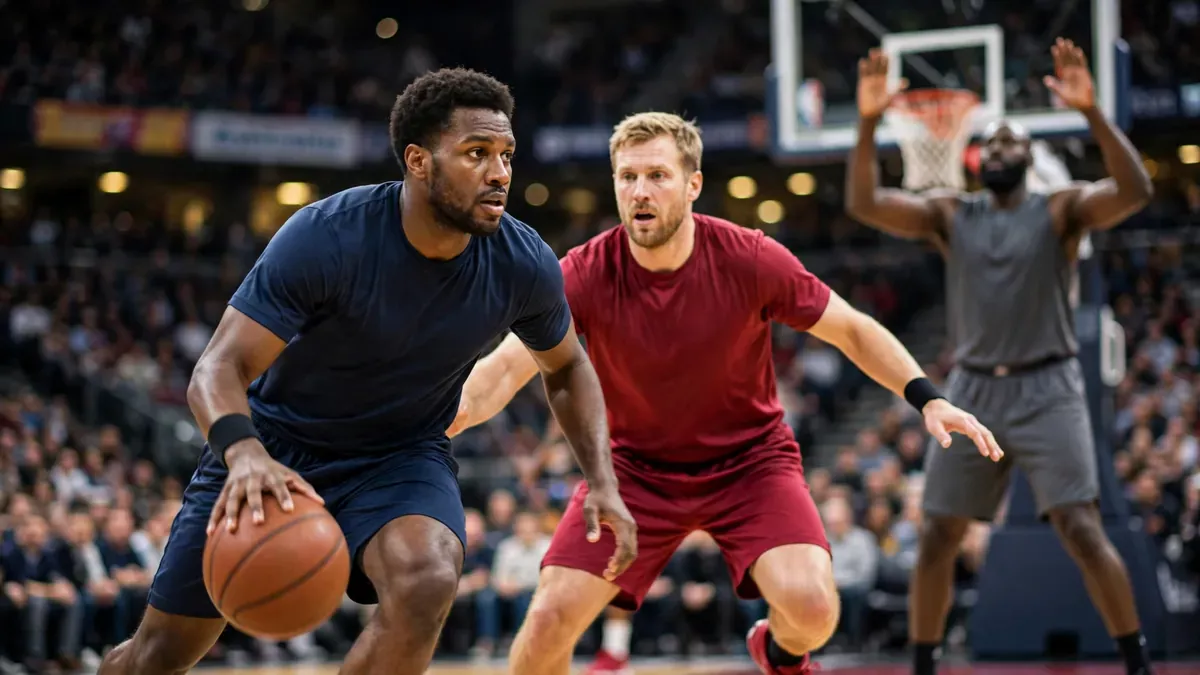
For a century, basketball lineups were described with five positions — point guard, shooting guard, small forward, power forward and center — each with a defined job and a defined size. Modern NBA lineups still get announced that way, but the jobs have blurred into what analysts call “positionless” basketball: the player who runs the offense might be a 6-foot-9 forward or a center; the “power forward” might stand in the corner shooting threes; the center might be the team’s best passer. What survives is a functional taxonomy: every good lineup still needs a primary creator, shooting and spacing, wings who guard multiple positions, and size at the rim — it just no longer insists those functions arrive in five particular bodies. This guide explains the classic five roles honestly, then maps what each has become.
Key Takeaways
- The classic five: point guard (1), shooting guard (2), small forward (3), power forward (4), center (5) — a numbering and sizing convention that organized basketball for a century.
- Roles today are defined by skills, not slots: primary creator, secondary creator, spacer/shooter, connector, rim finisher, rim protector — mixed across heights.
- The three-point revolution moved the 4 and 5 out to the arc (“stretch” bigs) and pushed creation duties onto forwards and centers.
- Switching defenses are the other driver: a player who can only guard one position is now a target, so versatility outranks specialty.
- Position labels still matter administratively in reduced form: All-Star voting still divides backcourt/frontcourt, but All-NBA voting went fully positionless in 2023-24.
- Centers are not extinct — they evolved: the modern 5 protects the rim, finishes plays, and increasingly shoots or passes like a hub.
The classic five, as they were
Point guard (the 1). The floor general: brought the ball up, called the plays, distributed first and shot by exception. Prototypes were pass-first organizers, and the position was the smallest on the floor.
Shooting guard (the 2). The designated scorer on the wing: came off screens, shot from midrange and three, and defended the opponent’s best perimeter scorer.
Small forward (the 3). The versatile middle: slashed, defended multiple spots, rebounded from the wing — the athlete’s position, sized between guards and bigs.
Power forward (the 4). Muscle near the basket: rebounded, set screens, scored in the post and mid-post, and did the interior dirty work next to the center.
Center (the 5). The tallest player: anchored the defense at the rim, rebounded everything, and scored with his back to the basket in the low post. Offenses for decades ran inside-out through the 5.
What each job looks like now
The 1 became “the lead guard” — often a scorer first. Modern primary ball-handlers are expected to be the offense’s top scoring threat and its organizer; the pure pass-first point guard is nearly gone, replaced by high-usage creators of all sizes, including forwards who run the offense as “point forwards” and one famous lineage of oversized initiators. If your best player bends the defense, he has the ball — whatever his listed position.
The 2 and 3 merged into “wings.” The league now thinks in wings: players roughly 6-foot-5 to 6-foot-9 who shoot threes, attack closeouts and guard up and down the lineup. Within wings, the prized subtype is the 3-and-D player (corner threes plus multi-position defense) and the premium subtype is the two-way star wing who also creates. “Shooting guard” and “small forward” survive mostly as roster-listing vocabulary.
The 4 became a spacer. The power forward’s post game migrated to the perimeter: the stretch four stands at the arc to drag a big defender out of the paint, sets the league’s most important screens (as the roll/pop partner in pick-and-roll), and is expected to switch onto guards defensively. Interior bruising survives only as a matchup weapon.
The 5 split in two. Modern centers come in two dominant models: the rim runner/protector (screens, rolls hard, dunks lobs, anchors the defense — value from verticality at both ends) and the hub (a center who initiates from the elbows and top of the key — Nikola Jokić’s passing artistry being the extreme — sometimes with three-point range, the “stretch five”). Either way, the back-to-the-basket post-up feast of the classic 5 is now a situational tool, not an offense.
The small-ball 5. The era’s emblem: lineups with no traditional center at all — Golden State’s famous “Death Lineup” ran the 6-foot-6 Draymond Green at center — trading rim size for five-out spacing and total switchability. Small ball is now a standard playoff adjustment rather than a gimmick.
Why the positions dissolved
Two revolutions did it. The three-point economy repriced every skill: a power forward who shoots is worth more than one who posts, a center who can’t defend in space gets played off the floor in May, and every lineup optimizes for four or five credible shooters. Switching defense followed: if the defense switches every screen, each player must survive guarding anyone for five seconds — which selects for five similar-sized, multi-skilled athletes and against specialists. Add tracking data that values “gravity” (how much a shooter’s mere presence warps a defense) and the old labels lost their informational content: front offices now classify players by roles in actions (initiator, spacer, screener, short-roll playmaker, low-man defender) because that predicts lineups better than “he’s a 3.” The standings don’t care about any of this, but the playoffs are where positional versatility is audited — series are famously decided by which team’s specialists get hunted off the floor.
Where the labels still bite
Positions haven’t vanished from the rulebook’s edges. All-Star selections still organize fan voting by backcourt and frontcourt within each conference. All-NBA teams — the honor that gates supermax money — were positional for a century (two guards, two forwards, a center per team) until the current CBA made All-NBA positionless starting in 2023-24, letting voters simply choose the best fifteen players. And coaching language keeps the numbers as a shorthand for defensive assignments (“take the 2”) and inbound alignments, even as everyone in the huddle knows the 2 might be guarded by the nominal 4. The labels survive, in other words, the way street names survive in a rebuilt city: useful for directions, silent about what actually happens inside the buildings.
NBA positions FAQ
What are the five positions in basketball?
Point guard (1), shooting guard (2), small forward (3), power forward (4) and center (5) — traditionally arranged from smallest/playmaking to tallest/interior.
What does “positionless basketball” mean?
Lineups built from skills rather than fixed slots: creation, shooting, wing defense and rim play distributed across players regardless of listed position — a forward or center may run the offense, a guard may be the screener.
Who brings the ball up in the modern NBA?
Usually the team’s primary creator, whatever his position — a lead guard, a point forward, or even a center in hub-based offenses. The job follows the skill, not the label.
What is a stretch four or stretch five?
A power forward (four) or center (five) who shoots threes credibly, “stretching” the defense by pulling his big defender away from the rim.
Are centers extinct in today’s NBA?
No — they changed. Centers still anchor defense and rebounding and finish at the rim at elite rates; the best also pass and shoot. What vanished is the post-up as a default offense and the one-dimensional specialist.
Why do starting lineups still list positions?
Convention and administration: broadcasts, box scores and All-Star voting still use the framework. All-NBA voting dropped positions in 2023-24; the on-court assignments were already fluid.
Position labels explain the box scores in our triple-double guide and the contract stakes in our supermax guide — see the modern roles in action on our NBA hub and scores page.
Corrections: if you spot an error in this guide, tell us through our Corrections Policy page and we will check it against official sources.