
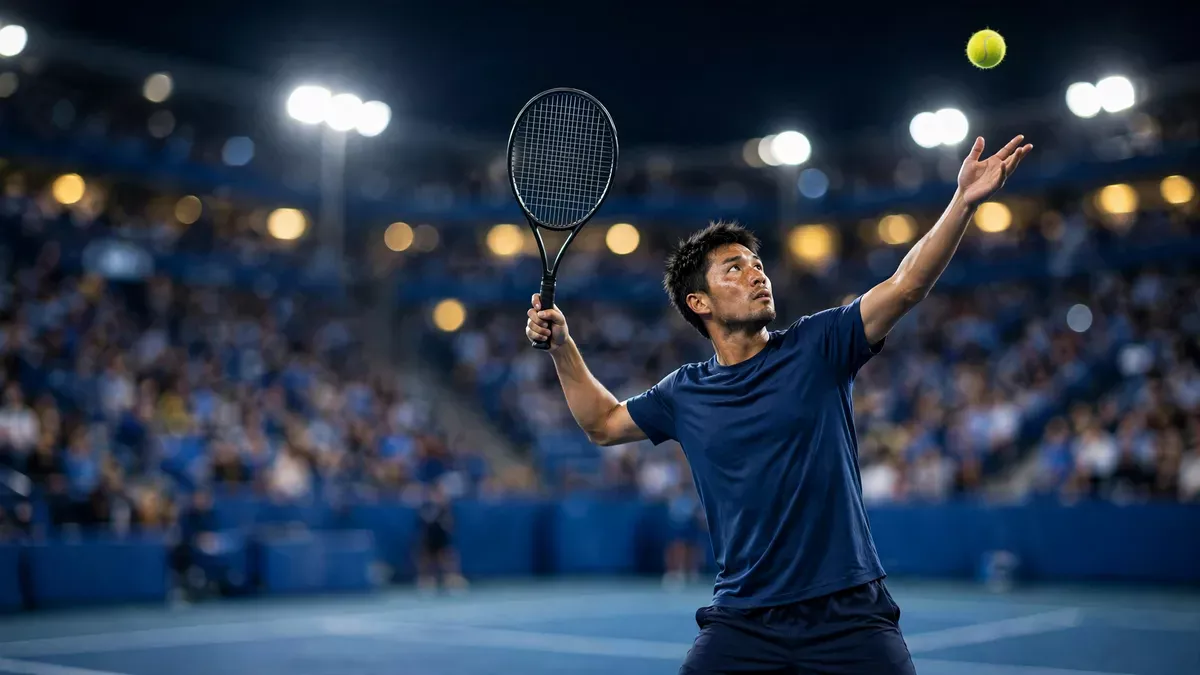
First, a clarification this tournament always needs in the United States: this is the tennis US Open — the fourth and final Grand Slam of the tennis year, played on outdoor hard courts at the USTA Billie Jean King National Tennis Center in Flushing Meadows, Queens, New York, in late August and early September. It is not the golf championship of the same name. The tennis US Open works like this: 256 singles players — 128 men and 128 women — enter single-elimination draws, each champion must win seven matches in a row, the men play best-of-five sets and the women best-of-three, and the whole thing builds to the women’s final on the second Saturday and the men’s final on the closing Sunday.
The tournament is the loudest, latest and richest of the four Slams, and the one where the crowd is part of the event. This guide explains how a player gets into the draw, how the draw and the 32 seeds are arranged, what the road to the final actually looks like round by round, and how the doubles, the rebuilt mixed doubles and the qualifying week fit around the main show.
Key Takeaways
- The US Open is the last Grand Slam of the year, played on Laykold hard courts at Flushing Meadows in New York. The tournament has been held at this site since 1978; the championship itself dates back to 1881.
- Each singles draw holds 128 players. Most enter directly on their world ranking, 16 fight through qualifying, and 8 receive wild cards. Thirty-two players in each draw are seeded.
- A champion wins seven matches. Men play best-of-five sets throughout; women play best-of-three. Every final set level at 6-6 is settled by a 10-point tiebreak.
- Arthur Ashe Stadium holds 23,771 people — the largest tennis stadium in the world — and both it and the second stadium, Louis Armstrong, have roofs, so the show courts can always finish the night.
- In 2025 the tournament expanded to 15 days with a first Sunday start, and paid out a record $90 million in total player compensation, including $5 million to each singles champion — figures for that edition; the purse is reset every year.
The setting: Flushing Meadows
The US Open has been played at Flushing Meadows–Corona Park since 1978, on a public tennis center named for Billie Jean King. Its centerpiece, Arthur Ashe Stadium, opened in 1997 and seats 23,771 — bigger than any other tennis arena on earth — and gained a retractable roof in 2016, which ended the era of finals washed over to Monday by rain. The second show court, the current Louis Armstrong Stadium, opened in 2018 and also has a roof; between them, the biggest matches are guaranteed a finish whatever the weather does.
The surface is a hard court — Laykold, the blue-in-green acrylic familiar from every broadcast — and it plays medium-fast: quicker than clay, slower than grass, the neutral ground of the tennis calendar. The atmosphere is anything but neutral: night sessions that run past midnight, the loudest crowds in the sport, an energy closer to a ballpark than a country club. The Open was also a pioneer: in 1973 it became the first Grand Slam to offer equal prize money to men and women, a standard the other three took decades to match.
Who gets in: the 128
A Grand Slam singles draw of 128 is filled three ways. The great majority of places go to direct entries — players whose world ranking, taken several weeks before the tournament, is high enough to claim a spot without any further work. Sixteen places in each draw are earned the hard way, in qualifying. And eight places are wild cards, handed out by the USTA at its discretion — typically to young Americans, to players returning from injury, and to winners of designated American junior and collegiate events.
Qualifying is a tournament in its own right: in the week before the main draw, during what the USTA stages as Fan Week, 128 men and 128 women each play a separate knockout draw in which three wins earn one of the 16 main-draw places. For the players involved — ranked roughly from just outside the direct-entry line down into the 200s — it is the most consequential week of their year.
| Route into the singles draw | Places (per draw) |
|---|---|
| Direct entry on world ranking | The bulk of the 128 |
| Qualifying (three wins in Fan Week) | 16 |
| Wild cards awarded by the USTA | 8 |
The draw and the 32 seeds
Once the field is set, the draw arranges it. Thirty-two players in each singles draw are seeded — the top 32 entrants by world ranking — and the draw places them in fixed, spaced positions so that they cannot meet each other in the first two rounds. The No. 1 seed sits at the top of the draw and the No. 2 seed at the very bottom, which guarantees the two highest-ranked players cannot meet before the final. The other seeds are distributed by lot through the bracket, and the unseeded players — including the qualifiers and wild cards — fill the remaining lines at random.
The logic is protection with limits. A seed is shielded from elite opposition early, but from the third round onward the seeds begin colliding, and by the second week the draw is designed so that the best surviving players meet. When an unseeded player beats a seed, the bracket does not rearrange — the winner simply takes that line of the draw and the open path that came with it, which is how Cinderella runs happen. Our guide to how tennis rankings work explains the points system behind the ranking order the seeds follow.
The road to the final
Seven wins. That is the whole assignment, and it is why the Grand Slam title is the hardest prize in tennis to win: nobody flukes seven consecutive matches against this field. The men’s champion must do it playing best-of-five sets in every round — potentially 35 sets of tennis across the fortnight — while the women’s champion plays best-of-three. Since 2022, all four Grand Slams use the same finish: a final set that reaches 6-6 is decided by a tiebreak played to 10 points, win by two, which ended the era of marathon final sets at this tournament for good.
| Round | Players remaining | What a win earns |
|---|---|---|
| First round (round of 128) | 128 | A place in the second round — and, for most of the field, the week’s first real test |
| Second round | 64 | The last round before seeds can meet |
| Third round | 32 | A place in the second week |
| Fourth round (round of 16) | 16 | A quarterfinal — and the stage where contenders separate |
| Quarterfinals | 8 | A semifinal berth |
| Semifinals | 4 | A place in the final |
| Final | 2 | The title, and 2,000 ranking points |
The fortnight divides naturally in two. The first week, spread across the whole grounds, is volume: dozens of matches a day, upsets on the outside courts, the top seeds easing in. The second week contracts onto the two big stadiums, one or two matches at a time. Play is organized in day and night sessions, with the night session on Ashe — two matches under the lights, in front of the sport’s biggest crowd — the signature ticket of the tournament. The women’s singles final is played on the second Saturday and the men’s on the final Sunday.
Doubles, mixed doubles and the rest of the fortnight
The singles are the headline, but the grounds run several championships at once. The men’s and women’s doubles are 64-team draws, best of three sets, and the wheelchair and junior championships run alongside them.
The mixed doubles is the piece that changed most recently. For the 2025 edition the USTA rebuilt it entirely: instead of running during the main fortnight, it moved into Fan Week, played over two days before the singles began, with a compact 16-team draw — eight teams entering on their combined singles rankings and eight wild-card teams — a shortened, fast format, and, in 2025, a $1 million prize for the champion pair. The idea was to put the sport’s biggest singles stars into the event while the grounds were already full for qualifying; it turned the mixed doubles from a sideshow into one of the week’s talking points.
The stakes across the main events are the largest in the sport. The 2025 tournament’s total player compensation of $90 million was a record for any tennis event, with $5 million to each singles champion — figures that reset annually, so treat them as a snapshot of the 2025 edition rather than a standing rate. The ranking stakes are permanent, though: 2,000 points to each singles champion, the maximum available anywhere in tennis.
US Open tennis FAQ
Is this the same US Open as the golf tournament?
No. Golf’s US Open is a June championship run by the USGA. This is the tennis US Open, a Grand Slam played in New York in late August and September. The two share a name and a country and nothing else.
How many matches must the champion win?
Seven, in a single-elimination draw of 128. Lose once and the tournament is over.
When is the US Open played?
In late August and early September — qualifying during Fan Week first, then the main draw. In 2025 the main draw started on a Sunday for the first time, stretching the tournament to 15 days.
What happens if it rains?
Matches on Arthur Ashe and Louis Armstrong stadiums continue under their roofs. Matches on the outside courts stop and are rescheduled, which can shuffle the order of play for a day or two.
Why do the men play five sets and the women three?
It is the Grand Slam tradition the four majors share: men’s singles is best-of-five at the Slams (and best-of-three everywhere else), women’s singles is best-of-three at every level. The five-set format is a large part of what makes the men’s title the sport’s ultimate endurance test.
How much does the champion earn?
In 2025, each singles champion received $5 million, from a record $90 million in total player compensation. The purse is announced fresh each year, so check the current edition’s figure rather than assuming it carries over.
Related reading
More from our Tennis hub: the four Grand Slams compared, how tennis rankings work, the tennis terms behind every broadcast, and the scores, schedule and standings pages that follow the season week by week.
Corrections: if you spot an error in this guide, tell us through our Corrections Policy page and we will check it against official sources.