
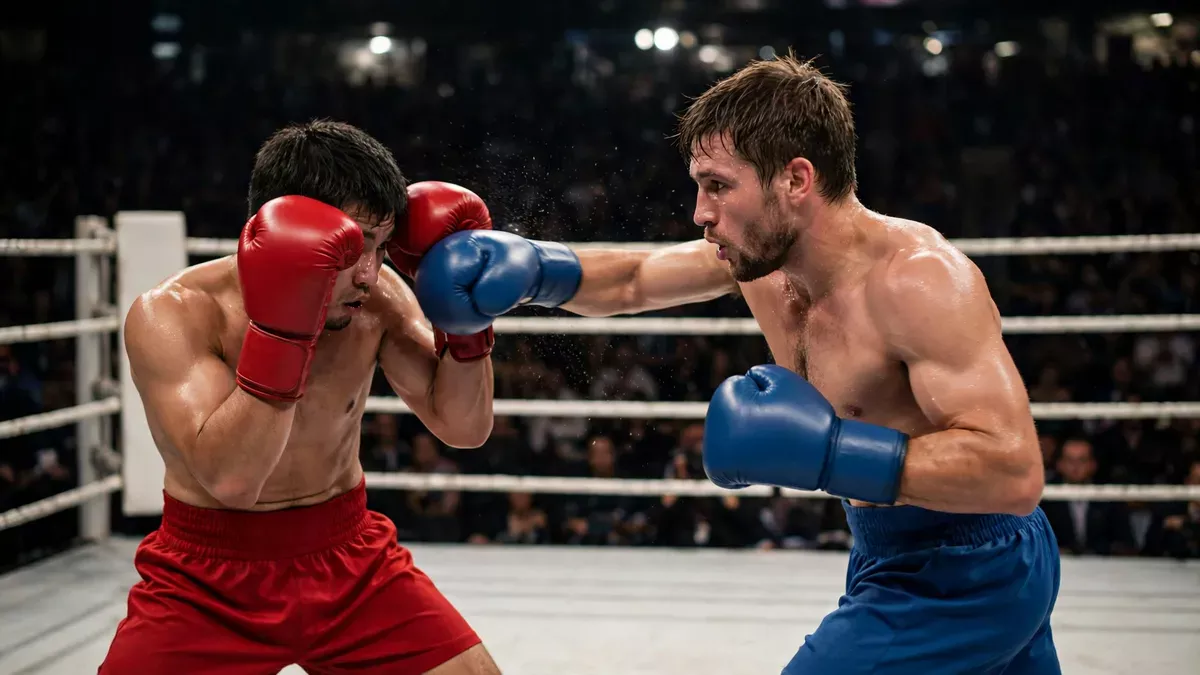
UFC and boxing are both one-on-one combat sports scored by three judges under a 10-point must system — and that is nearly everything they have in common. A boxer may only punch, fights in a roped ring over three-minute rounds, and wins the moment the referee counts out a fallen opponent; a UFC fighter can punch, kick, knee, elbow, wrestle and choke, fights in a fenced cage over five-minute rounds, and keeps fighting when the action hits the floor. Those rule differences do not just change the technique — they change the pacing, the risks and what “winning” a fight looks like.
Fans crossing over from one sport to the other usually stumble on the same handful of surprises: no count in the cage, knockdowns that barely matter to MMA judges, a clinch that is a rest in boxing and a weapon in the UFC. This guide works through the differences one by one.
Key Takeaways
- Boxing allows punches only, above the belt. The UFC allows punches, kicks, knees and elbows, plus takedowns, ground fighting and submissions.
- Championship boxing is 12 rounds of three minutes in a roped ring. UFC title fights are five rounds of five minutes in a fenced cage called the Octagon.
- A knockdown in boxing triggers a mandatory eight count and usually a 10-8 round. In MMA there is no count at all: the fight continues on the ground until a finish, a submission or the referee’s intervention.
- Both sports use the 10-point must system, but they judge different things — boxing rewards clean punching above all; MMA’s criteria start with effective striking and grappling, which includes damage done on the floor.
- Only MMA has submissions: a fighter can win by making an opponent tap out to a choke or a joint lock, a finish boxing simply does not have.
The two rulebooks at a glance
| Boxing | UFC (MMA) | |
|---|---|---|
| Arena | Roped ring | Fenced cage (the Octagon) |
| Title fight format | 12 rounds × 3 minutes | 5 rounds × 5 minutes |
| Non-title format | Up to 10 or 12 rounds × 3 minutes | 3 rounds × 5 minutes |
| Gloves | 8 or 10 oz, closed fist | 4 to 6 oz, open fingers for grappling |
| Legal strikes | Punches only, above the belt | Punches, kicks, knees, elbows |
| Ground fighting | None — a downed boxer is counted | Central to the sport |
| Submissions | None | Chokes and joint locks win fights |
| Knockdown rule | Mandatory eight count; round usually scored 10-8 | No count; action continues |
| Scoring | 10-point must, clean punching first | 10-point must, effective striking/grappling first |
| Weight classes | 17 divisions | 12 divisions |
The arena: ring against cage
A boxing ring is a raised platform ringed by ropes, typically between 16 and 24 feet across. The ropes are part of the tactics: fighters cut off the ring, trap opponents in corners, and sometimes lean on the ropes to survive. A downed boxer who falls through or out of the ropes gets extra time to recover.
The UFC’s Octagon is a chain-link cage about 30 feet across for major events. There are no corners to be trapped in and no ropes to fall through, but the fence itself becomes a tool — fighters pin opponents against it, use it to stand back up, and are not allowed to grab it with their fingers to stop a takedown. The bigger space changes the geometry of everything: boxing is a game of angles in a square, MMA a game of distance in a circle.
Rounds, time and gloves
A championship boxing match runs 12 three-minute rounds with one minute of rest — 36 minutes of fighting at most. A UFC title fight runs five five-minute rounds, 25 minutes at most, and a standard UFC bout is three rounds. Women’s championship boxing has traditionally been fought over two-minute rounds, though some major fights now use three-minute rounds too.
The gloves explain the styles. Boxing gloves weigh 8 or 10 ounces depending on the division and the commission, with a closed, padded fist built purely for punching — and for blocking punches. UFC gloves weigh 4 to 6 ounces and leave the fingers free, because a fighter who cannot grip cannot wrestle or apply a choke. Less padding also means MMA strikes land with a smaller, harder surface.
What you are allowed to throw
Boxing’s rule is a sentence long: punch with the knuckles, above the belt, no holding, no hitting on the break, no punching a man who is down. Almost everything else — elbows, forearms, headbutts, rabbit punches behind the head, low blows — is a foul.
The Unified Rules that govern the UFC allow nearly the whole body as a weapon: punches, kicks to the body and head, knees, and elbows, including the straight downward “12 to 6” elbow that was a foul until the rule changed on November 1, 2024. The foul list still matters — eye pokes, groin strikes, headbutts, strikes to the back of the head and kicking a grounded opponent in the head are all illegal, and since November 2024 a fighter counts as “grounded” the moment anything other than their hands or feet touches the canvas. But within those lines, a UFC fighter defends against threats from every direction — which is why MMA defense starts with distance, not a high guard.
The ground: the biggest divide of all
When a boxer goes down, the fight pauses: the standing boxer goes to a neutral corner, the referee counts, and a fighter who cannot beat the count of ten loses. When a UFC fighter goes down, the fight usually gets more dangerous. The standing fighter can follow them down and strike from top position, hunt for a choke or an arm lock, or stand over them and kick at the legs. There is no count and no neutral corner; a downed fighter must defend, improve position or get up, and the referee stops the fight only when a fighter can no longer defend themselves intelligently.
Submissions live in this world. A rear-naked choke, an armbar, a guillotine — a UFC fighter can win without hurting an opponent at all, by forcing a tap-out, and a fighter who refuses to tap to a choke loses by technical submission when they lose consciousness or the referee steps in. Boxing has no equivalent: its corner stoppage, where the trainer throws in the towel, is the closest thing, and that ends the fight as a TKO loss, not a surrender to a hold.
The clinch: rest in one sport, weapon in the other
Tie up with an opponent in boxing and the referee will separate you — the clinch is where tired boxers steal seconds. Tie up in the UFC and the fight continues: knees from the Thai clinch, elbows at close range, trips and takedowns all start there. Former boxers crossing into MMA routinely cite this as the hardest adjustment, because the moment that resets a boxing match is the moment an MMA fight can be lost.
Scoring: same numbers, different sport
Both sports hand the judges a 10-point must system: the winner of a round gets 10, the loser 9 or fewer. The resemblance ends there. Boxing judges score clean, effective punching first, then effective aggression, ring generalship and defense — and a knockdown almost automatically makes a round 10-8, which is why boxing scorecards swing so hard on knockdowns. Some commissions and sanctioning bodies also apply a three-knockdown rule that ends a fight outright.
MMA adopted the same numbers in the Unified Rules but judges effective striking and grappling: significant strikes landed, damage done, takedowns, control and submission attempts all count, and a knockdown is only one moment inside a round that keeps being scored for five full minutes. A UFC fighter can be knocked down, recover, and still win the round on the floor — an outcome boxing’s count-based system makes impossible.
How fights end
The shared endings are the knockout, the technical knockout (referee, doctor or corner stoppage) and the judges’ decision, plus disqualification for fouls in both sports. The UFC adds the submission and the technical submission. Boxing adds the count-out: a boxer who is up at nine but judged unable to continue loses by KO just as surely as one who never rises. For the finishes in full, see our companion guide to knockouts, TKOs and submissions — and for the divisions they happen in, our guide to weight classes in MMA and boxing.
UFC vs. boxing FAQ
Is a UFC fight longer than a boxing match?
Not in total fighting time. A boxing title fight can run 36 minutes of action (12 rounds of three minutes); a UFC title fight runs 25 (five rounds of five minutes). UFC rounds are longer, boxing fights have more of them.
Can a UFC fighter punch like a boxer?
Yes — punches are fully legal, and many UFC fighters build their game on boxing. They just also have to defend kicks, takedowns and submissions, which is why MMA stances are usually lower, wider and further away than a boxer’s.
Why is there no count in the UFC?
Because a knockdown does not stop the action in MMA: the downed fighter can still defend, grapple and submit from the floor. The referee stops the fight only when a fighter cannot defend themselves intelligently.
Are elbows legal in boxing?
No. Any strike with the elbow is a foul in boxing. In the UFC, elbows are a core weapon — including, since November 2024, the straight downward 12-to-6 elbow that used to be banned.
Which sport has more ways to win?
The UFC, by one whole category: knockout, TKO, decision and disqualification are shared, but only MMA has the submission. Boxing adds its own twist — the count-out — where a fighter who beats the count can still be waved off.
Do UFC fighters and boxers ever fight each other?
Occasionally, as crossover events under one sport’s rules — a boxer entering the cage plays MMA’s game, and an MMA fighter entering the ring boxes. The results underline this guide’s point: the rulebook, not toughness, decides what works.
Related reading
More from our UFC and Boxing hub: weight classes and weigh-ins explained, how to watch UFC and boxing, and the scores page for the latest fight results.
Corrections: if you spot an error in this guide, tell us through our Corrections Policy page and we will check it against official sources.