
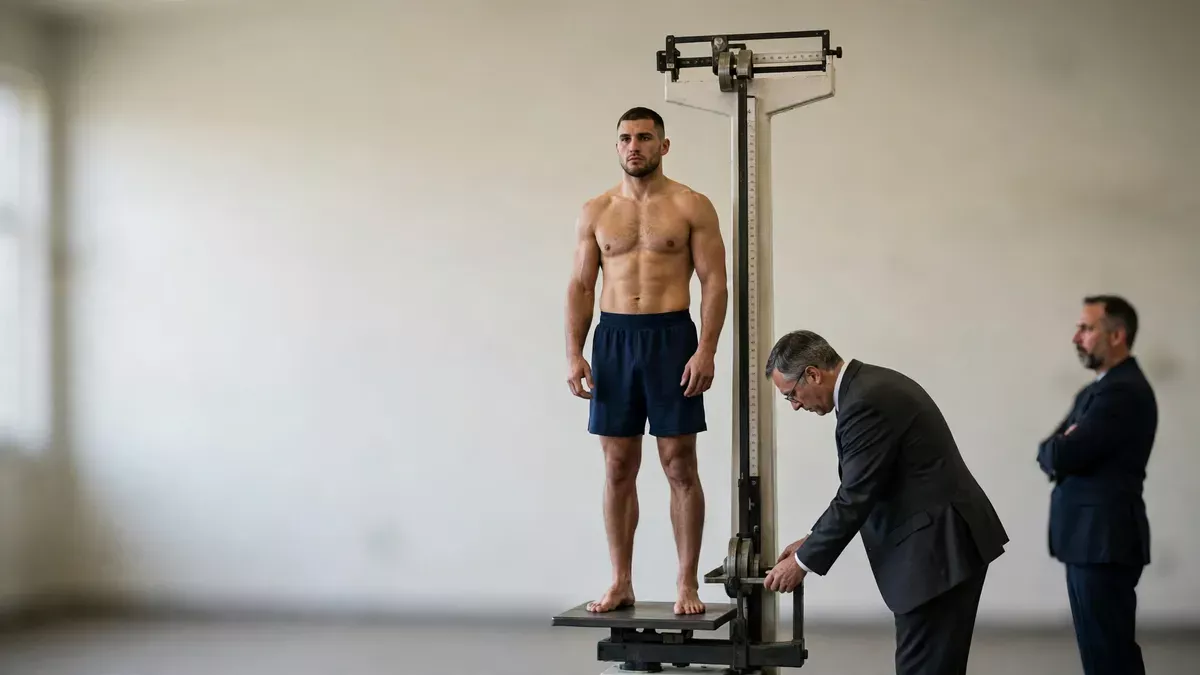
Weight classes are the divisions that separate fighters by body weight, so that nobody has to face an opponent carrying a decisive size advantage. Professional boxing recognizes 17 divisions, running from minimumweight at 105 pounds up to a heavyweight division with no upper limit, while the UFC uses 12 divisions, from women’s strawweight at 115 pounds to a heavyweight class capped at 265 pounds. In both sports the number is a maximum checked at an official weigh-in, usually held the day before the fight.
The two ladders grew out of the same history but no longer match: boxing added divisions over more than a century, while MMA borrowed boxing’s names and then set its own numbers. That is why a boxing lightweight (135 pounds) and a UFC lightweight (155 pounds) are very different sizes of athlete. This guide lists both sets of classes, explains how weigh-ins work, and covers the part fans argue about most — what happens when a fighter misses.
Key Takeaways
- Professional boxing has 17 weight classes shared by the four major sanctioning bodies, from minimumweight (105 lb) to heavyweight (over 200 lb, no limit). The WBC also recognizes an extra division, bridgerweight, that the other bodies do not.
- The UFC has 12 divisions: eight for men, from flyweight (125 lb) to heavyweight (265 lb), and four for women, from strawweight (115 lb) to featherweight (145 lb).
- The names overlap but the numbers do not. A UFC lightweight weighs up to 155 pounds; a boxing lightweight up to 135.
- Fighters weigh in the day before the fight. In the UFC, non-title bouts allow one pound over the limit; title fights must be made exactly. Missing weight costs a share of the purse, and missing for a title fight can cost a champion the belt itself.
- Most fighters weigh far more on fight night than on the scale, because they cut water weight before the weigh-in and rehydrate afterward.
Why weight classes exist
A ten-pound advantage in a grappling exchange or a punching contest is enormous, because weight is reach, leverage and punching mass all at once. Boxing learned this in its bare-knuckle era and gradually built divisions to keep contests fair and safe, starting with a handful of classes — the “original eight” of flyweight, bantamweight, featherweight, lightweight, welterweight, middleweight, light heavyweight and heavyweight — and adding the in-between “super” and “junior” divisions as the sport grew. MMA adopted the idea wholesale when the Unified Rules standardized the sport in the United States, and the classes are enforced by state athletic commissions, not by the promotions themselves.
Boxing’s 17 divisions
The four major sanctioning bodies — the WBA, WBC, IBF and WBO — use the same limits, though some names vary between them (one body’s “super” is another’s “junior”). Every limit below is a maximum.
| Division | Limit | Also called |
|---|---|---|
| Minimumweight | 105 lb | Strawweight, mini flyweight |
| Light flyweight | 108 lb | Junior flyweight |
| Flyweight | 112 lb | — |
| Super flyweight | 115 lb | Junior bantamweight |
| Bantamweight | 118 lb | — |
| Super bantamweight | 122 lb | Junior featherweight |
| Featherweight | 126 lb | — |
| Super featherweight | 130 lb | Junior lightweight |
| Lightweight | 135 lb | — |
| Super lightweight | 140 lb | Junior welterweight |
| Welterweight | 147 lb | — |
| Super welterweight | 154 lb | Junior middleweight |
| Middleweight | 160 lb | — |
| Super middleweight | 168 lb | — |
| Light heavyweight | 175 lb | — |
| Cruiserweight | 200 lb | Junior heavyweight |
| Heavyweight | Over 200 lb | No upper limit |
Two quirks matter. First, heavyweight has no ceiling: a 205-pound heavyweight and a 270-pound heavyweight meet in the same division. Second, the WBC additionally recognizes bridgerweight, capped at 224 pounds, between cruiserweight and heavyweight — a class the other three major bodies do not use, so it sits outside the standard 17.
The UFC’s 12 divisions
MMA’s classes come from the Unified Rules of Mixed Martial Arts, and the UFC’s ladder is shorter and spaced more widely, especially at the top, where the gaps grow from 10 pounds to 15 and then 20.
| Division | Limit | Who competes |
|---|---|---|
| Strawweight | 115 lb | Women |
| Flyweight | 125 lb | Men and women |
| Bantamweight | 135 lb | Men and women |
| Featherweight | 145 lb | Men and women |
| Lightweight | 155 lb | Men |
| Welterweight | 170 lb | Men |
| Middleweight | 185 lb | Men |
| Light heavyweight | 205 lb | Men |
| Heavyweight | 265 lb | Men |
That is nine distinct limits covering 12 divisions. Unlike boxing, the UFC caps its heavyweights: a fighter must weigh more than 205 and no more than 265 pounds. The women’s featherweight division still exists on paper, but its championship has been vacant since 2023 and the UFC rarely books the class, leaving 11 active divisions in practice.
How weigh-ins work
In both sports the official weigh-in happens the day before the fight — boxing settled on day-before weigh-ins decades ago, replacing the old same-day system, and MMA followed the same pattern. Fighters step on the scale in front of commission officials; the reading, not the fighter’s usual walking-around weight, is what counts.
The tolerances differ slightly. In the UFC, a fighter in a non-title bout may weigh one pound over the divisional limit — a lightweight can come in at 156 — but a championship fight must be made exactly, to the ounce. A fighter who is over is normally given extra time, up to a couple of hours, to lose the remaining weight and try again. Contracts in boxing can also include a “catchweight,” an agreed limit set between two divisions for a specific fight, which is how many of boxing’s biggest cross-division matchups get made; the UFC books catchweight bouts less often, usually as a short-notice fix.
The cut: why fighters look bigger on fight night
The day-before weigh-in creates the weight cut. Because fighters have roughly a day to recover, most compete one or even two divisions below their natural size, shedding water weight through saunas, hot baths and fluid restriction, then rehydrating aggressively once the scale is behind them. A UFC lightweight who weighed 155 on Friday morning may enter the cage closer to 175 on Saturday night. Commissions and promotions have debated earlier weigh-ins and hydration checks to discourage extreme cuts, but the day-before system — and the size it produces on fight night — remains the sport’s standard practice.
What happens if a fighter misses weight?
Missing weight is expensive and sometimes catastrophic. The usual consequences:
- A second chance first. The fighter typically gets up to a couple of hours to lose the excess and re-weigh.
- A purse penalty. If they still miss, the fight can go ahead only if the opponent agrees, and the overweight fighter forfeits a percentage of their purse to the opponent.
- Cancellation. The opponent can refuse, and the bout falls off the card.
- Title disaster. In a championship fight, a fighter who misses cannot leave with the belt. If the challenger misses, they can win the fight but not the title. If the champion misses, the title is taken before a punch is thrown: in May 2022, UFC lightweight champion Charles Oliveira weighed 155.5 pounds — half a pound over — and was stripped of the championship, so only his opponent could win the vacant belt the next night. Boxing works the same way: an overweight champion loses the title on the scale.
Weight classes FAQ
How many weight classes are there in boxing?
Seventeen standard divisions, shared by the WBA, WBC, IBF and WBO, from minimumweight at 105 pounds to heavyweight with no upper limit. The WBC also recognizes bridgerweight (up to 224 pounds), which the other bodies do not.
How many weight classes does the UFC have?
Twelve: eight men’s divisions from flyweight (125 lb) to heavyweight (265 lb) and four women’s divisions from strawweight (115 lb) to featherweight (145 lb). Women’s featherweight has been dormant since its title became vacant in 2023.
Why is a UFC lightweight heavier than a boxing lightweight?
Because the sports set their own numbers. Boxing’s lightweight limit is 135 pounds; the UFC’s is 155. The names were borrowed from boxing, the limits were not, so the same word means different weights in each sport.
What is a catchweight?
A one-off contracted weight between two divisions, agreed for a specific fight. Catchweights are common in boxing’s biggest matchups and appear in the UFC mainly when a bout is rearranged at short notice.
Do fighters actually weigh the limit on fight night?
Almost never. They weigh in the day before, then rehydrate, so most fighters enter the ring or cage noticeably heavier than the official limit — often by 10 pounds or more.
Can a fighter compete in more than one division?
Yes. Fighters move up chasing bigger fights — boxing history is full of multi-division world champions — or down in search of a size advantage. Each move means making a new limit at a new weigh-in.
Related reading
More from our UFC and Boxing hub: how UFC and boxing rules differ, how to watch UFC and boxing, and the scores page for the latest fight results.
Corrections: if you spot an error in this guide, tell us through our Corrections Policy page and we will check it against official sources.