
Tennis has four tournaments that stand above all the others: the Australian Open, the French Open, Wimbledon and the US Open. They are the Grand Slams, and together they form the sport’s calendar and its history — the events that every player grows up dreaming of winning, and the tournaments that define a career.
Players plan their year around them, fans plan their year around watching them, and every other event on tour is measured against them. This guide explains what each Slam is, how the four differ, and how the points race is decided in the rankings.
Key Takeaways
- The four Grand Slams are the Australian Open (January), the French Open (May–June), Wimbledon (June–July) and the US Open (August–September).
- Each Slam is played on a different surface: hard (Australia and the US), clay (Paris) and grass (Wimbledon).
- Grand Slams have 128-player singles draws, seven rounds, and 2,000 ranking points for the winner.
- Best-of-five sets for men and best-of-three for women, with final-set tiebreaks at 10 points in Melbourne, Paris and New York, and 12 points at Wimbledon.
- Tennis has four Grand Slams a year, which is why the “calendar Grand Slam” — winning all four in one year — is one of the rarest achievements in the sport.
What makes a tournament a Grand Slam
There are exactly four Grand Slam tournaments in tennis — the Australian Open, the French Open, Wimbledon and the US Open. They are the only events that matter in this category, and the three that are not part of the four — the ATP and WTA Finals, the Olympic Games, the Davis Cup and the Billie Jean King Cup — are events of a different kind, not Grand Slams.
Largest draws. A Grand Slam singles draw has 128 players. That means one player must win seven matches to take the title — more than any other event on the tour. By comparison, the average weekly tour event has 28 or 32 players, and even the biggest Masters 1000 events have 96.
Most ranking points. The winner of a Grand Slam takes 2,000 ranking points — the largest prize on offer, double the 1,000 for a Masters 1000 or WTA 1000 win. A Grand Slam is the single easiest way for a player to move up the rankings, and the single hardest event to win. Our guide to how tennis rankings work explains how those points are put together.
Longest matches. Men play best-of-five sets, women best-of-three, and a final set that reaches 6–6 goes to a deciding tiebreak. Each Slam decides the final set in its own way, and every Grand Slam match can run for four hours or more. Only the Davis Cup, the Olympics and the Finals use different formats, and they are not Slams.
Most prize money. The 2026 Grand Slams paid prize pools of between $50 million and $100 million each, with the singles champions taking home millions. Those pools are the largest in tennis, by a wide margin.
Most prestige. The four Slams set the calendar, and the game is measured by them: the player who wins the most Slams is the greatest of all time, and the events have their own traditions, their own audiences and their own rules, so each one is a world of its own.
The Australian Open: the year’s first test
The season begins in Melbourne in January, in the middle of the Australian summer. The tournament is played on hard courts, and heat is part of the story: the Australian Open’s heat rules are the most advanced in tennis, and matches can be suspended when the temperature reaches 40°C. The event is called the “Happy Slam” because the players enjoy its relaxed atmosphere, its night sessions and its position as the first major of the year. For the players chasing the year-end No. 1 ranking, the Australian Open is where the season’s points race starts — and a win in January is worth the same 2,000 points as a win in any other Slam.
The French Open: clay, endurance and the hardest Slam to win
The French Open is played in late May and June on the red clay of Roland Garros in Paris. Clay is the slowest surface in tennis, and it changes the game: points last longer, the ball bounces higher, and matches are decided by endurance and patience rather than power. Players slide into their shots, the surface rewards topspin and consistency, and the tournament is the most physically demanding of the four — the final is often a war of attrition that runs for four hours or more. The French Open is the hardest of the four Slams to win for most players, because clay is a specialist surface: a player who grows up on clay has an advantage, and a player who does not must adapt or lose.
Wimbledon: grass, tradition and the fastest tennis of the year
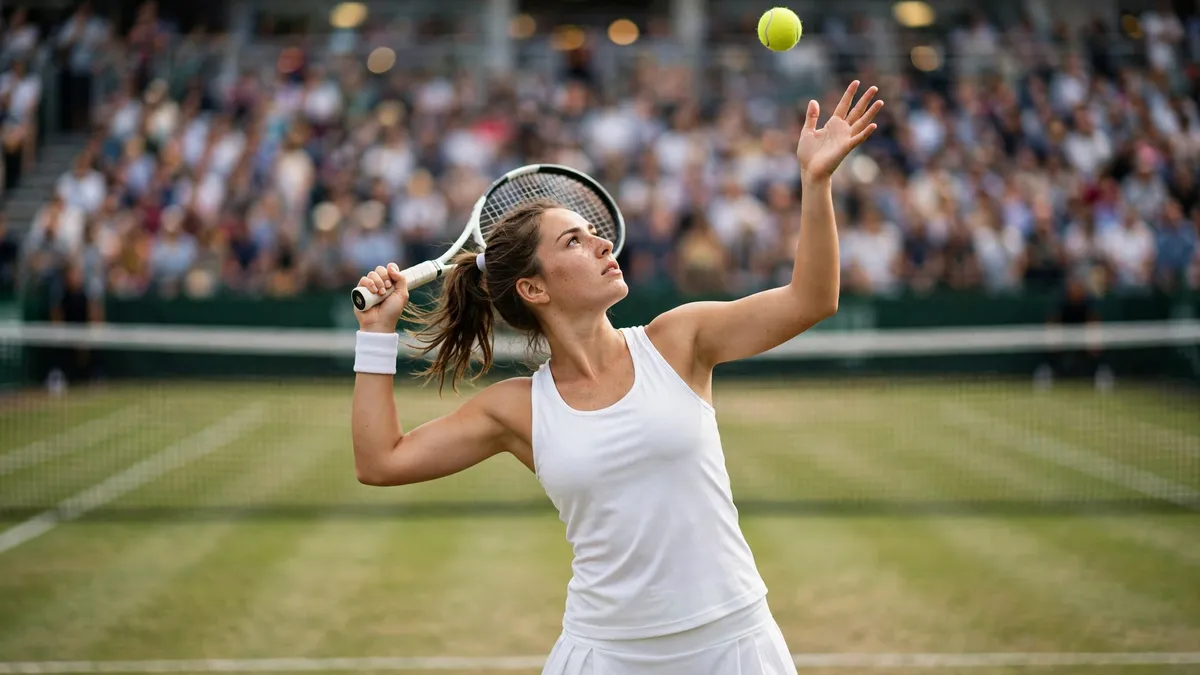
Wimbledon is played in late June and July on the grass courts of the All England Club in London. Grass is the fastest surface in tennis: points are the shortest, and the ball bounces lower and less predictably, favouring players who can serve and volley. Wimbledon is the oldest of the four Slams — it began in 1877 — and the most traditional: players wear white, the royal box is full, and the tournament is the only Slam that has never been played on a surface other than grass. The event is also the most prestigious in the calendar, and the one that every player wants most to win.
The US Open: the loudest Slam
The US Open is played in late August and September in New York, on hard courts, and it is the loudest and most unpredictable of the four. The courts are fast, the crowds are the largest, and the tournament has the most night sessions — matches start in the late evening and often run past midnight. The US Open is the one Grand Slam where the crowd is a force of its own: the stadium holds 24,000 people, and the atmosphere is louder and harder for players to ignore than at any other event. The US Open was also the first Slam to allow equal prize money for men and women, introduced in 1973, and the first to use Hawk-Eye for line calls.
How the Slams differ at a glance
| Tournament | When | Where | Surface | Character |
|---|---|---|---|---|
| Australian Open | January | Melbourne | Hard | Fast, attacking, night sessions, summer heat |
| French Open | Late May – June | Paris | Clay | Slow, long rallies, most physical |
| Wimbledon | Late June – July | London | Grass | Fastest, shortest points, most traditional |
| US Open | Late Aug – Sept | New York | Hard | Loudest, biggest crowds, most unpredictable |
The same player can look like a different athlete from one Slam to the next. The surfaces reward different skills, the seasons reward different fitness, and the atmospheres reward different temperaments. The players who win all four have had to master all of that, and the player who has mastered only one surface has a ceiling that no amount of talent can lift.
The deciding set: no more endless matches
Every Slam now has a final-set tiebreak, and that change ended the era of the endless match. Before the change, a final set had to be won by two games, and matches could run for hours without a break. That ended in 2019, when Wimbledon finally introduced a final-set tiebreak, and in 2022 the four Slams agreed on a common rule: a final set that reaches 6–6 goes to a super tiebreak, played to 10 points.
Wimbledon alone uses 12 points for its final-set tiebreak, a legacy of the old rule: the deciding set there is played to 12 points, not 10. The difference is small but real: a Wimbledon final set lasts longer, and the player who wins it has to win two more points than at the other three Slams.
What the Slams mean for rankings
Every match in a Slam is worth ranking points, and the more rounds a player wins, the more points they take. A first-round loss is worth 10 points; a quarter-final is worth 360; a semi-final is worth 780; a final is worth 1,300; and a win is worth 2,000. So a player who reaches two Slam quarter-finals earns the same points as a player who wins one Masters 1000 title, and a player who wins a Slam leapfrogs almost everyone on tour.
Because the points are so large and the draws are so deep, a Grand Slam run can change a player’s year: a young player who reaches the second week of Wimbledon can jump into the top 50, and a player who defends a title can hold their ranking without winning anything else. The 2,000 points are the single biggest lever in the sport, and the Slams are the four biggest events on the calendar.
Tennis Grand Slams FAQ
What are the four Grand Slams in tennis?
The Australian Open, the French Open, Wimbledon and the US Open. They are the four most important tournaments in tennis.
How many points is a Grand Slam worth?
2,000 ranking points for the winner, 1,300 for the finalist, 800 for the semi-finalist, 360 for the quarter-finalist, and so on down to 10 points for a first-round exit.
How many sets are played in a Grand Slam?
Five sets for men, three for women, with final-set tiebreaks at 10 points in three Slams and at 12 points at Wimbledon.
Which Grand Slam pays the most prize money?
The US Open pays the most, with a prize pool of over $100 million. The Australian Open, French Open and Wimbledon also pay prize pools of $50 million or more.
Who has won the most Grand Slams?
Novak Djokovic has won 24 Grand Slam singles titles, ahead of Rafael Nadal on 22 and Roger Federer on 20, in the men’s game. In the women’s, Margaret Court leads with 24 titles, followed by Serena Williams with 23.
Which Grand Slam is the oldest?
Wimbledon, first played in 1877 — older than the other three, and the only major still played on grass.
What is a calendar Grand Slam?
Winning all four Grand Slams in a single calendar year. It is the rarest achievement in tennis, achieved only by a handful of players in the history of the sport — and only by one man besides the women who have done it.
Related reading
Follow the sport on our Tennis hub (/tennis/), scores page (/tennis/scores/), schedule (/tennis/schedule/) and standings (/tennis/standings/), and learn how matches are scored in our guide to how tennis scoring works, and how the points race is decided in our guide to how tennis rankings work.
Corrections: if you spot an error in this guide, tell us through our Corrections Policy (/corrections-policy/) page and we will check it against official sources.