
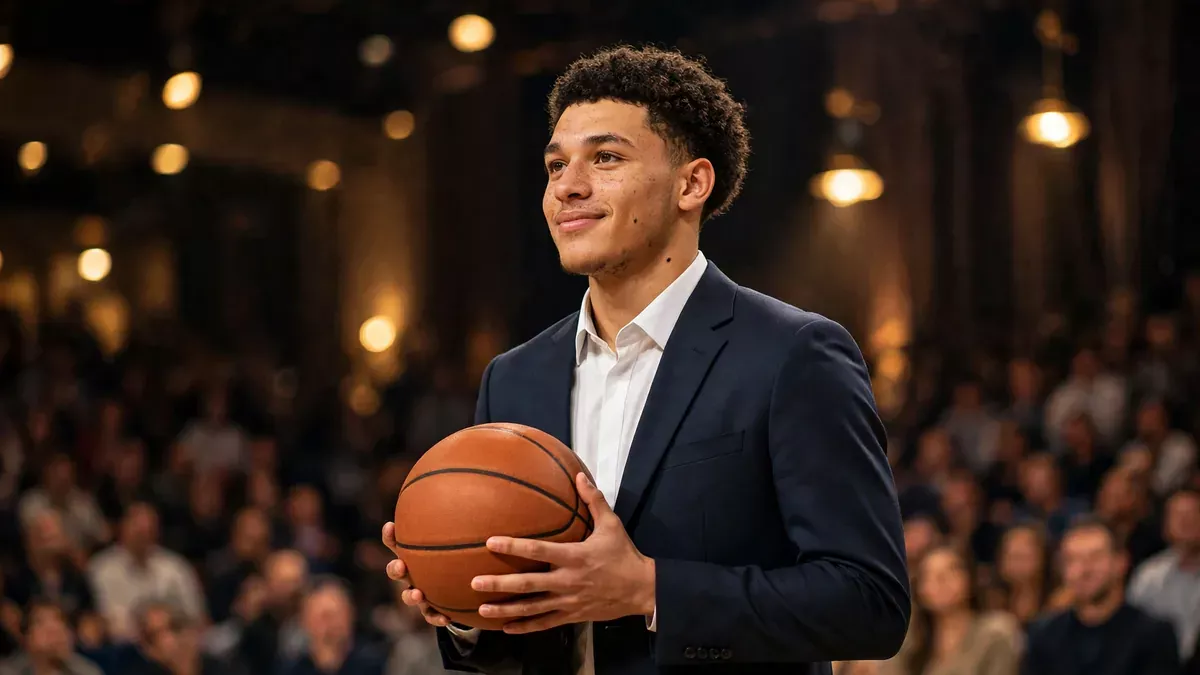
The NBA draft, held in late June, distributes the sport’s incoming talent in two rounds of 30 picks — 60 players (occasionally fewer when picks are forfeited for rule violations). The 14 teams that missed the playoffs are ordered by the draft lottery; everyone else slots by reverse regular-season record, and the second round follows record order too. To be eligible, a US player must be at least 19 during the draft’s calendar year and at least one year removed from his high-school class — the “one-and-done” rule; international players become automatically eligible at 22. First-round picks sign preset “rookie scale” contracts; second-rounders negotiate freely, often landing on two-way contracts; and international selections may be “stashed” overseas while the team retains their rights. This guide covers the order, eligibility, the money, draft-and-stash, and the two-night televised mechanics — with the lottery itself explained fully in our lottery guide.
Key Takeaways
- Two rounds, 30 picks each, in late June — since 2024 split across two nights (first round night one, second round night two).
- Order: picks 1–14 by lottery among non-playoff teams; 15–30 and the entire second round by reverse order of regular-season record.
- Eligibility: 19 years old in the draft year and one year removed from high school (US players); internationals are auto-eligible at 22.
- First-round contracts are on the rookie scale (four years: two guaranteed plus two team options, salary fixed by pick slot).
- Second-round picks have no scale and no guarantees — minimum deals, two-way contracts or stash arrangements are common.
- Draft-and-stash: a team can hold an international player’s NBA rights indefinitely while he develops under contract overseas, with no cap charge until he signs.
The order: lottery first, then the standings
The first 14 picks belong to the teams that missed the playoffs, sequenced by the lottery’s weighted draw (full mechanics, odds and anti-tanking design in our lottery guide). Picks 15–30 go to playoff teams in reverse order of record — the champion’s slot is 30th — and the second round repeats the full league in reverse record order, with the lottery teams at the front. What record order produces is only the default assignment: thanks to the trade market in our trades guide, a large share of every draft’s picks belong to someone else — protected, swapped, or owed from deals years old, which is why draft night coverage reads the fine print of trades past as much as the players present.
Who can be drafted
American players enter through early entry: they declare for the draft by the spring deadline, may work out for teams and receive feedback, and can withdraw by the NCAA’s deadline to preserve college eligibility — the “testing the waters” season that fills May. Players who exhaust college eligibility are automatically in. The hard gates are age and time: 19 years old during the calendar year of the draft and one NBA season elapsed since the player’s high-school class graduated. International players follow the same early-entry route before 22 and become automatically eligible in the year they turn 22. A player may be drafted only once down this path — if he re-enters after withdrawing properly, he can be drafted again; if he stays in and goes undrafted, he is a free agent forever, the fork that makes the withdrawal deadline a genuine life decision (and makes returning to college a rational option rather than a failure).
Draft night itself
Since 2024 the draft runs two nights: the first round in primetime on night one, the second round on night two — a change that gave the second round its own stage and gave teams a night to renegotiate the pick market in between. Teams get five minutes per first-round pick and four minutes per second-round pick. Every selection is the transfer of rights: the drafted player belongs to the drafting team (or the team that traded for the pick — announced selections are often already traded, pending league approval, which is why rookies wear the hat of a team they will never play for). Trades agreed on draft night are typically made official weeks later during the summer moratorium’s end, and the rights to a drafted player can themselves be traded for years afterward if he never signs.
The money: rookie scale and the second-round wild west
First-round picks sign the rookie scale from our salary-cap guide: four-year contracts with salaries preset by draft slot (the No. 1 pick’s deal starts in eight figures; the 30th pick’s near the minimum), two guaranteed years followed by two team-option years, almost always signed at 120 percent of scale. Fourth-year options and extension windows structure the player’s entire first half-decade from that June night. Second-rounders get no scale and no promise: teams may use cap space or exceptions — the 2023 CBA added a dedicated second-round exception allowing standardized three- or four-year deals — and players sign everything from four-year partially guaranteed pacts to camp invites. The economic split explains the draft’s psychology: late-first-round picks are owed money and patience; second-rounders are owed nothing, which is why some prospects’ camps prefer going undrafted (free choice of team) to being picked 58th.
Two-way contracts: the draft’s third economy
Each team may carry up to three players on two-way contracts: hybrid deals for developing players (limited to those with three or fewer years of NBA service when signed) that split time between the NBA roster and the G League affiliate without counting against the salary cap. Two-way players are limited in how many regular-season games they can be active for the NBA club (50 games under the current CBA) and are ineligible for the playoffs unless converted to a standard contract — conversions that contenders execute every spring for exactly that reason. The two-way system has become the draft’s unofficial third round: most second-rounders and priority undrafted free agents now pass through it, and its success stories (rotation players and even starters who began on two-ways) have made it a genuine development league pathway rather than a consolation prize.
Draft-and-stash: rights without a roster spot
When a team drafts an international player who is under contract abroad, it may leave him there — draft-and-stash. The team retains his exclusive NBA rights; he develops on someone else’s payroll; and no salary or roster spot is consumed until he signs (an unsigned first-round stash carries formalities around cap holds, which teams manage by confirming he will not sign that season). Some stashes ripen into stars arriving fully formed in their primes; some never come at all, their rights tossed into trades for decades as filler with theoretical value. The stash is also a cap-era strategy: a late-first-round pick a capped-out team cannot afford to pay scale salary to can be converted into a stashed prospect instead of a guaranteed contract — one more place where the draft and the cap system are the same machine viewed from different ends.
NBA draft FAQ
How many picks are in the NBA draft?
Sixty: two rounds of 30. Some drafts have had 58 or 59 after the league forfeited picks for free-agency violations.
How old do you have to be for the NBA draft?
At least 19 during the draft’s calendar year, and at least one year removed from your high-school class if you are a US player. International players become automatically eligible at 22.
When is the NBA draft?
In late June, shortly after the Finals. Since 2024 it spans two nights: round one on night one, round two on night two.
What is a two-way contract?
A hybrid NBA/G League deal (up to three per team) for players with three or fewer years of service. Two-way players don’t count against the cap, can be active for up to 50 NBA games, and must be converted to a standard contract to play in the playoffs.
What does draft-and-stash mean?
The drafting team keeps an international player’s NBA rights while he continues playing overseas under contract — development without a roster spot or salary until he signs.
Do second-round picks get guaranteed contracts?
No. There is no rookie scale for the second round; contracts are negotiated (minimum deals, the second-round exception, two-ways) and are often partially or fully non-guaranteed.
Related reading
The lottery that sets the top of the order, the cap rules that price the picks and the trade market that moves them complete the picture — with draft outcomes feeding the standings and our NBA hub.
Corrections: if you spot an error in this guide, tell us through our Corrections Policy page and we will check it against official sources.