
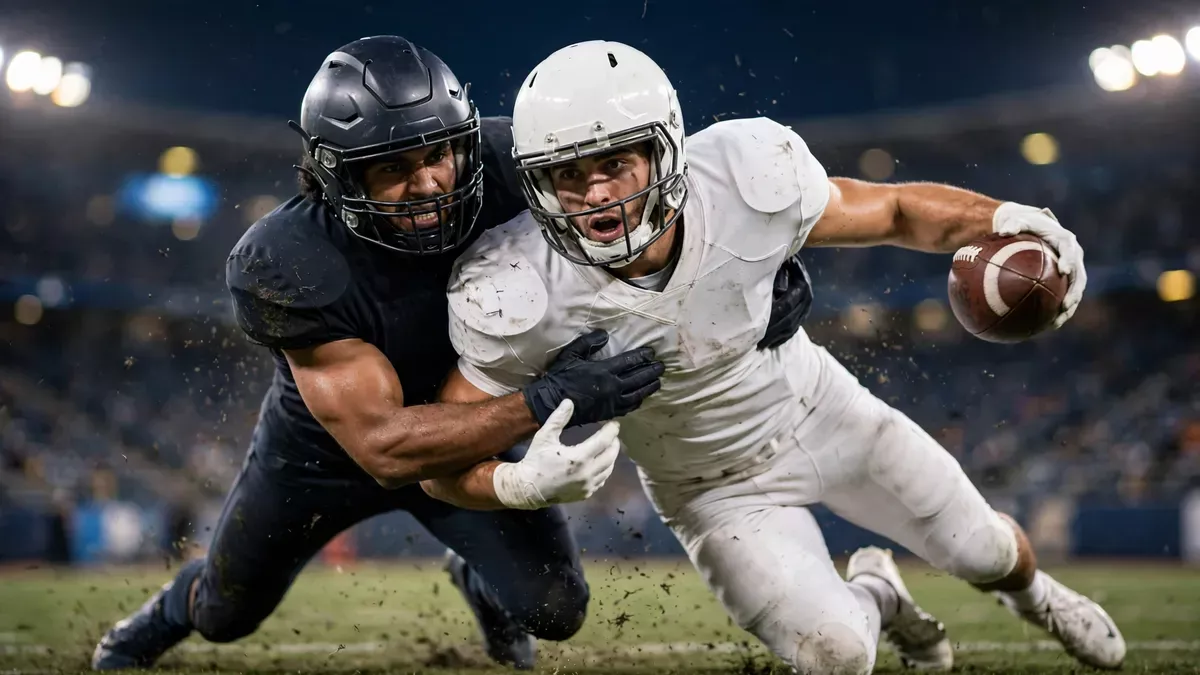
Football’s three signature defensive statistics all describe a play that ends behind the offense’s line of scrimmage — but they are not interchangeable. A sack is a tackle of the quarterback (or a quarterback forced out of bounds, or stripped of the ball) behind the line on a play where he intended to pass. A tackle for loss (TFL) is any tackle of a ball carrier behind the line of scrimmage — on runs, screens, and (in college bookkeeping) sacks themselves. A QB hit is legal contact that knocks the quarterback down as or just after he releases a pass, without bringing him down with the ball. Together with their unofficial cousin, the pressure, they form the vocabulary of defensive evaluation — and of the contracts paid to the edge rushers in our guide to the NFL’s most important positions (/the-nfls-most-important-positions-explained-why-quarterback-pay-sets-the-market/).
This guide defines each stat precisely, explains the judgment calls inside them (pass intent, half sacks, shared credit), and shows why the box score’s simplest numbers both reveal and conceal defensive dominance.
Key Takeaways
- Sack = quarterback tackled behind the line intending to pass. The intent matters: a tackled scrambler counts as a TFL, not a sack.
- Tackle for loss = any ball carrier tackled behind the line. In NCAA statistics, sacks are counted inside a player’s TFL total.
- QB hit = the quarterback is knocked down on a pass he got away — no sack, but the contact is recorded.
- Two defenders arriving together split a sack (0.5 each); partial credit is a normal part of pass-rush totals.
- Sacks became an official NFL statistic only in 1982 — earlier greats (Deacon Jones, who popularized the very word) have unofficial totals.
- Sacks subtract from a team’s net passing yards in the NFL; in college, sack yardage is charged against the quarterback’s rushing totals instead.
The sack: a pass play that ends behind the line
For a play to be scored a sack, three conditions must hold: the quarterback still has the ball, he is behind the line of scrimmage, and the play was a pass play — he intended to throw, or is judged to have been setting up to throw. The tackle itself can take several forms:
- The classic sack: the quarterback is tackled in the pocket or scrambling behind the line while looking to pass.
- The strip sack: the defender knocks the ball loose before the tackle; if the quarterback is downed or the ball is lost behind the line, the sack (and a forced fumble) is credited.
- The boundary sack: a quarterback driven out of bounds behind the line before he can throw is credited as a sack for the nearest defender, exactly as if tackled in bounds.
- The coverage sack: no rusher wins quickly, but airtight downfield coverage leaves the quarterback nowhere to go until the pressure arrives — still credited entirely to whichever defender finishes the play, a box-score injustice every pass rusher accepts.
The negative cases matter just as much. If a quarterback tucks the ball and runs — a designed keeper or a decided scramble — tackling him behind the line is a tackle for loss, not a sack, even though the result is identical. Scorers judge intent from the play’s design and the quarterback’s actions, which is why broadcast totals occasionally get revised by the league’s official statisticians during the week: a Sunday “sack” can quietly become a TFL (or vice versa) by Wednesday. Sack yardage also feeds team statistics directly: in the NFL, yards lost on sacks are deducted from the offense’s passing yardage (net passing yards), never from anyone’s rushing line; the NCAA instead charges sack yards against the quarterback as negative rushing yards — which is why college quarterbacks’ rushing totals look so strange next to their pro equivalents.
Half sacks keep the accounting honest when two defenders arrive simultaneously: each is credited with 0.5. Quarter sacks do not exist; if three men arrive, the official scorer awards halves or a full sack to the principal defender by judgment.
The tackle for loss: the run game’s negative play
A tackle for loss is scored whenever a defender tackles a ball carrier behind the line of scrimmage on any play that isn’t a sack — a running back met in the backfield, a receiver wrapped up behind the line on a screen or jet sweep, a quarterback tackled on a designed run. TFLs are the signature statistics of disruptive interior defenders and penetrating linebackers: the defensive tackle who lives in the opponent’s backfield may post modest sack numbers while leading his team in TFLs, and coaches grade run defense substantially on how many negative plays it manufactures, because a single TFL typically turns second-and-manageable into second-and-long and bends the whole drive’s math (see our first-down guide (/what-is-a-first-down-the-chains-the-line-to-gain-and-the-spot-of-the-ball/) for why that bend matters).
In college statistics, the categories nest: sacks are included within a player’s tackles-for-loss total, so an NCAA defender’s TFL line is always at least his sack line. NFL stat services list them side by side in the same spirit — a sack is, after all, a tackle behind the line — but the NFL’s official record-keeping treats the sack as its own headline category with its own history: it became an official statistic only in 1982, so the great rushers of the 1960s and 70s have no official career totals. The term itself was popularized by Hall of Fame defensive end Deacon Jones, who liked the image of sacking a city; historians have since reconstructed his unofficial totals from film, and the league acknowledges them informally while keeping the official record book clean from 1982 forward.
The QB hit — and the unofficial world of pressures
A quarterback hit is recorded when a defender knocks the quarterback to the ground on a play where the pass still got away. No yardage is lost and no tackle is made, yet the hit is anything but harmless: it is the stat that tracks punishment accumulation. Hits are recorded in official gamebooks and drive a player’s reputation with coaches and quarterbacks alike — the rush that arrives a half-step late all afternoon is the one that has the quarterback hearing footsteps by the fourth quarter, rushing throws he would normally make.
Beyond hits lies the analyst-built layer, none of it official and all of it essential to modern evaluation:
- Pressure: any play where the quarterback is sacked, hit, or hurried — forced to move or throw early — umbrellaed into one number by analytics services.
- Hurry: a pressure where the rusher forces an early or off-platform throw without making contact.
- Win rate: how often a rusher beats his blocker within a set time, tracked by player-tracking data — the stat front offices now treat as the purest measure of pass-rush skill, because sacks themselves depend on coverage, quarterback behavior, and luck.
The distinction explains the classic evaluation puzzle: the rusher with six sacks and an elite pressure rate is usually a better player — and will be paid like a better player, per the positional economics in our positions guide (/the-nfls-most-important-positions-explained-why-quarterback-pay-sets-the-market/) — than the rusher with eleven sacks built on cleanup plays and a quarterback who holds the ball forever. Sacks are events; pressure is a process. The box score counts events; the game is decided by the process.
Defensive stats FAQ
Is a sack also a tackle for loss?
In the NCAA, yes — sacks count inside a player’s TFL total. In the NFL the sack is its own official category, recorded alongside TFLs as a related statistic.
What is the difference between a QB hit and a sack?
A sack requires the quarterback to go down with the ball behind the line. A QB hit is contact that knocks him down after (or as) he releases the pass — the throw still counts.
What is a half sack?
When two defenders tackle the quarterback together, each is credited with 0.5 sacks. It is the only fractional credit the statistic allows.
Do sack yards count against the quarterback’s stats?
In the NFL, sack yardage is deducted from the team’s passing yards (net passing), not from the quarterback’s rushing. In college, it is charged against the quarterback’s rushing total.
When did sacks become an official NFL stat?
1982. Pass rushers before then — including Deacon Jones, who popularized the term — have only unofficial, film-reconstructed totals.
What is a pressure?
An analytics term (not an official stat) covering sacks, hits and hurries combined — the standard modern measure of how often a rusher disrupts the quarterback.
Related reading
These numbers drive the paydays in our guide to the NFL’s most important positions (/the-nfls-most-important-positions-explained-why-quarterback-pay-sets-the-market/) and the flags in our pass interference explainer (/what-is-pass-interference-the-rule-the-penalty-and-the-replay-limits/) — follow them live on our NFL scores page (/nfl/scores/) and the NFL hub (/nfl/).
Corrections: if you spot an error in this guide, tell us through our Corrections Policy (/corrections-policy/) page and we will check it against official sources.