
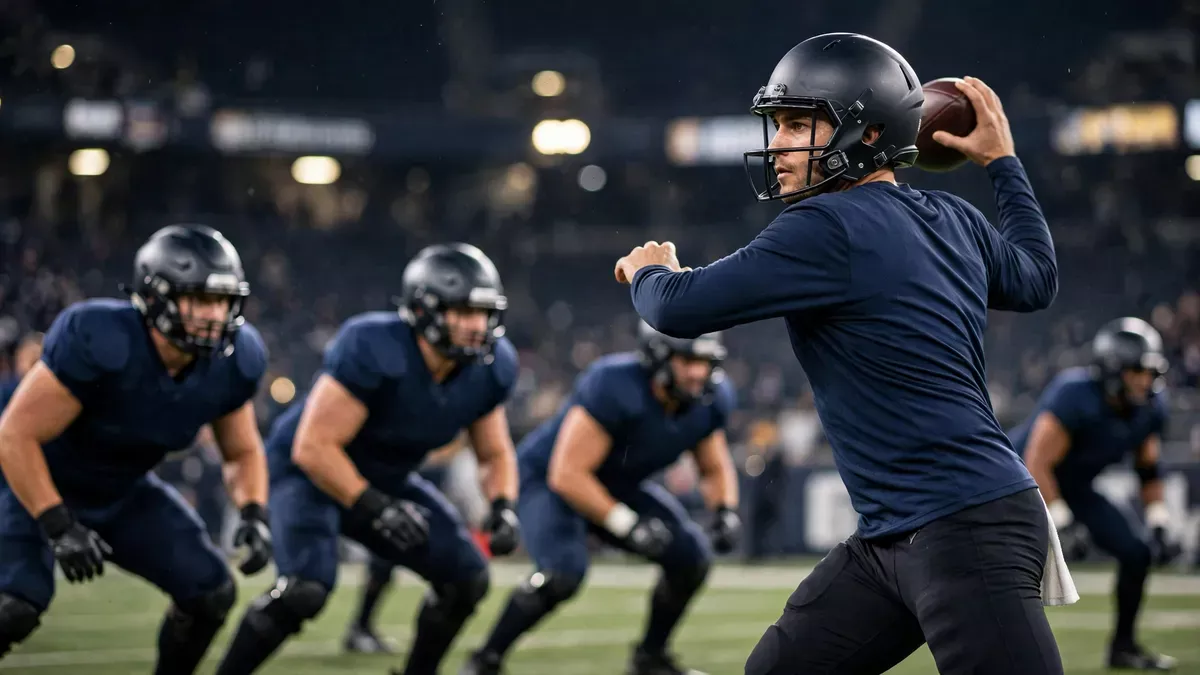
Not all 22 starting jobs in football are equal, and the NFL’s pay scales prove it. The quarterback is the most valuable single position in team sports — the richest contracts in league history, now averaging around $55–60 million per year at the very top, belong to quarterbacks alone — because he touches the ball on every offensive play, makes pre-snap decisions no one else can make, and is scarcer than any other elite skill on the field. Behind him sits a clear hierarchy of “premium positions”: edge rusher, offensive tackle, cornerback and wide receiver, paid and drafted early because their skills are rare and their failures are catastrophic. This guide explains the hierarchy, why quarterback pay sets the market for everyone else, and why running backs ended up on the wrong side of the sport’s economics.
Key Takeaways
- Positional value = on-field impact × scarcity. Quarterback leads both by enormous margins, which is why its pay resets the market.
- The premium tier after QB: edge rusher, left tackle, No. 1 cornerback, and (now) No. 1 wide receiver — all paid at or near $25–40 million per year at the top.
- A franchise QB on a veteran deal consumes roughly a fifth of the salary cap; on a rookie deal, a small fraction — the largest roster-building edge in sports.
- Running back is the devalued position: replaceable production, short peaks, and brutal injury attrition make second contracts rare.
- Draft position mirrors the pay hierarchy: premium positions dominate the top 10; running backs and off-ball linebackers have nearly vanished from it.
- “Best player” and “most valuable player” are different questions — value is about the gap between a star and his replacement at that position.
Why the quarterback stands alone
Every offensive snap begins in the quarterback’s hands, and in the modern game roughly two of every three plays end as his decision: the pass he throws, the run he checks into, the protection he resets, the blitz he identifies (or doesn’t). No other player in American team sports combines that volume of involvement with that degree of difficulty. The performance gap compounds the case: the distance between the league’s fifth-best and twentieth-best quarterback is, by any wins-based measure, worth several victories a season. The same gap at almost any other position is worth a fraction of one.
Scarcity seals it. At any given moment, perhaps a dozen human beings can play the position at a championship level, while 32 teams need one — a permanent seller’s market. The result is the contract ladder fans watch each offseason: the newest franchise quarterback to sign becomes the highest-paid player in history (recent cycles have pushed the top average to roughly $55–60 million per year), and within two years he ranks fifth, because the cap keeps growing and the next contracts keep landing on top of his. As our salary cap guide (/nfl-salary-cap-explained-dead-money-restructures-and-the-franchise-tag/) explains, the smart teams exploit the one loophole in this economy: the rookie contract, where a star quarterback costs less than a mid-tier guard, and the savings fund an entire supporting cast.
The premium tier: the positions that protect, attack and cover
Beneath quarterback, four positions share a profile: one-on-one jobs, performed in space, where individual failure shows up immediately on the scoreboard.
- Edge rusher: the most direct way to ruin a quarterback’s day without blitzing. An elite edge bends the entire protection scheme — chips, double teams, quicker throws — which is why top pass rushers are paid in the $30–40 million range and drafted in the top five. A defense that can pressure with four can cover with seven; everything downstream gets easier.
- Offensive tackle (especially left tackle): the blindside protector, matched one-on-one against the defense’s best athlete on every pass. Top tackles now earn in the mid-$20 millions and up. The position’s value is quietly binary: competence is invisible, and the one snap of failure can end a quarterback’s season.
- Cornerback: the only defensive job that asks an athlete to run backward against the league’s fastest players and still contest the ball. A true No. 1 corner erases a side of the field and licenses aggressive blitzing behind him; the top of the market pays like it, in the mid-$20 millions and climbing.
- Wide receiver: the newest arrival in the premium tier. As passing volume climbed, elite receivers’ market corrected violently upward — the top contracts now exceed $35 million per year — because a receiver who wins one-on-one against top corners tilts coverage the same way a great edge tilts protection.
What unites the tier is replacement scarcity: there is no scheme that manufactures an elite edge rusher, and no depth chart that hides a bad left tackle. Teams pay for irreplaceability, not effort or popularity.
The squeezed middle — and the running back problem
Below the premium tier, the market cools fast, and the reasons are instructive. Interior offensive linemen, off-ball linebackers, safeties and tight ends all matter enormously to winning — but competent replacements are findable in the draft’s middle rounds and free agency’s second wave, so star pay at those spots tops out well below the premium tier and teams rarely fight bidding wars to keep even excellent players. Only true outliers (a generational tight end, a safety who runs a defense) break the pattern.
Running back is the extreme case, and the league’s most debated economics lesson. The facts front offices act on: rushing production depends more on blocking and scheme than on the individual back; the position’s peak is short and early (most backs decline sharply before their late 20s); carries themselves accelerate the decline; and capable replacements are available every draft in the middle rounds for minimum money. The result is not that running backs are unimportant — a great back still transforms an offense — but that their value peaks exactly when their contract is cheapest, on the rookie deal described in our draft guide (/how-the-nfl-draft-works-order-picks-trades-and-the-rookie-wage-scale/), and second contracts have become rare exceptions reserved for the handful of backs who are also elite receivers. The franchise tag tells the same story: priced off the position’s suppressed salary averages, the running back tag has fallen to among the cheapest in the league — a fact running backs cite, fairly, as the system’s insult added to its injury.
How value shows up on draft day
The draft board is the hierarchy made visible. Top-10 picks are spent overwhelmingly on the premium tier — quarterbacks first and always, then tackles, edges, corners and receivers — because the draft is the only place those players are cheap, and a five-year cost-controlled star at a premium position is the most valuable asset in the sport. Running backs taken in the first round, once routine, have become rarities discussed as indulgences; off-ball linebackers and safeties slide similarly. This is also why trade-up prices (see our trades guide (/how-nfl-trades-work-deadlines-draft-pick-values-and-why-deals-fall-through/)) explode when a quarterback is the target and merely wobble for everyone else: the market is not pricing the player alone, it is pricing the position’s replacement cliff.
NFL positional value FAQ
Why is the quarterback paid so much more than everyone else?
Volume of involvement (every play), decision-making no one else performs, and scarcity: championship-level quarterbacks number in the low teens while 32 teams need one. The pay reflects the cliff between a star and his replacement.
What is the second most valuable position?
There is no universal order, but edge rusher, left tackle and No. 1 cornerback form the consensus next tier, with elite wide receiver now joining them in both pay and draft priority.
Why aren’t running backs paid like other stars?
Because their production is replaceable, their peaks are short, and the wear of the position is severe — teams have learned they can approximate a veteran back’s output with a mid-round rookie at a fraction of the cost.
What is a “premium position”?
A position where elite talent is scarce, failure is immediately costly, and replacement-level play is far below star level: quarterback, edge rusher, offensive tackle, cornerback and, increasingly, wide receiver.
Does the most valuable player mean the best player?
No. A guard can be the best player at his position in a decade and still matter less to winning than a merely good quarterback, because value measures the star-to-replacement gap at that spot.
How much of the salary cap does a top quarterback take?
At the top of the market, roughly a fifth of one team’s cap — which is why a star on a rookie contract, at a tenth of that share, warps roster-building league-wide.
Related reading
This hierarchy is priced by the machinery in our salary cap (/nfl-salary-cap-explained-dead-money-restructures-and-the-franchise-tag/), draft (/how-the-nfl-draft-works-order-picks-trades-and-the-rookie-wage-scale/) and free agency (/how-nfl-free-agency-works-unrestricted-restricted-and-the-legal-tampering-window/) guides — and debated weekly on our NFL hub (/nfl/).
Corrections: if you spot an error in this guide, tell us through our Corrections Policy (/corrections-policy/) page and we will check it against official sources.