
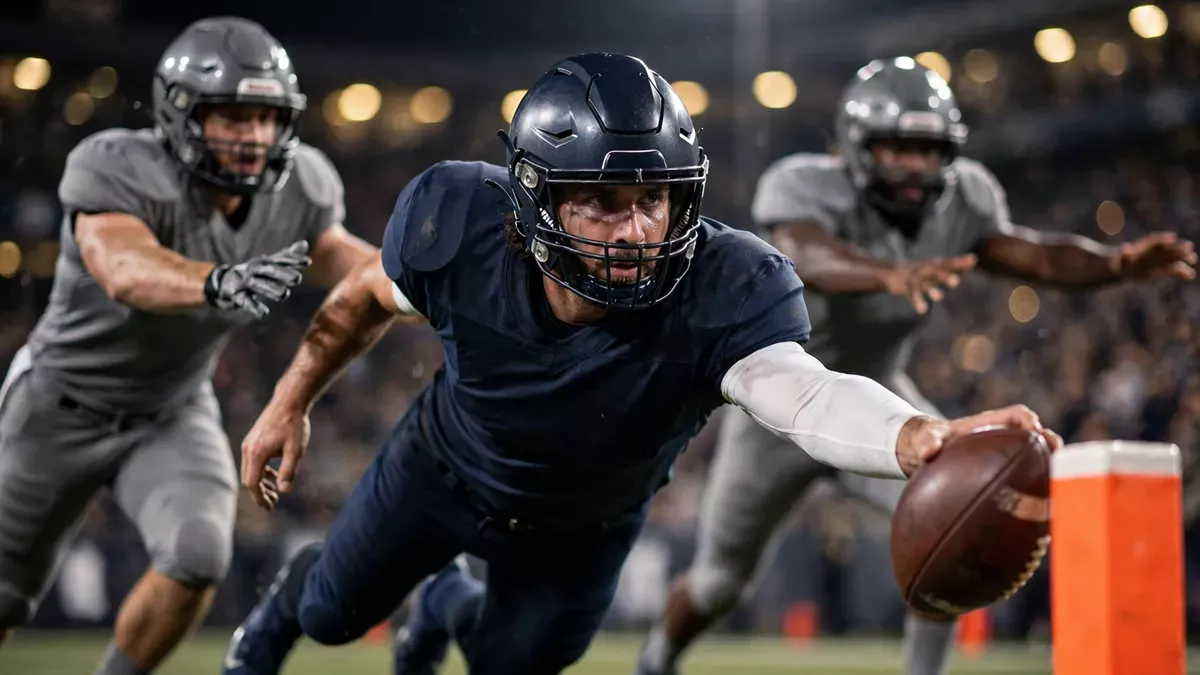
After a touchdown, the scoring team chooses how to add to it: kick an extra point (one point, from a snap at the 15-yard line) or run a single untimed play from the 2-yard line worth two points if the offense reaches the end zone — the two-point conversion. The NFL adopted the two-point try in 1994, decades after college football (1958) and the old AFL had it. The long-run math is nearly a coin flip of value — extra points succeed about 94–95 percent of the time since the kick was moved back in 2015, two-point tries about 47–48 percent — so the real question is never just the averages. It is the score, the clock, and what each outcome does to the rest of the game.
This guide explains the rule itself, the strange scoring possibilities it creates (including the defense scoring two points, and the one-point safety), and the scoreboard states where the math genuinely favors rolling the dice.
Key Takeaways
- A two-point conversion is one play from the 2-yard line after a touchdown (3-yard line in college). Success adds two points; failure adds none.
- The NFL adopted it in 1994; the extra point was moved back to the 15-yard line snap in 2015, which narrowed the value gap between the two choices.
- League-wide, two-point tries succeed at roughly 47–48 percent and extra points at roughly 94–95 percent — near-identical expected value.
- The defense can score on a try: a turnover returned the length of the field is worth two points for the defense (a rule since 2015).
- The clearest “go” spot is down 8 after a touchdown, where conversion ties the game; down 14 late, analysts favor trying on the first touchdown too.
- Penalties on a try can move the ball closer (or push it back), and a team may change its choice after a penalty or timeout within the rules.
The rule, precisely
The try is a single scrimmage play with the game clock stopped. In the NFL the ball is spotted at the defense’s 2-yard line for a two-point attempt; for a kick attempt, the ball is snapped from the 15 (making it a 33-yard kick). The offense declares its choice by how it lines up, and it can change its mind after a timeout or after a penalty changes the distance: a defensive foul on a failed try gives the offense another attempt from half the distance — one yard from the goal line, among the most valuable single yards in sports — while an offensive foul pushes the retry back 10 yards, at which point most teams take the kick instead.
The try ends like any play: score, stop, or turnover. And since 2015, the try is a live two-way street:
- Defensive two points: if the defense gains possession (interception or fumble recovery) and returns the ball the length of the field into the offense’s end zone, the defense scores two points. Blocked kicks recovered and returned count the same way. It remains one of the rarest scores in the sport, and the loudest.
- The one-point safety: if the offense commits a safety during its own try — say, a fumble recovered in the field of play and carried back into its own end zone, or a foul in its own end zone — the defense is awarded one point. This is the only way to score exactly one point in an NFL game, and it has never happened in a regular-season game.
- No re-kick drama: a missed kick with no foul is simply dead — no points, kickoff follows, same as a failed run or pass.
College football runs the same play from the 3-yard line and adds one flourish the NFL doesn’t: in overtime, from the third overtime period onward, college teams run only two-point tries instead of full possessions, which is how modern college overtimes end in alternating single-play duels.
The math: why “the chart” became a model
For decades, sideline decisions ran on a laminated card — the “chart” popularized in the 1970s–90s — that simply mapped score difference to choice: down 2, go for two; down 5, kick; and so on. The chart’s logic was endgame arithmetic, not value: it asked which choice kept a tie or a lead reachable with the scores most likely to remain.
Analytics rebuilt the question from expected value and win probability, and reached two conclusions that now drive most aggressive calls:
- On average, the two plays are worth the same. At ~47.5 percent, a two-point try returns about 0.95 expected points; a kick at ~94–95 percent returns about the same. Choosing two is not “riskier value” over a season — it is the same value with more variance, and variance itself is a tool: underdogs want it, favorites late in games do not.
- Score state beats averages. The famous case is trailing by 14 late and scoring a touchdown to cut it to 8. Conventional wisdom said kick, take the sure point, and play for a tie. The models say go for two immediately: make it, and the next touchdown wins the game outright; miss it, and you can still convert after the next touchdown to tie. Because you learn the outcome of the try while another possession remains, the aggressive call buys information — worth roughly several percentage points of win probability by most published models. The same logic governs the simpler spots: down 8 after scoring (go for two to tie), down 2 (go for two to lead), and up 1 late (go for two to lead by 3, the margin that changes the opponent’s endgame).
Weather, a shaky kicker, a dominant short-yardage offense, or a gassed defense all nudge the inputs. What the models killed was the reflex — the automatic kick in states where the tie it protects is worth less than the win it forfeits.
Why coaches still get conservative
If the math is this balanced, why do kicks still outnumber tries by a wide margin in ordinary situations? Partly personnel: many offenses are genuinely below-average from the 2-yard line, and league-average rates misdescribe them. Partly sequencing: an early failed try “chases points” the rest of the afternoon, forcing later decisions (the second-guess cascade every coach knows by heart). And partly job security — a failed two-point call is a press-conference topic for a week; a missed kick is the kicker’s fault. The trend line, though, moves one way: attempts per season have climbed steadily since 2015’s kick change, aggressive young staffs treat the down-8 and down-14 spots as solved, and playoff games have begun turning on exactly the decisions the old chart got wrong.
Two-point conversion FAQ
When did the NFL adopt the two-point conversion?
In 1994. College football had used it since 1958, and the AFL had it throughout its existence in the 1960s.
From where is the two-point conversion attempted?
From the defense’s 2-yard line in the NFL (the 3-yard line in college). A kick attempt is snapped from the 15-yard line in the NFL.
What is the success rate?
Two-point tries succeed at roughly 47–48 percent league-wide in recent seasons; extra points at roughly 94–95 percent since the kick moved back in 2015.
Can the defense score on a two-point try?
Yes. Since 2015, a defense that gains possession and returns the ball to the other end zone scores two points — the same value as the conversion itself.
What is the one-point safety?
A safety committed by the offense during its own try awards the defense exactly one point. It is the only single point in football scoring, and it has never occurred in an NFL regular-season game.
When should a team always go for two?
The clearest spots: trailing by 8 after a touchdown (to tie), trailing by 2 (to lead), and — per modern analytics — trailing by 14 late upon scoring the first of the two touchdowns needed.
Related reading
Endgame math connects this guide to our explanations of NFL overtime (/how-nfl-overtime-works-and-why-the-rules-changed/) and how the playoffs work (/how-the-nfl-playoffs-work-seeding-byes-and-home-field-advantage-explained/) — and you can watch the calls in real time on our NFL scores page (/nfl/scores/) and the NFL hub (/nfl/).
Corrections: if you spot an error in this guide, tell us through our Corrections Policy (/corrections-policy/) page and we will check it against official sources.