
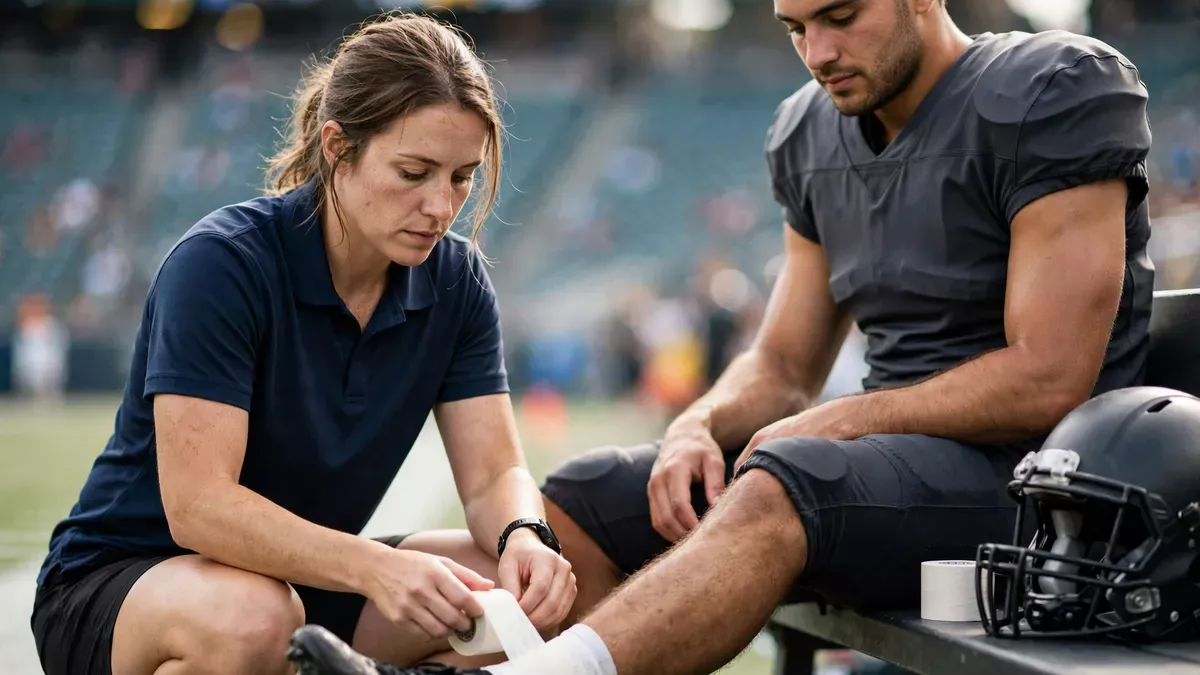
The NFL injury report is the league’s official, mandatory accounting of every player’s health during the season. Teams must report practice participation after every practice — Did Not Participate, Limited, or Full — and assign one of three game-status designations on the final report before each game: Questionable (uncertain whether the player will play), Doubtful (unlikely to play), or Out (will not play). The system exists for one founding reason: competitive integrity. The league has required honest disclosure since the 1940s precisely so that no insider profits from secret injury knowledge, and teams that fudge the report are fined.
This guide explains the weekly rhythm of the report, what each designation really means in practice, why “Probable” disappeared in 2016, and how Injured Reserve and the related lists work.
Key Takeaways
- Teams file practice reports Wednesday, Thursday and Friday (for Sunday games), grading every injured player: DNP, Limited, or Full participation.
- Final game status uses three designations: Questionable (uncertain), Doubtful (unlikely), Out (will not play).
- “Probable” was abolished in 2016 because almost every “probable” player played, making the label meaningless — and soaking up players who belonged in Questionable.
- Injured Reserve now requires a minimum of four games missed; teams get a limited number of designated-for-return slots per season.
- The inactives list, due 90 minutes before kickoff, is the final word on who is actually playing.
- The report exists to protect the game’s integrity: teams are fined for failing to disclose injuries.
The weekly rhythm: practice reports first
The report is really two documents. The first is the practice participation report, filed after each practice day — Wednesday, Thursday and Friday for a Sunday game, compressed for Thursday- or Monday-night teams. Every player with a reportable injury is listed with the body part or illness involved and one of three participation levels:
- DNP (Did Not Participate): no practice work at all. A Wednesday DNP for a veteran is routine maintenance; a Friday DNP is a red flag.
- Limited Participation (LP): practiced, but less than a full workload — the report’s most common entry, and the one that tells you the least.
- Full Participation (FP): a complete practice. A player who is Full by Friday is almost always playing, designation or not.
Reading the trend matters more than any single day. A player going DNP → Limited → Full is ramping toward Sunday. The reverse pattern — Full early, DNP Friday — usually means a setback, and setbacks, not the original injury, are what the designations on Friday afternoon are really pricing in.
A separate line you’ll see often is “DNP — Rest” or “NIR” (not injury related): veteran maintenance days and personal absences must be disclosed too, so that a healthy star’s missing practice never masquerades as a secret injury or vice versa.
Game status: the three designations
On the final practice report, teams assign game status to players whose availability is in any doubt:
- Questionable: officially defined as “uncertain that the player will play.” In practice this is the report’s true 50/50 band — and since 2016, its most crowded one. Historical tracking consistently finds that a majority of questionable players do suit up, but the label covers everything from near-certainties being cautious to genuine game-time decisions.
- Doubtful: “unlikely that the player will play.” Doubtful players almost never appear — in practice the designation is a near-final no, and a doubtful player who dresses is a genuine surprise worth a headline.
- Out: the player will not play. Definitive. Teams must also declare players Out who are being held for the reserve lists or travel reasons.
Statuses can be updated on Saturday for Sunday games (a downgrade to Out for a player not traveling with the team is the common one), and the last checkpoint of all is the inactive list, submitted 90 minutes before kickoff: seven players (with roster exemptions) named inactive, ending all speculation.
Why “Probable” disappeared
Long-time fans remember a fourth label: Probable, defined as “virtually certain to play.” The league abolished it before the 2016 season for a simple statistical reason — players listed as Probable played at a rate so high (historically around 95 percent) that the designation carried no information, while teams were parking genuinely uncertain players there to keep opponents guessing. The league folded that population into Questionable, where uncertainty properly lives.
The side effect is the ambiguity modern fans live with: Questionable now spans “held out of practice as a precaution, definitely playing” through “will test it in warmups.” Analysts cope the way this guide suggests: weight the Friday practice level, the player’s history with the designation, and the Saturday travel news. Anyone who tells you Questionable means exactly 50 percent is describing the dictionary, not the document.
Injured Reserve and the other lists
Beyond the weekly report sit the roster lists that govern longer absences:
- Injured Reserve (IR): for players with major injuries. Under current rules a player on IR must miss at least four games before returning, and each team has a limited number of designated-for-return slots per season (eight in recent seasons, with an additional allowance in the postseason) — which is why “will they use a return slot on him?” is a real front-office question in November. A player can return from IR only twice in a season, and the same player only once.
- Physically Unable to Perform (PUP): for players injured before training camp who have never practiced that season. The preseason PUP list carries its own minimum absence into the regular season; in-season, the reserve/PUP return window mirrors IR’s four-game structure.
- Non-Football Injury/Illness (NFI): the parallel list for injuries or illnesses suffered outside team activities — a training accident at home, a medical condition — with similar return mechanics and different pay implications.
These lists interact with the salary cap and the trade market (covered in our salary cap guide (/nfl-salary-cap-explained-dead-money-restructures-and-the-franchise-tag/)) in ways that shape rosters as much as the injuries themselves: every IR return slot spent in October is one unavailable for a December stretch run.
Why the league polices the report so hard
The injury report is not a media courtesy; it is an anti-corruption instrument. Secret injury information has obvious value to anyone wagering on games or trading on inside knowledge, and the league’s answer — since the report’s origins in the 1940s, and with real enforcement teeth in the modern era — is radical, mandatory, symmetrical transparency: everyone learns the same information at the same time. Compliance is audited, and violations draw real punishment: in 2023, for example, the league fined the Atlanta Falcons and their head coach after the team failed to disclose a running back’s illness before a game in which his role suddenly shrank. Coaches who treat the report as gamesmanship — the surprise scratch, the phantom listing — reliably end up writing the league a check. For fans, that enforcement is what makes the Friday report worth reading at all: imperfect as the labels are, a listed injury is a real injury, and the absences that matter will never be hidden entirely.
NFL injury report FAQ
What does Questionable actually mean?
Officially, “uncertain that the player will play.” In practice a majority of questionable players do play — read the Friday practice level for the real signal.
Do Doubtful players ever play?
Almost never. Doubtful means unlikely, and in practice it functions as Out with a small theoretical exception.
When does the final injury report come out?
After the final full practice before the game — Friday afternoon for Sunday games, Saturday for Monday games, and on the compressed schedule for Thursday games.
Why was Probable removed?
Because nearly every Probable player played. The league abolished it in 2016 and moved those players into Questionable.
How long must a player stay on Injured Reserve?
At least four games. Teams also have a limited number of designated-for-return slots each season, so not every IR player can come back.
What is the inactive list?
The final list of players not dressing for the game, submitted 90 minutes before kickoff. It supersedes every designation.
Related reading
Injury news moves fantasy football more than any other weekly information — pair this guide with our fantasy football basics (/fantasy-football-basics-how-to-play-draft-and-win-your-league/) and the salary cap guide (/nfl-salary-cap-explained-dead-money-restructures-and-the-franchise-tag/), and follow game-day availability on our NFL scores page (/nfl/scores/) and the NFL hub (/nfl/).
Corrections: if you spot an error in this guide, tell us through our Corrections Policy (/corrections-policy/) page and we will check it against official sources.