
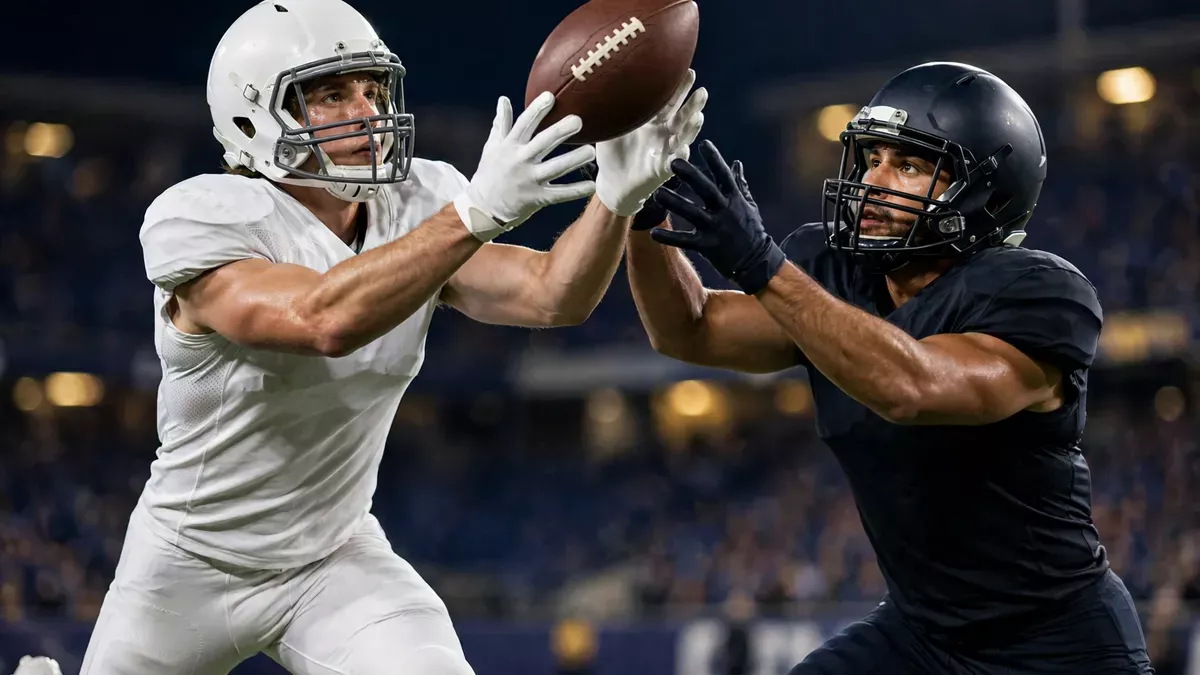
Pass interference is a foul for illegally restricting an opponent’s chance to catch a forward pass after the ball has left the quarterback’s hand. In the NFL, defensive pass interference is one of the most punishing penalties in sports: the ball is placed at the spot of the foul with an automatic first down, which can mean a gain of 40 or 50 yards on a single flag. Offensive pass interference costs the offense 10 yards. And since a one-season experiment ended in 2020, interference calls in the NFL cannot be reviewed on replay at all — which is why this judgment call, more than any other in football, decides arguments long after games end.
This guide sets out exactly what the rule covers, what contact is legal, how the NFL and college penalties differ, and why replay review of interference came and went so quickly.
Key Takeaways
- Pass interference is significant contact that restricts an opponent’s opportunity to catch a pass, after the pass is thrown and before it is touched.
- Both sides can commit it: defensive pass interference (DPI) and offensive pass interference (OPI) are mirror-image fouls.
- NFL defensive pass interference is a spot foul with an automatic first down — in the end zone, the ball goes to the 1-yard line.
- College defensive pass interference is capped at 15 yards, which changes late-game strategy completely.
- There is no foul if the pass is uncatchable, the contact is incidental, or a defender playing the ball makes legal contact going for the interception.
- The NFL allowed replay review of interference for one season only (2019) and repealed it; the call is not reviewable today.
What counts as pass interference
The rule protects one specific moment: a legal forward pass in the air, beyond the line of scrimmage, not yet touched by any player. During that window, neither team may restrict the other’s opportunity to make the catch. The acts officials are trained to look for are consistent across rulebooks:
- Contact that restricts: grabbing an arm, hooking a receiver around the waist, pushing or shoving a player off his route to the ball, or running through a receiver before the ball arrives.
- Playing the man, not the ball: a defender who makes significant contact without turning to locate the ball — cutting off a receiver’s path, or colliding with him while facing him the whole way — is judged far more harshly than a defender contesting the throw.
- Early arrival: tackling or colliding with the receiver before the ball gets there, the classic “he was early” flag.
- For the offense: a receiver pushing off to create separation at the catch point, extending an arm into a defender, or a teammate setting what amounts to a moving screen downfield (the “pick play” officials watch for near the goal line).
The legal window closes the instant the ball is touched — by anyone, including a deflection at the line of scrimmage. Once a pass is tipped, interference restrictions fall away and the scramble for the loose ball is, within the other rules, fair game.
What is NOT pass interference
Just as important is the contact the rules expressly forgive, because most “missed calls” fans argue about live here:
- Incidental contact: two players with their eyes on the ball, feet tangled or shoulders brushing while both play the throw, is not a foul. Both sides have an equal right to the ball and to the position they occupy going for it.
- Playing the ball: a defender who turns, locates the throw and makes contact while genuinely contesting the catch — the hand fighting through to knock the ball away — is making a legal play, even when the contact is substantial.
- Uncatchable passes: if the throw sails so far over, wide or behind that no player had a realistic chance to catch it, interference cannot be called even if contact occurred. Quarterbacks throwing the ball away under pressure benefit from this constantly.
- Face guarding without contact: a defender running step for step with his back to the quarterback, arms waving, is legal in the NFL if he never touches the receiver. It looks wrong; it is not, by itself, a foul.
- Contact before the pass: restrictions begin when the ball is thrown. Contact within the first five yards of the line of scrimmage by a defender is judged under the illegal-contact and defensive holding rules instead — related fouls, but different ones, with 5-yard penalties rather than spot enforcement.
The penalty: why the NFL and college games diverge
Enforcement is where interference becomes famous. In the NFL, defensive pass interference places the ball at the spot of the foul and awards an automatic first down (one of the automatic first downs explained in our first-down guide (/what-is-a-first-down-the-chains-the-line-to-gain-and-the-spot-of-the-ball/)). A foul in the end zone puts the ball on the 1-yard line; a foul close to the defense’s goal is enforced half the distance. The practical result: a defender beaten deep on a 45-yard bomb can cost his team 45 yards without a catch being made — the largest single-play yardage swing in the rulebook, and the reason quarterbacks happily launch contested deep balls on free plays and third-and-long.
College football caps defensive pass interference at 15 yards (or half the distance to the goal), with the automatic first down attached. Critics have long noted the obvious strategic consequence: a beaten college defender is rationally better off tackling the receiver early and conceding 15 yards than allowing a 50-yard completion — the “professional foul” debate the NFL’s spot foul was designed to eliminate. Proposals to move the NFL to a 15-yard cap surface every few years and go nowhere, because the spot foul is precisely what keeps deep passing viable.
Offensive pass interference is enforced the same in both codes — 10 yards from the previous spot, down replayed — and no version of interference by the offense can put the ball in the end zone or award a touchback-style windfall to the defense.
The replay experiment: one season and out
Pass interference’s modern infamy has a date: the January 2019 NFC Championship Game, where an obvious, uncalled interference foul in the final minutes effectively sent the wrong team — by near-universal agreement at the time — to the Super Bowl. The backlash pushed the NFL to an extraordinary step: for the 2019 season only, pass interference (called or uncalled) became reviewable by replay, including coach’s challenges in the final two minutes.
It failed on its own terms. Officials, reluctant to overturn judgment calls frame by frame, upheld almost everything; the standard for reversal (“clear and obvious”) so rarely matched how the foul looks in slow motion that the rule changed few outcomes while adding delay and fresh controversy. The league let it expire after one season and has never restored it. Today, interference is entirely a real-time judgment: not reviewable, not challengeable, and correctable only by an official’s conference on the field before the next snap. The episode remains the league’s clearest statement of a philosophy it applies nowhere else so strictly — that some calls are too judgment-bound for the replay booth, and the game accepts the human error that comes with that.
Why this flag starts more arguments than any other
Interference sits at the collision point of the sport’s biggest stakes and its vaguest standard. “Significant contact” and “restricts” are not measurements; they are judgments made at full speed, from one angle, on plays where a yard of separation is worth millions. Crews differ, games differ, and the informal truth every fan learns — that the standard quietly loosens in the final minutes and on Hail Mary plays, where officials let crowds of players fight for the ball — is acknowledged by everyone and written down nowhere. The 1978 rule changes that opened up the passing game made interference the fulcrum of modern offense; everything in today’s scoring records leans on where, exactly, officials draw this line. That is why a single yellow flag, or a pocket kept conspicuously empty, can lead a week’s coverage: no other call moves win probability so far on language so open to interpretation.
Pass interference FAQ
Is pass interference reviewable in the NFL?
No. It was reviewable for the 2019 season only. Since 2020 it cannot be challenged or reviewed, whether it was called or not called.
How many yards is defensive pass interference in the NFL?
It is a spot foul: the ball is placed where the foul occurred, plus an automatic first down. In the end zone, the ball is placed at the 1-yard line.
How is college pass interference different?
The NCAA caps defensive pass interference at 15 yards (or half the distance to the goal) with an automatic first down — far less costly than the NFL’s spot foul.
What is offensive pass interference?
A receiver illegally restricting a defender’s chance to play the ball — classically pushing off to create separation. It costs the offense 10 yards.
Can pass interference be called on a tipped ball?
No. Once the pass is touched by any player, interference restrictions no longer apply on that play.
What does “uncatchable” mean?
A pass so far beyond the intended receiver’s reach that he had no realistic opportunity to catch it. Contact on an uncatchable pass is not interference.
Related reading
Round out the rules picture with our guides to first downs and the chains (/what-is-a-first-down-the-chains-the-line-to-gain-and-the-spot-of-the-ball/) and NFL overtime (/how-nfl-overtime-works-and-why-the-rules-changed/), and watch the flags fly on our NFL scores page (/nfl/scores/) and the NFL hub (/nfl/).
Corrections: if you spot an error in this guide, tell us through our Corrections Policy (/corrections-policy/) page and we will check it against official sources.