
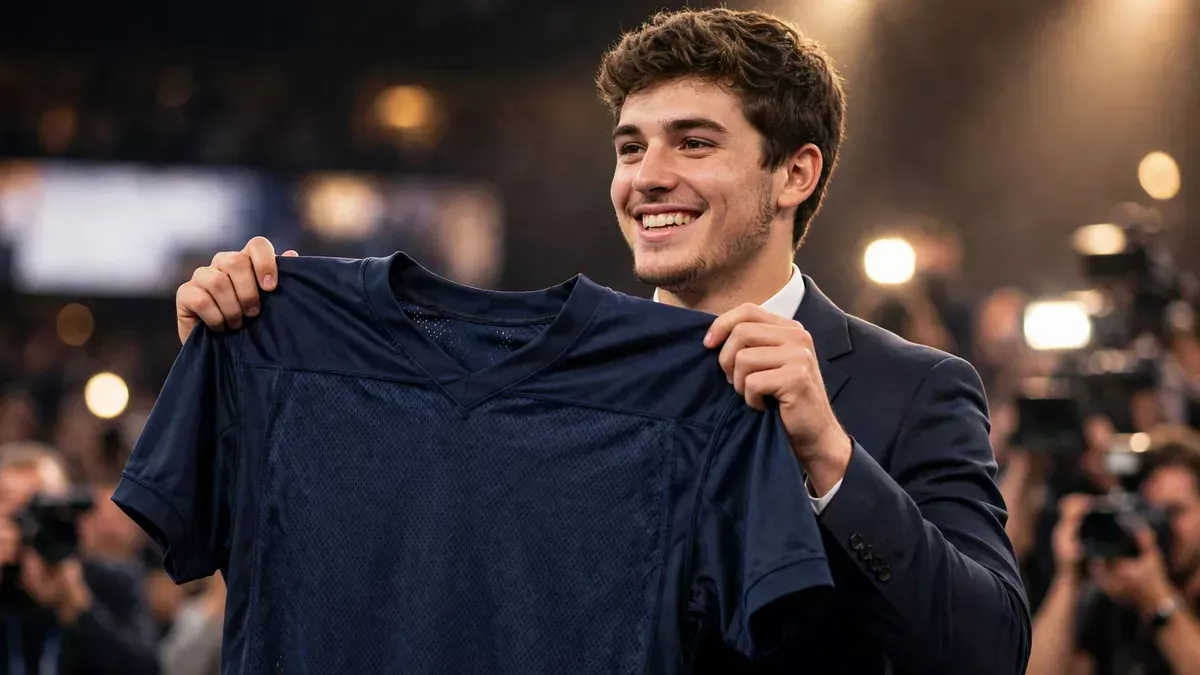
The NFL draft is how the league distributes new talent: over three days and seven rounds, the 32 teams take turns selecting eligible college players, with the worst team from the previous season picking first in each round. Every drafted player is assigned a slotted rookie contract under the rookie wage scale, and picks themselves can be traded — which is why the draft is as much about strategy and negotiation as it is about scouting.
This guide explains the whole machine: how the draft order is built, what compensatory picks are, how trades work, how much time teams get on the clock, and what happens to players who are not drafted at all.
Key Takeaways
- The draft has 7 rounds, held over 3 days each spring; the basic order is the reverse of the previous season’s standings.
- Non-playoff teams pick first (by record), then playoff teams in the order they were eliminated, with the Super Bowl winner picking last.
- Teams can trade picks — including future picks — before and during the draft.
- Compensatory picks, awarded to teams that lost more free agents than they gained, are added at the ends of rounds 3 through 7.
- Rookie contracts are slotted by draft position under the rookie wage scale: four-year deals, with a team option for a fifth year on first-round picks.
- Players not drafted become undrafted free agents and can sign with any team.
The basics: seven rounds, three days
The modern NFL draft runs for three days: the first round on its own night, rounds two and three on the second day, and rounds four through seven on the third. Each round gives every team one selection as a starting point, so a round begins with up to 32 picks before trades and compensatory selections are factored in.
A player is generally eligible once he is at least three years removed from high school and has used or renounced his remaining college eligibility. Hundreds of players declare or become eligible each year; only about 250-plus are drafted. The rest begin their professional careers — if they begin at all — as undrafted free agents.
Teams do not draft in a room together anymore. Each club works from its own facility, submits selections electronically and by phone to the league, and the picks are announced from a stage in the host city, which rotates among NFL markets.
How the draft order is decided
The order is built from the previous season, worst to first, with playoff results layered on top.
The first picks belong to the teams that missed the playoffs, ordered by record: the team with the league’s worst record picks first in every round, the second-worst picks second, and so on. Ties in record are broken first by strength of schedule — the team that played the weaker schedule picks earlier — and then by divisional and conference tiebreakers and, if absolutely necessary, a coin flip.
Once the non-playoff teams are placed, the playoff teams are slotted by how their seasons ended. Teams eliminated in the Wild Card Round come next, then Divisional Round losers, then the conference championship losers, then the Super Bowl loser, and finally the Super Bowl champion, which picks last in each round. Within each of those groups, teams are again ordered by regular-season record.
That structure is why you will see a 10-win playoff team picking after an 8-win team that missed the postseason: playoff qualification, not just record, sets the back half of the order.
What “on the clock” means
Each team works against a countdown. In the first round, a team has 10 minutes to make its selection; the clock shrinks in later rounds, down to just a few minutes on the third day. If time expires without a pick submitted, the next team can jump in and select — the late team does not lose its pick, it simply picks as soon as it is ready, a rare embarrassment that has happened only a handful of times.
The clock is also negotiation time. Most draft-night trades are finalized while a team is on the clock, because the value of a pick changes the moment a coveted player starts to slide.
Compensatory picks explained
Beyond the 32 picks per round, the league awards compensatory selections at the ends of rounds three through seven — up to 32 of them across the whole draft.
Compensatory picks are compensation for free agency. A team that loses more or better qualifying free agents than it signs in a given year receives picks the following draft, placed at the end of the round corresponding to the value of the players lost. The exact formula is not published by the league, but it is driven mainly by the size of the contracts the departing players signed, along with playing time and honors.
One important modern wrinkle: compensatory picks can be traded, which has not always been the case. Another: the league also awards special compensatory selections to teams that develop minority candidates who are hired as head coaches or general managers by other clubs, under the league’s diversity incentive policy.
How draft pick trades work
Picks are currency. Teams can trade selections in the current draft and in future drafts, and they can trade players for picks or picks for players, subject to league approval and the trade deadline during the season.
Two types of trades dominate draft weekend. In a trade up, a team packages picks — often including a future first-rounder — to move into a higher slot, usually to secure a quarterback or a specific falling player. In a trade down, a team with an early pick slides back, collects extra selections, and bets that depth beats one premium prospect. The league’s worst teams are often urged to trade down; the best teams often trade down because their rosters need cheap depth more than stars.
Because future picks are discounted by uncertainty — nobody knows whether next year’s first-rounder will be the 5th pick or the 28th — front offices use informal value charts to balance trades. The most famous dates to coach Jimmy Johnson’s Dallas teams, and many clubs now use their own analytics-based versions. No chart is official; they are negotiating tools, and every general manager will tell you a pick is worth whatever the market will pay that night.
A trade is not official when it is announced on television. The league must receive and approve the terms from both teams, and traded players must pass physicals — deals occasionally collapse at that stage.
The rookie wage scale
Before 2011, top draft picks signed enormous, largely unregulated contracts, and a miss at the top of the draft could damage a team’s salary cap for years. The collective bargaining agreement solved that with the rookie wage scale, a slotting system that assigns each draft position a predetermined contract range.
Every drafted rookie signs a four-year contract. The total money is driven by where the player was selected: the first overall pick signs the largest rookie deal, and the value declines slot by slot down to the final pick of round seven. Negotiating room is narrow — mostly in details like signing-bonus timing and contract language — which is why rookie holdouts have become rare and why drafted players now sign quickly.
First-round picks carry a special feature: the fifth-year option. A team may extend a first-rounder’s rookie deal by one additional year at a salary set by a formula tied to draft position, position group and playing honors. The decision comes after the player’s third season, and it is one of the most consequential roster decisions a front office makes, because exercising it locks in a known cost for a premium position, while declining it can send a former first-rounder to free agency a year early.
Undrafted players are not covered by the scale in the same way; they typically sign standard three-year contracts at or near the league minimum, which is part of why finding contributors among undrafted free agents is such a competitive advantage.
What happens after the draft
The moment the final pick is announced, the most frantic market in football opens: undrafted free agency. Teams race to sign the best remaining players, offering small signing bonuses and, more importantly, opportunity — a real path to make the roster.
The last selection of the draft has its own title and its own small celebration: “Mr. Irrelevant,” the player chosen with the final pick. The nickname is affectionate, and final picks have gone on to real NFL careers; the most famous recent example is quarterback Brock Purdy, the last pick of the 2022 draft, who went on to start in a Super Bowl for San Francisco.
Drafted rookies then report to rookie minicamp, followed by organized team activities and training camp, where the class is evaluated against veterans. Not every draft pick makes the team — late-round picks and even some mid-round picks are cut each summer, and many continue their careers on practice squads, where they can be elevated to the active roster during the season.
How teams evaluate players before the draft
Draft night is the end of a year-long evaluation process, not the beginning of one. Area scouts watch college players throughout the fall, file reports, and build the first version of each team’s draft board — the ranked list from which selections are actually made.
In late winter, the top prospects gather at the scouting combine, where they are measured, medically examined, interviewed by teams, and run through standardized drills such as the 40-yard dash, the vertical jump and position-specific workouts. Colleges then host pro days, teams bring a limited number of prospects in for private visits and workouts, and medical and background checks continue until draft week.
All of it feeds the board. By the time a team is on the clock, its decision is usually between a small number of pre-ranked players — the drama comes from trades, from players sliding further than expected, and from teams disagreeing with each other’s evaluations. A player described as a “steal” on television is simply a player one team’s board rated far above the slot where he was finally chosen.
Why the draft matters so much
The draft is the cheapest source of talent in a salary-cap league. A star on a rookie contract costs a fraction of what the same player would earn in free agency, so teams that draft well gain a financial advantage that compounds: they can spend their cap money on the few veterans they cannot develop, while rivals overpay to fill holes.
That is also why draft coverage has grown into a year-round industry — from college Saturdays to the scouting combine, pro days, and finally the draft itself. For fans of rebuilding teams, draft night is often the most hopeful night of the year. Our guide to how the NFL playoffs work (/how-the-nfl-playoffs-work-seeding-byes-and-home-field-advantage-explained/) explains the other end of the cycle: what all that rebuilding is aiming for.
NFL draft FAQ
How many rounds are in the NFL draft?
Seven rounds, held over three days: round one on day one, rounds two and three on day two, and rounds four through seven on day three.
Who gets the first overall pick?
The team with the worst record in the previous season, unless it traded the pick. Ties are broken first by strength of schedule.
Can draft picks be traded?
Yes. Teams can trade picks in the current draft and future drafts, and picks are the main currency in most draft-day deals.
What is a compensatory pick?
An extra selection, added at the end of rounds three through seven, awarded to teams that lost more value in free agency than they gained.
How long are rookie contracts?
Four years for every drafted player. First-round picks also carry a team-held option for a fifth year.
What happens to players who are not drafted?
They become undrafted free agents, free to sign with any team once the draft ends.
Related reading
Build out your football basics with our NFL hub (/nfl/), our guide to how the NFL playoffs work (/how-the-nfl-playoffs-work-seeding-byes-and-home-field-advantage-explained/), and the NFL standings page (/nfl/standings/) once the season begins.
Corrections: if you spot an error in this guide, tell us through our Corrections Policy (/corrections-policy/) page and we will check it against official sources.